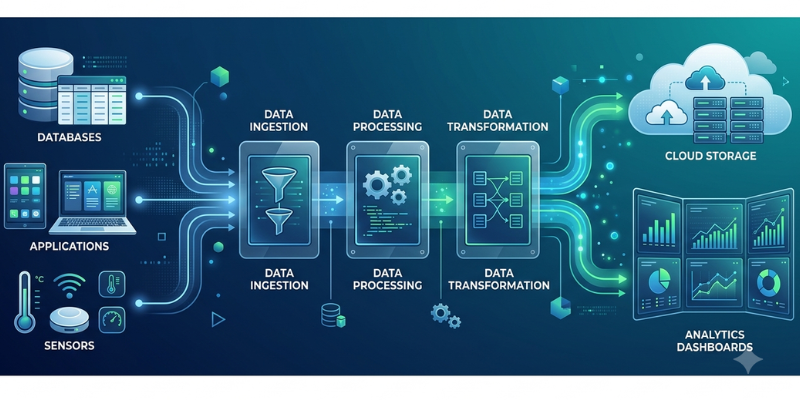
Data pipelines are one of the most important foundations of modern data science. They help organizations collect, move, process, and store data so it can be used for analysis and decision-making. A data pipeline creates a smooth flow of information from different sources to a storage system where data professionals can access it when needed.
For beginners, understanding data pipelines is essential because they connect every stage of the data journey. From collecting raw information to preparing useful datasets, pipelines make data workflows more organized and efficient. If you want to build strong skills in managing data workflows, consider enrolling in a Data Science Course in Mumbai at FITA Academy to start your learning journey with structured guidance.
What is a Data Pipeline
A data pipeline is a process that transfers data from one location to another while applying necessary transformations along the way. It collects information from sources such as databases, applications, websites, sensors, or business systems and prepares it for storage and analysis.
The primary goal of a data pipeline is to guarantee that data arrives at the appropriate destination in a usable format. Without pipelines, organizations would need to manually collect and organize large amounts of information, which would take more time and increase the chances of errors.
The Main Stages of a Data Pipeline
A typical data pipeline includes three major stages: data extraction, data processing, and data storage. Each stage plays an important role in converting raw information into valuable insights.
The first stage is data extraction, where information is collected from different sources. These sources may include customer records, transaction systems, social media platforms, or online applications. The collected data may be incomplete or inconsistent, so it requires further processing.
The second stage involves data transformation and cleaning. During this step, data is organized, errors are corrected, and unnecessary information is removed. This process improves data quality and ensures that analysts and data scientists can work with reliable information.
The final stage is data storage, where processed data is saved in systems designed for easy access and analysis. Storage solutions may include databases, cloud platforms, or data warehouses. A well-designed storage system helps businesses retrieve information quickly and make better decisions.
Importance of Data Pipelines in Data Science
Data pipelines allow data scientists to focus more on analysis instead of spending excessive time collecting and preparing information. They automate repetitive tasks and create a consistent process for handling large amounts of data.
In machine learning projects, data pipelines are especially important because models require clean and organized datasets. A reliable pipeline ensures that models receive accurate information, which improves their performance and reliability.
Modern businesses depend on data pipelines to support real-time applications such as recommendation systems, fraud detection, and customer analytics. Learning how these systems work can help professionals understand how data moves across different platforms. If you want to improve your practical knowledge of data handling and analytics, explore a Data Science Course in Kolkata to develop essential skills for working with real-world data projects.
Different Types of Data Pipelines
Data pipelines can be designed based on how quickly information needs to be processed. Batch pipelines handle large amounts of data at scheduled intervals, making them useful for regular reporting and historical analysis.
Streaming pipelines process data continuously as it is generated. They are commonly used in applications where immediate results are needed, such as monitoring systems, online services, and financial transactions.
Another important type is cloud-based data pipelines. These pipelines use cloud platforms to provide flexibility, scalability, and easier data management. They allow organizations to handle growing data requirements without building large physical infrastructure.
Challenges in Building Data Pipelines
Creating effective data pipelines requires careful planning and management. One common challenge is maintaining data quality because incorrect or incomplete data can affect analysis results.
Another challenge is handling large volumes of information. As organizations generate more data, pipelines need to scale efficiently while maintaining speed and accuracy.
Security is also an important consideration. Data pipelines must protect sensitive information during collection, processing, and storage. Proper security practices help prevent unauthorized access and maintain user trust.
Data pipelines are the foundation that allows organizations to transform raw information into meaningful insights. They connect data sources, processing systems, and storage platforms to create efficient workflows for analysis and innovation.
Understanding data pipelines helps beginners develop a stronger foundation in data science because data management is a key part of every successful project. As businesses continue to depend on data-driven solutions, professionals with pipeline knowledge can contribute to better decision-making and advanced analytics. If you want to expand your career opportunities and gain deeper knowledge of modern data workflows, join a Data Science Course in Delhi to enhance your skills with industry-focused learning.