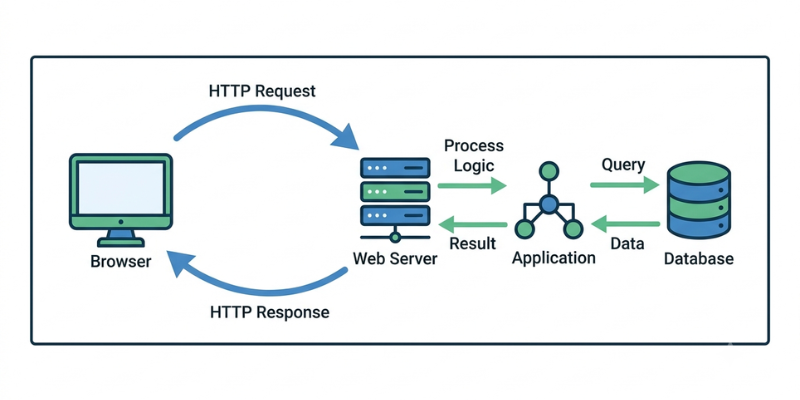
When you open a website, click a button, or submit a form, many processes happen behind the scenes within seconds. Every action follows a sequence that allows your browser, server, and database to work together. This complete journey is known as the request lifecycle. Understanding this process helps beginners see how full-stack applications function from start to finish.
Learning the request lifecycle makes it easier to understand both frontend and backend development. Instead of viewing web development as separate technologies, you begin to see how each part connects to create a smooth user experience. If you want to build a strong foundation, you can explore the Full Stack Developer Course in Mumbai at FITA Academy to strengthen your practical understanding and apply these concepts with confidence.
What is a Request Lifecycle
A request lifecycle is the complete path that a user’s request follows from the browser to the server and back again. Every time you visit a webpage or perform an action, your browser sends a request asking for information. The server processes that request and returns a response that the browser displays to you.
Although this process happens very quickly, it involves several important steps. Each step has a specific responsibility, and together they ensure that websites work efficiently.
Step One Browser Sends a Request
The lifecycle begins when a user performs an action. This action could be opening a webpage, clicking a link, logging into an account, or submitting a form.
The browser creates an HTTP request that contains useful information such as the requested page, request method, and any data entered by the user. This request is subsequently transmitted to the web server via the internet.
Step Two Server Receives the Request
Once the request reaches the server, it is examined to understand what the user wants. The server identifies the requested resource and forwards the request to the correct part of the application.
At this stage, routing plays an important role. Routes determine which function or controller should handle the incoming request based on its URL and request type.
Step Three Application Processes the Request
After the request reaches the correct part of the application, the business logic begins its work. The application may validate user input, perform calculations, check permissions, or prepare data for the next step.
If the request needs stored information, the application communicates with the database. The database searches for matching records and returns the required data to the application. If you are interested in understanding how frontend, backend, and databases work together in real projects, consider joining the Full Stack Developer Course in Kolkata to practice these essential development skills with confidence.
Step Four Server Creates the Response
After all processing is complete, the server prepares a response for the browser. This response may contain HTML pages, JSON data, images, or status messages depending on what the browser requested.
The server also includes an HTTP status code that tells the browser whether the request was successful or if an error occurred. For example, a successful request returns a success status, while an unavailable page returns an error status.
Step Five Browser Displays the Result
The browser gets the response and starts displaying the content for the user. HTML creates the page structure, CSS controls the appearance, and JavaScript adds interactivity.
If the response contains data instead of a complete webpage, JavaScript updates only the required section without reloading the entire page. This results in a quicker and more seamless user experience.
Why Understanding the Request Lifecycle Matters
Understanding the request lifecycle helps developers identify where problems occur when an application does not behave as expected. It also improves debugging skills because each stage can be checked independently.
This knowledge also helps developers design better applications by improving performance, security, and communication between different parts of the system. As projects become larger, understanding the complete flow becomes even more valuable.
The complete request lifecycle explains how a simple user action becomes a visible result on the screen. From the browser sending a request to the server processing data and returning a response, every step plays an important role in modern web applications. Once you understand this flow, learning advanced backend development, APIs, authentication, and databases becomes much easier because you can clearly see how they fit into the overall process. If you are ready to deepen your practical knowledge and build real-world full-stack applications, you can take the Full Stack Developer Course in Delhi to continue developing your skills with structured learning and hands-on experience.
Also check: DOM Manipulation How Browsers Render Web Pages