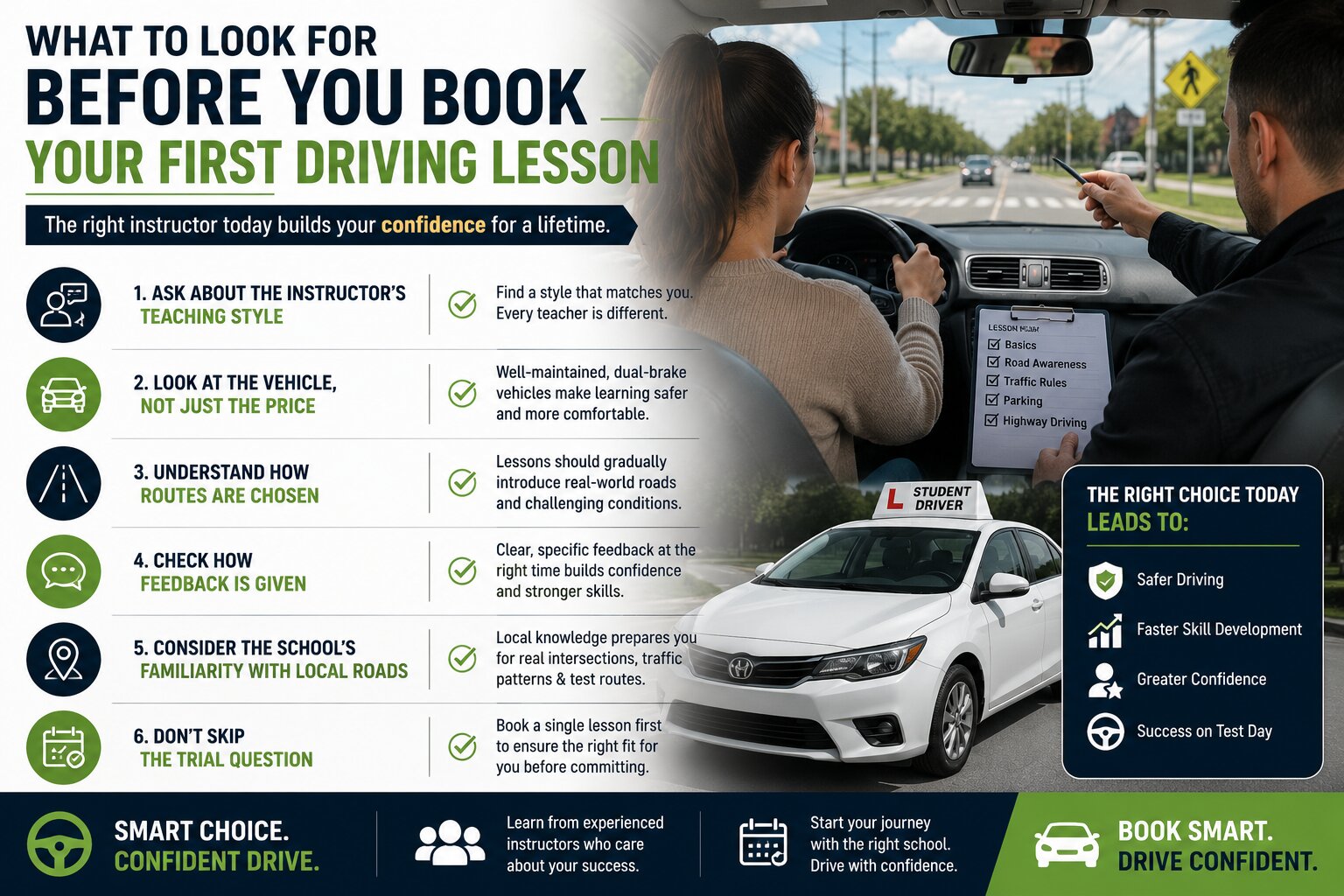
I remember sitting in the passenger seat of my first driving lesson, hands sweaty, convinced I was about to fail before we even left the parking lot. What I didn’t know then was how much the quality of that first lesson, and the instructor sitting beside me, would shape my confidence behind the wheel for years afterward.
Choosing a driving school isn’t something most people research carefully. They pick whoever comes up first in a search or whoever a friend mentioned once. But the right instructor and the right program can mean the difference between a nervous, hesitant driver and one who actually enjoys getting behind the wheel.
Here’s what I’d tell anyone booking their first lesson.
Ask About the Instructor’s Teaching Style, Not Just Their Certification
Every licensed instructor meets a minimum standard, but teaching styles vary enormously. Some instructors talk through every decision out loud. Others let you make small mistakes first and correct afterward. Neither approach is wrong, but one will suit you better than the other.
Before booking, it’s worth asking how a lesson typically runs. A school that can describe its actual teaching approach, rather than just listing credentials, usually has a more thought-out program behind it.
Look at the Vehicle, Not Just the Price
New drivers spend hours in that car, and the vehicle itself affects how quickly skills develop. Dual-brake systems, well-maintained mirrors, and a car that isn’t intimidatingly large for a first-timer all matter more than people expect.
I’ve seen students struggle unnecessarily because they learned in a vehicle too big or unfamiliar for their comfort level. A quick question about the training vehicle can save a lot of early frustration.
Understand How Routes Are Chosen
A good driving program doesn’t just circle the same quiet street for ten lessons. It gradually introduces harder conditions: busier intersections, highway merging, parallel parking on an actual hill, not a flat empty lot.
If routes stay too easy for too long, students end up passing their test but still feeling unprepared for real traffic. Ask how lesson difficulty progresses over the course.
Check How Feedback Is Given
This one is underrated. Some instructors give feedback only at the end of a lesson. Others narrate in real time. For anxious new drivers especially, the way feedback is delivered can either build confidence or quietly erode it.
I’ve found that instructors who balance encouragement with direct, specific correction tend to produce more confident drivers, not just more technically correct ones.
Consider the School’s Familiarity With Local Roads
This matters more than people think. An instructor who knows the specific intersections, school zones, and tricky merges in your area can prepare you for the exact conditions you’ll actually drive in, not generic scenarios from a textbook.
For anyone searching for driving lessons Mississauga drivers, local road familiarity is especially useful given how much the traffic patterns and test routes vary from city to city.
Don’t Skip the Trial Question
Before committing to a full package, ask if you can book a single lesson first. A short trial lesson tells you more about instructor fit than any website testimonial ever could. If a school hesitates to offer this, that’s worth noting.
Final Thoughts
Learning to drive is one of those milestones that stays with people, for better or worse. Choosing carefully at the start, rather than defaulting to the first option that pops up, makes the entire process smoother and a lot less stressful. Ask a few of these questions before you book, and you’ll walk into your first lesson with a much clearer idea of what to expect.