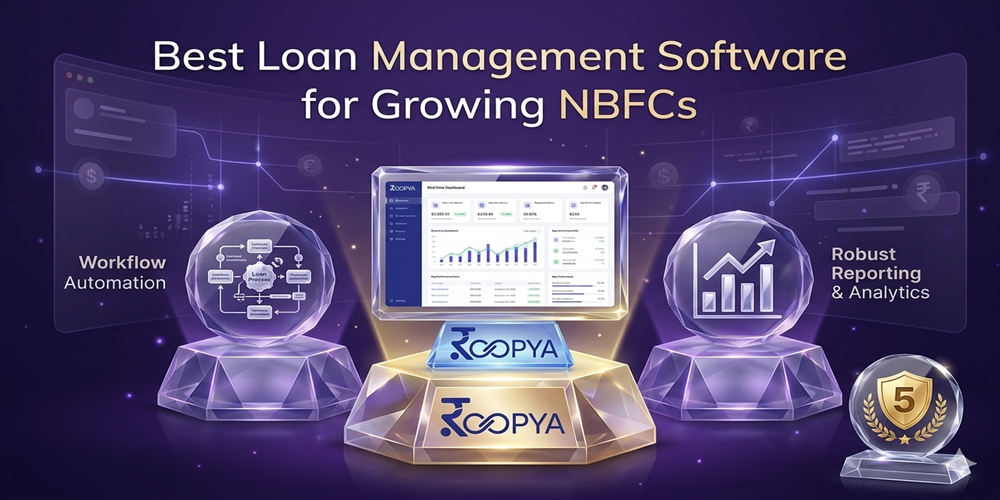
The Indian lending ecosystem is evolving rapidly. Non-Banking Financial Companies (NBFCs) are expanding their loan portfolios, embracing digital lending, and competing with fintech startups that offer faster approvals and seamless borrower experiences. As loan volumes increase, relying on spreadsheets or disconnected systems becomes inefficient and risky.
This is where modern Loan Management Software (LMS) plays a crucial role. It enables NBFCs to automate the entire lending lifecycle—from customer onboarding and loan origination to EMI tracking, collections, reporting, and compliance. A robust platform not only reduces manual work but also improves operational efficiency, minimizes errors, and enhances customer satisfaction.
For growing NBFCs, choosing the right loan management software can determine how effectively they scale their lending operations. Platforms like Roopya are designed to help lenders streamline workflows, integrate with third-party services, and launch new lending products without significant technical complexity.
What is Loan Management Software?
Loan Management Software is a centralized digital platform that helps financial institutions manage every stage of a loan’s lifecycle. Instead of handling applications, repayments, collections, and customer records across multiple systems, lenders can operate from a single dashboard.
The software automates:
- Loan application processing
- Customer onboarding
- KYC verification
- Credit assessment
- Loan approvals
- Disbursement workflows
- EMI schedule generation
- Repayment tracking
- Collections management
- Reporting and analytics
- Regulatory compliance
Modern cloud-based solutions also provide API integrations, AI-driven insights, and configurable workflows that adapt to different lending models.
Why Growing NBFCs Need Advanced Loan Management Software
As NBFCs expand, operational challenges also increase.
1. Faster Loan Processing
Manual verification and approval processes delay loan disbursement. Automated workflows reduce turnaround time and improve customer experience.
2. Better Portfolio Management
Real-time dashboards allow lenders to monitor active loans, overdue accounts, collections, and repayment performance.
3. Reduced Operational Costs
Automation minimizes repetitive tasks, reduces paperwork, and lowers dependency on manual intervention.
4. Improved Compliance
Regulatory requirements continue to evolve. Modern software helps maintain audit trails, documentation, and standardized workflows.
5. Enhanced Borrower Experience
Digital onboarding, online document uploads, automated reminders, and self-service portals increase customer satisfaction.
Features to Look for in the Best Loan Management Software
End-to-End Loan Lifecycle Management
The platform should support every stage from lead generation to final loan closure.
Cloud-Based Infrastructure
Cloud deployment enables secure access from anywhere while reducing infrastructure costs.
Automated EMI Management
Automatic EMI calculations, payment reminders, penalty computation, and reconciliation improve repayment efficiency.
AI-Powered Credit Decisioning
Artificial intelligence can assist lenders by analyzing borrower profiles and supporting faster risk assessment.
Business Rule Engine
Configurable lending rules help automate approvals and ensure policy consistency.
Multi-Product Lending Support
The software should accommodate personal loans, business loans, MSME financing, vehicle loans, gold loans, and other lending products.
Collections Management
Automated follow-ups, delinquency tracking, and recovery workflows help reduce defaults.
Reporting and Analytics
Comprehensive dashboards provide insights into loan performance, collections, NPAs, and portfolio health.
API Integrations
Integration with payment gateways, credit bureaus, KYC providers, banking systems, and CRMs simplifies operations.
Benefits of Loan Management Software for Growing NBFCs
Increased Productivity
Employees spend less time on repetitive administrative tasks and more time serving customers.
Faster Scaling
The platform supports increasing loan volumes without proportional growth in manpower.
Lower Default Rates
Automated reminders and predictive analytics improve repayment behavior.
Better Risk Management
Data-driven underwriting and portfolio monitoring reduce credit risk.
Improved Decision Making
Real-time reporting enables management teams to make informed business decisions.
Enhanced Security
Role-based access, encryption, and audit logs protect sensitive borrower information.
How Digital Automation Transforms Lending Operations
Digital lending is no longer limited to large financial institutions. Even mid-sized NBFCs now require automation to stay competitive.
Automation helps by:
- Eliminating duplicate data entry
- Accelerating document verification
- Reducing approval timelines
- Automating borrower communication
- Improving collection efficiency
- Providing centralized data access
The result is improved operational performance and a better customer journey.
Why Cloud-Based Loan Management Systems Are the Future
Cloud-native lending platforms provide several advantages over traditional on-premise software.
These include:
- Quick implementation
- Lower maintenance costs
- Automatic software updates
- Better scalability
- High availability
- Remote accessibility
- Enhanced disaster recovery
Growing NBFCs can focus on expanding their lending business instead of managing IT infrastructure.
Essential Modules Every NBFC Should Have
Loan Origination
Manage applications, document collection, underwriting, and approvals.
Customer Management
Maintain complete borrower profiles with communication history and KYC records.
Repayment Management
Track EMIs, overdue payments, penalties, and prepayments.
Collections Module
Automate reminders, settlement workflows, and recovery activities.
Accounting Integration
Synchronize financial transactions with accounting systems.
Reporting Dashboard
Generate operational, financial, and compliance reports instantly.
Choosing the Right Loan Management Software
Before selecting a platform, NBFCs should evaluate:
- Scalability
- Ease of customization
- Security standards
- API ecosystem
- Automation capabilities
- Reporting features
- Pricing flexibility
- Vendor support
- Compliance readiness
- Implementation timeline
The best software should adapt to business growth rather than require expensive redevelopment.
Why Roopya Is an Excellent Choice for Growing NBFCs
Roopya offers a modern lending infrastructure designed specifically for financial institutions seeking rapid digital transformation.
Key advantages include:
- No-code platform configuration
- Cloud-native architecture
- AI-powered automation
- Loan origination and management in one ecosystem
- Business Rule Engine
- Real-time analytics
- Multi-product support
- Extensive API integrations
- Automated collections
- Fast deployment
For NBFCs planning expansion, these capabilities enable operational efficiency while maintaining flexibility.
Future Trends in Loan Management Software
The next generation of lending platforms will increasingly adopt:
- Artificial Intelligence
- Machine Learning underwriting
- Predictive collections
- Embedded finance
- Open banking integrations
- Digital identity verification
- Hyper-personalized lending
- Real-time fraud detection
NBFCs adopting these technologies early will gain significant competitive advantages.
Growing NBFCs need more than basic software—they need a complete digital lending ecosystem that automates operations, reduces risk, improves customer experience, and supports business expansion.
The best loan management software centralizes every aspect of lending, from application processing to collections, while providing the flexibility to launch new products and adapt to changing market conditions.
A modern platform like Roopya empowers lenders with automation, analytics, cloud scalability, and intelligent workflows, making it an ideal technology partner for NBFCs aiming to scale efficiently in today’s competitive financial landscape.
FAQs
1. What is loan management software for NBFCs?
Loan management software is a digital platform that automates the complete lending lifecycle, including loan origination, EMI tracking, repayments, collections, reporting, and borrower management.
2. Why do growing NBFCs need loan management software?
Growing NBFCs require automation to process loans faster, reduce manual work, improve compliance, manage larger portfolios, and enhance customer experience.
3. What features should the best loan management software include?
Important features include loan origination, EMI management, cloud deployment, automated collections, reporting dashboards, API integrations, AI-powered analytics, and configurable workflows.
4. Can loan management software improve loan recovery?
Yes. Automated payment reminders, delinquency monitoring, and intelligent collection workflows can significantly improve recovery rates.
5. Is cloud-based loan management software secure?
Modern cloud platforms typically include encryption, role-based access controls, audit logs, backups, and compliance features to protect sensitive financial data.
6. Does loan management software support multiple loan products?
Yes. Most enterprise solutions support personal loans, business loans, MSME loans, vehicle loans, gold loans, education loans, and customized lending products.
7. How does AI help in loan management?
AI can assist with credit scoring, fraud detection, document verification, predictive analytics, and automated underwriting, helping lenders make faster and more informed decisions.
8. How can Roopya help NBFCs scale?
Roopya provides a cloud-native, AI-powered lending platform with no-code configuration, automation, analytics, and integrated loan lifecycle management to support business growth.