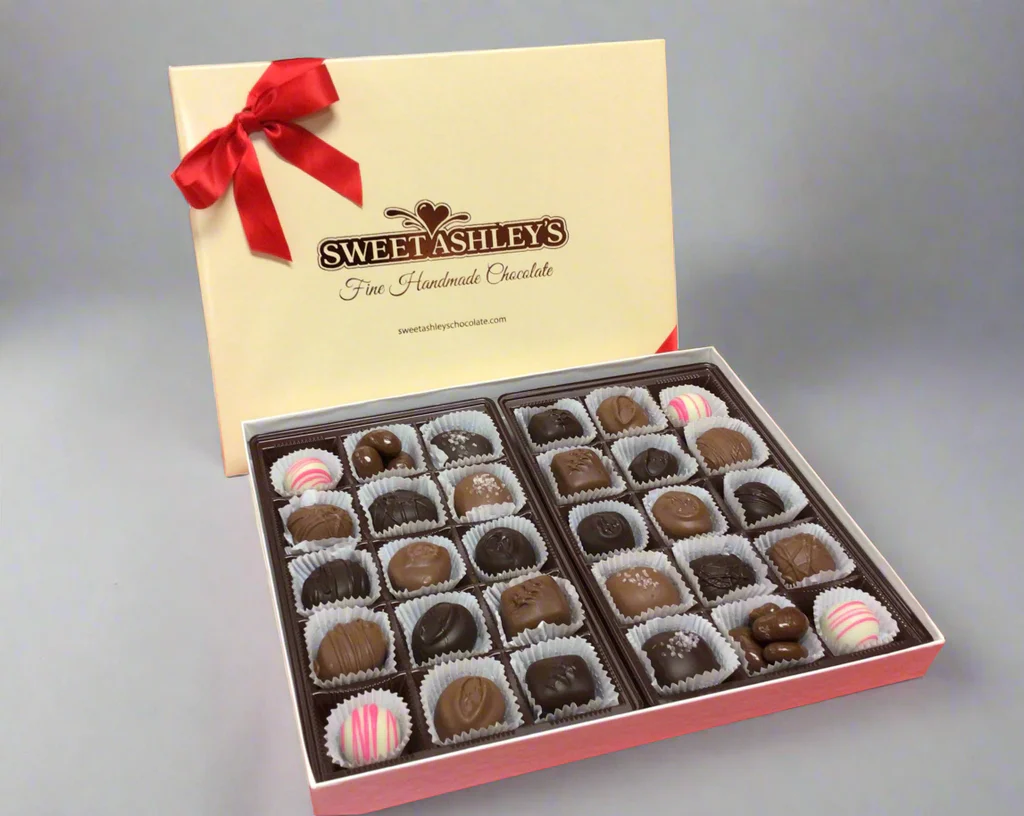
Chocolate is one of the most regulated categories in food packaging in the UK, and the rules tightened again in 2023 with the post-Brexit divergence between UK and EU food-contact standards. Most artisan chocolatiers do not learn the regulations from a guidebook; they learn them the hard way, usually after a retail buyer rejects an order or an environmental health officer pays an unannounced visit.
Custom chocolate boxes UK suppliers can do most of the compliance heavy-lifting on the brand’s behalf, but only if you know what to ask for. This guide breaks down the rules that actually matter for small and mid-sized chocolatiers, the materials that pass them, and the documentation you should be receiving from your packaging supplier on day one.
What “Food-safe” Really Means in the UK
Food-safe packaging in the UK is governed by the Materials and Articles in Contact with Food (England) Regulations 2012 (and parallel regulations in Scotland, Wales, and Northern Ireland), which incorporate EU Regulation 1935/2004 as retained law.
The headline principle is simple: any material that touches food must not transfer constituents in quantities that could endanger health, change the food’s composition, or affect its sensory properties.
In practice this means inks, varnishes, adhesives, and even the recycled fibre content in your chocolate box need to be certified for direct or indirect food contact depending on how the chocolate is wrapped inside.
If your truffles sit naked in a paperboard tray, the board must be food-grade. If they sit in foil cups inside the tray, the tray itself can be standard board provided the foil cups carry the food-contact certification.
Direct vs Indirect Contact: The Distinction That Matters
Most printed chocolate boxes UK orders are designed for indirect food contact. The chocolate sits in a moulded plastic tray, a foil cup, or a glassine paper wrap, and the printed outer board never touches the product. This dramatically widens the range of inks, finishes, and stocks you can use.
Direct-contact applications (the chocolate sitting on bare board, for example) are much more restricted. UV-cured inks, conventional offset inks, and most metallic foils cannot legally touch the food surface unless they carry specific food-contact migration data. For chocolate bar packaging boxes where the bar is fully wrapped in inner foil before being placed in the outer carton, indirect-contact rules apply and you can specify almost any finish.
If you are unsure, ask your supplier for the EU Declaration of Compliance (DoC) and the corresponding migration testing certificates. A reputable manufacturer will provide both without hesitation.
Allergen and Labelling Rules
Since October 2021, all pre-packed food sold in the UK (including pre-packed chocolates) must carry full ingredient labelling with the 14 named allergens emphasised. For artisan chocolatiers selling through their own shop or online, this typically means a printed label affixed to the outside of the box or a printed insert inside.
Heart shaped chocolate boxes wholesale orders intended for resale through third-party retailers must also account for retailer-specific labelling demands. Major UK retailers often require best-before dates printed on both the outer box and the inner wrap, batch codes traceable to a single production day, and country-of-origin statements compliant with the Food Information Regulations 2014.
Eid chocolate boxes UK and seasonal SKUs face the same rules. Seasonal packaging is not exempt; if anything, environmental health officers pay closer attention to seasonal runs because turnover is faster and labelling errors are more common.
Moisture, Light, and Temperature Management
Compliance is only half the picture. The other half is whether your packaging actually keeps the chocolate in good condition. Chocolate is hygroscopic (it absorbs moisture) and photosensitive (light degrades cocoa butter). It also blooms (develops a white surface haze) when temperature cycles too aggressively.
Truffle boxes wholesale UK orders that sit in retail environments for weeks need a lined inner tray (usually moulded plastic or wax-coated paper) to slow moisture migration. If your chocolate contains fresh ganache or cream, you should be specifying a barrier-coated inner liner and clearly printing storage instructions on the outer box.
Chocolate bomb boxes packaging deserves special attention because the product is typically hollow and prone to crushing. A rigid construction with a moulded insert keeps the product intact through retail handling and last-mile delivery.
Sustainability Claims and the Rules Around Them
“Recyclable”, “compostable”, and “biodegradable” are no longer interchangeable marketing words in the UK. The Competition and Markets Authority Green Claims Code (published 2021, enforced increasingly aggressively since 2023) requires sustainability claims on packaging to be specific, accurate, and supported by evidence. “Plastic-free” claims, in particular, are scrutinised because most moisture-barrier liners and foil cups still contain trace plastics.
If you want to make a sustainability claim on your chocolate packaging, get the certification first. FSC for the paperboard, PEFC for any wood-based components, and a recognised compostability standard (typically EN 13432) for any liners or wraps that claim to break down.
Wholesale and Retail Buyer Expectations in 2026
UK retail buyers (Selfridges, Fenwick, John Lewis food halls, Whole Foods Market UK, Booths) have tightened packaging audits significantly in the last two years.
Buyers now routinely request: Declaration of Compliance documents for the outer box, separate DoCs for the inner tray or cup, migration testing certificates for the specific food category, allergen labelling proof that survives shelf life testing, and country-of-origin compliance for any imported components.
Chocolatiers approaching wholesale for the first time often discover that their existing packaging passes none of these tests. The remedy is either swapping suppliers (slow and disruptive) or working with the existing supplier to provide retrospective compliance documentation (faster but only viable if the supplier can produce credible test data).
Seasonal Skus: Where Margin and Risk Both Spike
Christmas, Valentine’s, Easter, and Eid drive the majority of annual revenue for most UK chocolate brands. Seasonal packaging compresses production timelines, increases risk of labelling errors, and rewards brands that plan packaging six months ahead.
Best practice in the trade is to lock seasonal artwork by July for Christmas runs, by November for Valentine’s, by January for Easter, and three months in advance for Eid (which shifts year-on-year with the lunar calendar). Suppliers offering compliance review at the artwork stage (rather than just printing what they are sent) save brands from costly reprints.
A Documentation Checklist for Your Next Packaging Order
When you place your next chocolate packaging order, request the following documents in writing from your supplier before final approval of the artwork. First, a Declaration of Compliance covering the substrate, inks, varnishes, and any adhesives, with explicit reference to retained EU 1935/2004 and BfR Recommendation XXXVI for paper and cardboard.
Second, migration test certificates for the food categories your product falls into (cold and dry, fatty, hot, or acidic as relevant). Third, a Specific Migration Limit (SML) statement for any non-listed substances. Fourth, country-of-origin documentation for the substrate. Fifth, batch traceability information showing which production batch produced the packaging you have received.
If you cannot get these documents in a reasonable timeframe, the supplier is probably not the right partner. Reputable manufacturers produce them as standard with every order.
The Bottom Line
Compliance is not optional, but it is also not the brand-killer many chocolatiers fear. A good packaging supplier handles the technical work, leaving you to focus on the chocolate and the story.
The brands that thrive in 2026 are not the ones that just meet the minimum; they are the ones that treat compliance as a quality signal and a competitive moat.
Customers can tell the difference between a chocolate brand that knows its labelling rules cold and one that learned them after a retail rejection. The packaging is where that difference shows up first.