Picture this: a gynecologist walks into her clinic on a Monday morning, ready for a full day of diagnostic procedures. Her first patient is booked for a hysteroscopy to investigate abnormal bleeding. But the light source is flickering, the pump pressure keeps fluctuating, and the scope she’s using feels almost a decade behind what her colleagues at the city hospital are using. The procedure still gets done, but it takes longer, feels less precise, and leaves both doctor and patient a little more anxious than they should be.
This scenario plays out more often than you’d think, in small clinics and large hospitals alike. The truth is, hysteroscopy is only as good as the equipment behind it. Whether you’re setting up a new gynecology unit, upgrading an existing one, or simply trying to understand what goes into a hysteroscopy suite, this guide will walk you through everything you need to know about choosing the right Hysteroscopy Equipment — in plain, simple language.
What Exactly Is Hysteroscopy Equipment?
At its core, hysteroscopy is a procedure that lets doctors look directly inside the uterus using a thin, lighted telescope-like device called a hysteroscope. It’s used to diagnose and treat conditions like abnormal uterine bleeding, polyps, fibroids, and even certain fertility issues — often without the need for major surgery.
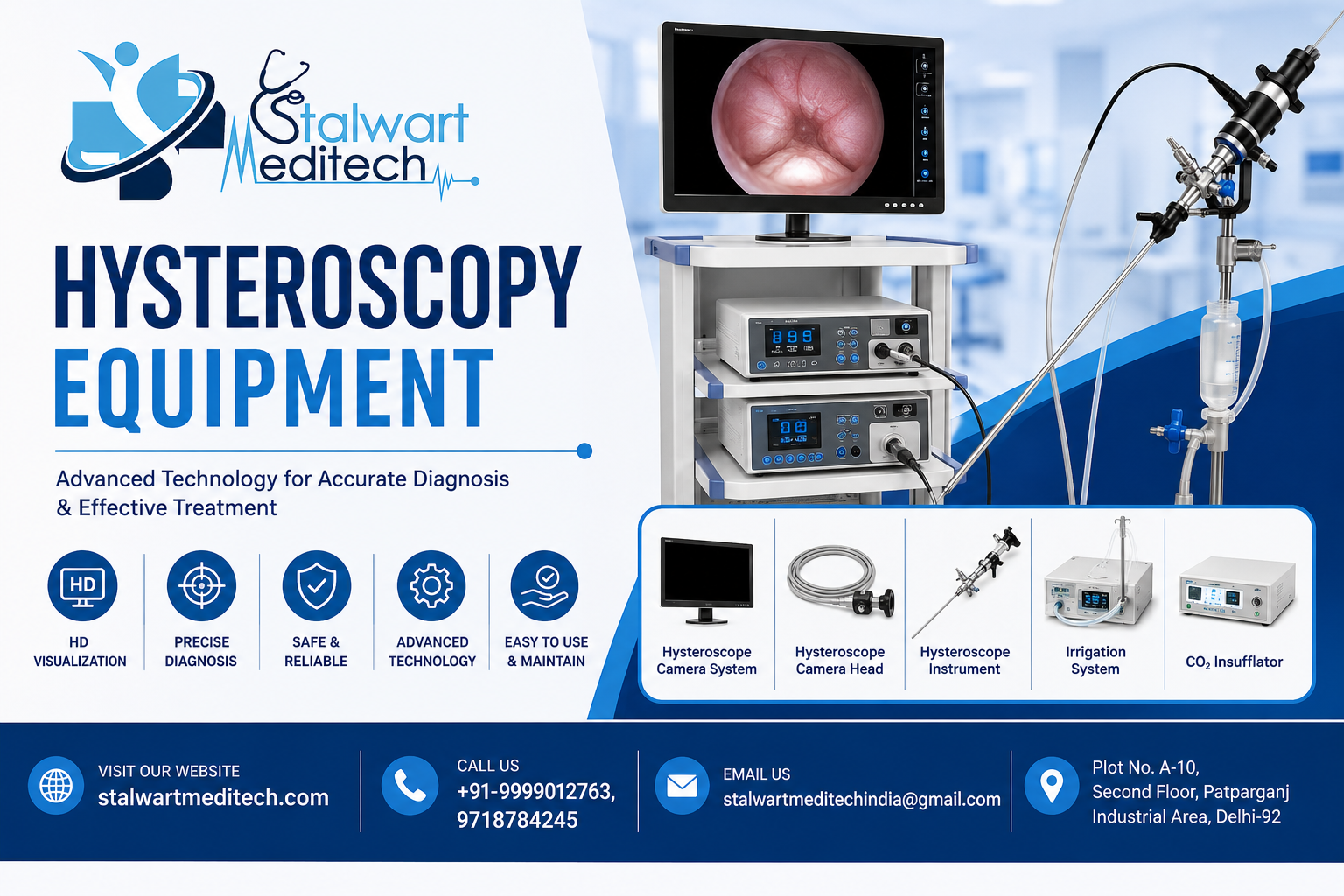
But a hysteroscope alone doesn’t make a procedure possible. It’s part of a larger system of hysteroscopy instruments that work together, including:
- Hysteroscopes (rigid or flexible) — the camera and light-carrying device itself
- Light source — usually LED or Xenon, to illuminate the uterine cavity
- Camera and video system — for real-time visualization on a monitor
- Hysteroscopy pump — controls fluid distension to keep the uterine cavity open and visible
- Operative instruments — graspers, scissors, biopsy forceps, and electrodes for treatment procedures
Think of it like a well-coordinated orchestra. Each piece plays its own role, but if even one instrument is out of tune — say, an unreliable pump or a dim light source — the entire performance suffers, and so does patient safety.
Why Choosing the Right Equipment Actually Matters
It’s easy to assume that “any hysteroscope will do the job.” But in reality, the quality and compatibility of your equipment directly affects diagnostic accuracy, procedure time, patient comfort, and even complication rates. A poorly calibrated pump, for instance, can lead to fluid overload — a genuinely serious risk during hysteroscopic procedures. Similarly, a low-resolution camera can cause a doctor to miss subtle findings that a sharper image would have caught instantly.
This is where working with a trusted manufacturer becomes important. At Stalwart Meditech, we’ve seen firsthand how the right combination of equipment can transform a clinic’s efficiency and the confidence of the medical team using it.
Rigid vs Flexible Hysteroscopes: A Quick Comparison
| Feature | Rigid Hysteroscope | Flexible Hysteroscope |
| Image Quality | Sharper, higher resolution | Good, slightly lower than rigid |
| Patient Comfort | Moderate, may need anesthesia | Higher, often no anesthesia needed |
| Best Suited For | Operative procedures | Diagnostic, office-based procedures |
| Durability | Very durable with proper care | Slightly more delicate |
| Cost | Generally lower | Generally higher |
Note: Many clinics keep both types on hand — rigid scopes for operative work and flexible scopes for quick, comfortable office diagnostics.
Key Features to Look For
When you’re evaluating hysteroscopy equipment, it helps to know what actually matters versus what’s just marketing language. Here’s a breakdown that keeps things simple.
Feature and Benefit Overview
| What It Is | Why It Matters |
| High-definition camera | Helps doctors catch small abnormalities that could otherwise be missed |
| Automated hysteroscopy pump | Maintains safe, consistent fluid pressure and reduces the risk of fluid overload |
| LED light source | Offers brighter, cooler illumination with a longer bulb lifespan |
| Autoclavable design | Makes sterilization faster and more reliable between procedures |
| Compact console design | Saves space in smaller clinics and improves workflow efficiency |
Quick tip: If you had to prioritize just one feature, the fluid management system (pump) deserves the most attention — it’s directly tied to patient safety.
Step-by-Step: How to Choose the Right Equipment for Your Facility
Choosing equipment shouldn’t feel like guesswork. Here’s a simple process that clinics and hospitals can follow.
The Equipment Selection Process
| Step | What to Do |
| 1. Assess patient volume | Estimate how many procedures you’ll perform monthly to decide between entry-level and high-capacity systems |
| 2. Decide diagnostic vs operative | Determine whether you mainly need diagnostic scopes or full operative setups |
| 3. Compare vendors | Look at build quality, warranty terms, and after-sales support |
| 4. Check compatibility | Confirm the pump, light source, and camera are all compatible with your chosen scope |
| 5. Plan for training | Ensure your team receives proper hands-on training before going live |
| 6. Set a maintenance schedule | Arrange routine servicing to keep the equipment performing reliably long-term |
Tips and Best Practices
- Don’t buy on price alone. The cheapest hysteroscopy pump might save money upfront but cost more in repairs and downtime later.
- Invest in staff training. Even the best equipment underperforms in untrained hands.
- Keep a maintenance log. Small issues caught early prevent bigger equipment failures during procedures.
- Choose modular systems where possible. This makes future upgrades easier without replacing the entire setup.
- Ask for a demo before buying. A live demonstration reveals a lot more than a spec sheet ever will.
Do’s and Don’ts of Hysteroscopy Equipment Selection
| Do | Don’t |
| Verify manufacturer certifications | Assume all vendors meet the same quality standards |
| Test equipment compatibility beforehand | Mix components from unverified sources |
| Schedule regular servicing | Wait until something breaks to call for maintenance |
| Budget for spare parts | Overlook the cost of consumables and replacements |
Common Mistakes to Avoid
Even experienced clinics sometimes get tripped up during equipment upgrades. Here are a few common missteps:
- Overlooking the fluid management system. Many buyers focus heavily on the scope and camera, forgetting that the hysteroscopy pump plays an equally critical role in patient safety.
- Ignoring long-term support. A great product with poor after-sales service can leave you stranded when something needs repair.
- Skipping staff training sessions. New equipment often comes with new workflows, and skipping training leads to slower adoption and avoidable errors.
- Buying more capacity than needed. High-end operative systems are great, but if your clinic mostly does diagnostic work, you may be overspending.
Buying Guide Checklist
| Checklist Item | Confirmed? |
| Scope type matches procedure needs | ☐ |
| Pump offers automated pressure control | ☐ |
| Camera resolution is HD or higher | ☐ |
| Warranty and service terms reviewed | ☐ |
| Staff training included or arranged | ☐ |
Frequently Asked Questions
1. What is the main difference between diagnostic and operative hysteroscopy equipment?
Diagnostic equipment is used mainly to view and assess the uterine cavity, while operative equipment includes additional instruments like scissors and graspers for treating conditions during the same procedure.
2. Why is a hysteroscopy pump so important?
The pump controls fluid pressure inside the uterus, keeping the cavity visible while minimizing the risk of complications like fluid overload.
3. How often should hysteroscopy equipment be serviced?
Most manufacturers recommend servicing every six to twelve months, though high-usage clinics may need more frequent checks.
4. Is flexible or rigid hysteroscopy equipment better?
Neither is universally “better” — rigid scopes are often preferred for operative work, while flexible scopes are favored for quick, comfortable office diagnostics.
5. Can small clinics afford quality hysteroscopy equipment?
Yes. Many manufacturers, including Stalwart Meditech, offer scalable systems designed specifically for smaller practices without compromising on core safety features.
6. What should I check before buying from a new supplier?
Look for proper certifications, verified compatibility between components, clear warranty terms, and responsive after-sales support.
Final Thoughts
Choosing the right hysteroscopy equipment isn’t just a procurement decision — it’s a decision that shapes patient outcomes, clinical confidence, and the day-to-day rhythm of your practice. From the scope itself to the often-overlooked pump and light source, every component plays a role in how smoothly a procedure goes.
If there’s one takeaway to hold onto, it’s this: don’t rush the decision, and don’t evaluate components in isolation. A well-matched system — scope, camera, pump, and instruments working in sync — will always outperform a mismatched collection of “good enough” parts.
At Stalwart Meditech, we’ve spent years helping clinics and hospitals build hysteroscopy setups that are reliable, safe, and genuinely easy to work with. If you’re exploring options for your facility, it’s worth taking the time to compare, ask questions, and choose equipment that truly fits how your team works — not just what looks good on a brochure.
Visit: https://stalwartmeditech.com/contact-us/
Call: +91-9999012763, 9718784245
Email: [email protected]
Address: Plot No. A-10, Second Floor, Patparganj Industrial Area, Delhi-92,
Address -: 4/2544, Street No.-11, Main Road, Govardhan Behari Colony, Shahdra, Delhi-32