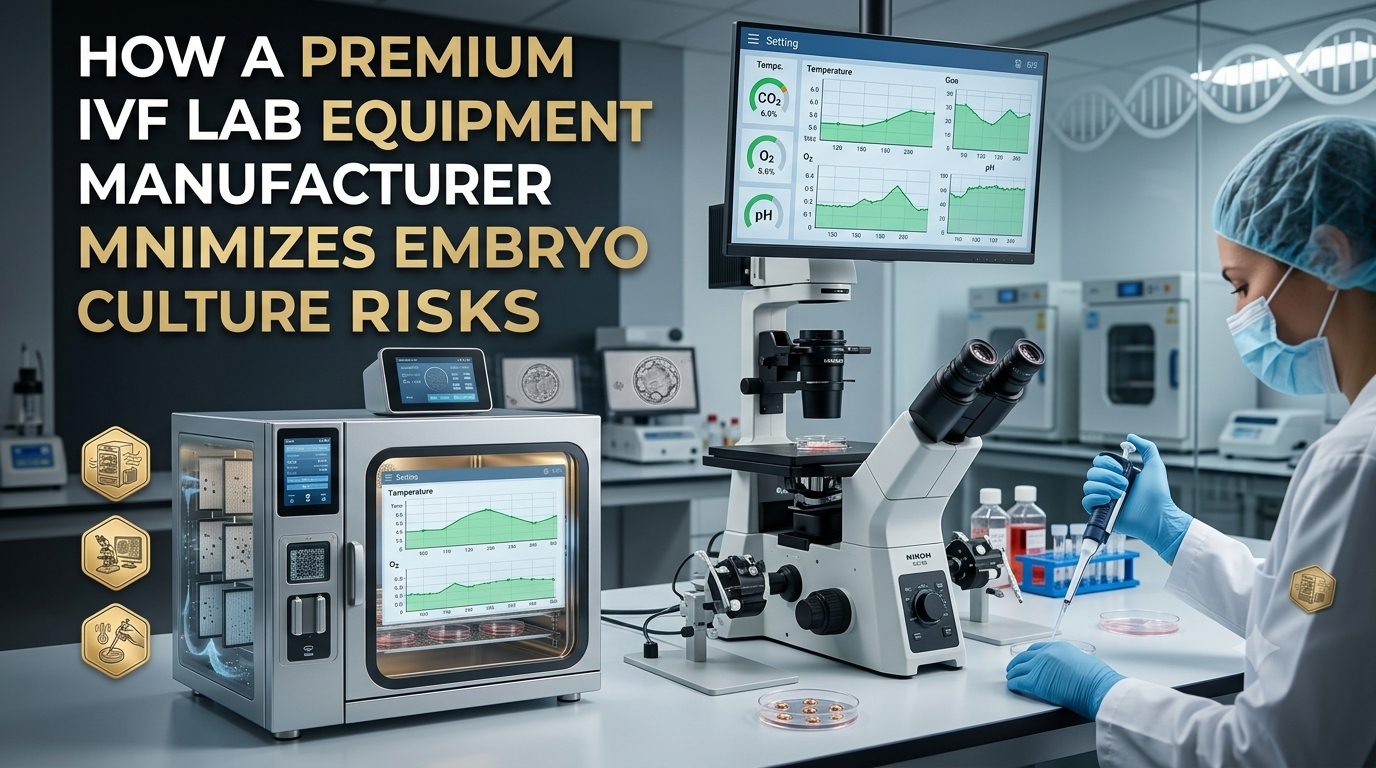
Embryo culture is one of the most delicate stages of the IVF process. A fertilized embryo can spend anywhere from three to six days developing in the lab before transfer, and during that window, it is extraordinarily sensitive to its surroundings. Tiny shifts in temperature, pH, humidity, or air quality can affect embryo viability and, ultimately, pregnancy outcomes. This is why fertility clinics around the world are placing growing emphasis on the equipment that supports the embryology lab, not just the clinical protocols.
If you’ve searched “how do IVF labs protect embryos” or “what equipment reduces embryo culture risk,” this guide breaks down the science and the technology in plain language.
Why is Embryo Culture So Risk-Prone?
An embryo outside the body has no natural buffer against environmental stress. Inside a controlled lab setting, embryologists try to replicate the fallopian tube and uterine environment as closely as possible. Several factors can disrupt this delicate balance:
- Temperature fluctuations – Even a one-degree change can slow or stall cell division.
- Volatile organic compounds (VOCs) – Off-gassing from paints, adhesives, or unfiltered air can be toxic to embryos.
- pH and gas imbalance – Incorrect CO₂ or oxygen levels alter the culture medium’s pH, stressing the embryo.
- Vibration – Micromanipulation procedures like ICSI require an extremely stable, vibration-free surface.
- Contamination – Airborne particles, bacteria, or fungal spores can compromise sterility.
Because embryos cannot repair damage the way older tissue can, prevention rather than correction is the only real strategy. This is where specialized lab equipment becomes essential.
What Equipment Actually Reduces These Risks?
1. CO₂ Incubators for Stable Culture Conditions
The incubator is arguably the single most important piece of equipment in an IVF lab. It maintains the temperature, CO₂ concentration, and humidity that embryos need to develop normally. A well-engineered incubator recovers quickly after the door is opened, preventing prolonged exposure to room air, and maintains uniform conditions throughout the chamber so no embryo culture dish is exposed to a “cold spot” or gas imbalance.
2. Air Purification Systems to Control VOCs
Because embryos are so sensitive to airborne chemical contaminants, many modern labs use multi-stage filtration systems designed specifically for fertility environments. These systems filter out volatile organic compounds before air ever reaches the culture area, which is critical since standard HVAC filtration is not built to the same tolerance.
3. Vibration-Controlled ICSI Workstations
Intracytoplasmic sperm injection (ICSI) requires an embryologist to manipulate a single cell under a microscope. Even minor vibration from footsteps, HVAC equipment, or nearby machinery can disrupt this. Anti-vibration tables isolate the workstation from ambient vibration, giving embryologists a stable platform for precision work.
4. Stage and Test Tube Warmers
Embryos and gametes are extremely temperature-sensitive once removed from the incubator. Warming stages and test tube warmers keep dishes and samples at body temperature during handling, preventing thermal shock during the brief windows when embryos are outside the incubator.
5. Laminar Airflow and Cleanroom Systems
Laminar airflow units create a continuous stream of filtered air over the work area, pushing contaminants away from open dishes. Paired with cleanroom design principles (positive air pressure, sealed surfaces, controlled humidity), this reduces the risk of microbial or particulate contamination during procedures.
6. Pressurization and Air Circulation Modules
Maintaining a slightly positive pressure differential in the lab, relative to surrounding areas, keeps unfiltered external air from seeping in whenever a door opens. Circulating a mix of fresh and recirculated filtered air also helps maintain consistent VOC and particulate levels throughout the day.
How Does a Manufacturer Build Equipment Around These Risks?
A premium manufacturer approaches embryo-safe equipment differently from a general lab equipment supplier. The design process typically accounts for:
Material selection. Corrosion-resistant, easy-to-sanitize materials such as powder-coated galvanized sheet metal reduce off-gassing and simplify decontamination between uses.
Recovery time engineering. Incubators and workstations are tested for how quickly they return to set-point conditions after a disruption, since the door of an incubator may open dozens of times a day.
Redundant environmental control. Reliable equipment includes safeguards like door interlocks, digital monitoring, and alarm systems so that any deviation is caught immediately rather than discovered hours later.
Ergonomics for the embryologist. Equipment that is uncomfortable to use increases the chance of human error during delicate procedures. Thoughtful workstation and microscope design reduces fatigue during long micromanipulation sessions.
Compliance with cleanroom and biosafety standards. Equipment built for fertility labs is generally designed to work within the broader cleanroom ecosystem — biosafety cabinets, pass boxes, and HVAC filtration — rather than as an isolated device.
What Should Clinics Look for When Choosing Equipment?
If you are setting up or upgrading an IVF lab, a few practical questions can help evaluate potential equipment:
- Does the incubator maintain uniform temperature and gas levels across all chambers, not just at the sensor location?
- Is the air filtration system specifically rated for VOC removal, rather than general particulate filtration?
- Are workstations and ICSI tables vibration-tested, not just marketed as “stable”?
- Does the supplier provide documentation, certifications, and after-sales support for calibration and maintenance?
- Can the manufacturer customize equipment for the lab’s specific space and workflow?
These questions matter because embryo culture risk is rarely caused by one dramatic failure. It is usually the accumulation of small, uncontrolled variables across incubation, handling, and air quality.
Getrus International’s Approach to Embryo-Safe Lab Equipment
Getrus International manufactures and supplies a full ecosystem of IVF and IUI lab equipment designed to work together rather than in isolation. Their product range includes CO₂ incubators (LifeNest) built for stable, contamination-free cell culture, the JONAIR purification system with four-stage VOC filtration, anti-vibration ICSI tables (VibraFree) for micromanipulation precision, IVF workstations constructed from corrosion-resistant materials, and pressurizing modules that help labs maintain the right balance of fresh and filtered recirculated air.
Because these components are designed as part of a connected lab environment, clinics can address temperature stability, air quality, vibration control, and contamination risk together, rather than patching individual weak points with mismatched equipment from multiple vendors.
Frequently Asked Questions
What is the biggest risk factor in embryo culture? Environmental instability, particularly temperature fluctuation and VOC exposure, is generally considered the most damaging factor because embryos have very limited ability to recover from stress once it occurs.
How often should IVF lab equipment be calibrated? Most embryology labs calibrate incubators, warmers, and monitoring equipment regularly, often monthly, and immediately after any power interruption or equipment service, to ensure conditions stay within tolerance.
Does air quality really affect embryo development? Yes. Airborne VOCs and particulates can be toxic to embryos even in trace amounts, which is why dedicated filtration systems are used instead of standard HVAC filters in embryology labs.
Can vibration really impact IVF outcomes? During procedures like ICSI, even minor vibration can affect the precision of the micromanipulation, making anti-vibration equipment an important safeguard rather than an optional upgrade.
Final Thoughts
Minimizing embryo culture risk is not the result of a single device, but of a coordinated lab environment where incubation, air quality, vibration control, and contamination prevention are all engineered to work in concert. Clinics evaluating a new IVF Lab Equipment Manufacturer should look beyond individual specifications and ask how well the equipment integrates as a system.
To explore CO₂ incubators, ICSI workstations, air purification systems, and other embryo-safe lab equipment, visit Getrus International’s IVF & IUI product range.
Call us: +91 9717076743
Email: [email protected]
Website: getrusinternational.com