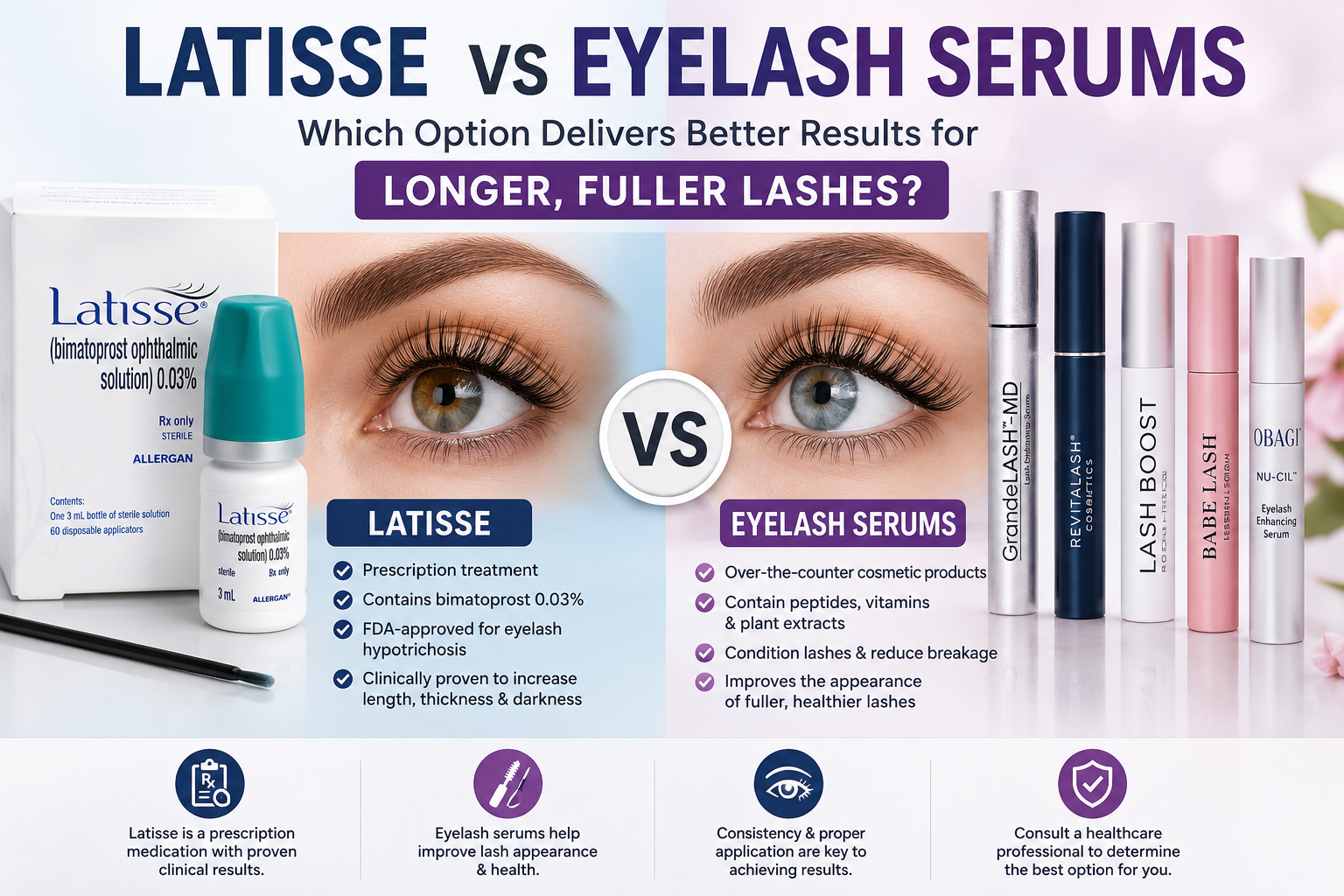
Long, thick eyelashes have become one of the most sought-after aesthetic goals, leading to a rapidly expanding market of eyelash growth serum products. Consumers now have access to dozens of options, ranging from cosmetic conditioning serums available without a prescription to prescription eyelash serum treatments that are regulated as medications. This variety has also created confusion about which products genuinely stimulate eyelash growth and which primarily improve lash appearance through conditioning and reduced breakage.
Among all available treatments, Latisse remains one of the most widely recognized names because it is the only U.S. Food and Drug Administration (FDA)-approved prescription treatment specifically indicated to treat inadequate eyelashes (eyelash hypotrichosis). Unlike cosmetic serums, Latisse contains bimatoprost, a medication with clinically demonstrated effects on eyelash length, thickness, and darkness when used as directed.
At the same time, numerous cosmetic lash serums—including GrandeLASH-MD, RevitaLash Advanced, Rodan + Fields Lash Boost, Babe Lash, Obagi Nu-Cil, NeuLash, and NuLastin—have gained popularity by offering conditioning ingredients, peptides, botanical extracts, vitamins, and amino acids designed to improve lash health and reduce breakage.
Understanding the differences between these products is important because they do not work in the same way, are not subject to the same regulatory standards, and may produce different outcomes depending on an individual’s goals, eye health, and tolerance for potential side effects.
This comprehensive guide explains:
- How eyelashes naturally grow
- How Latisse vs eyelash serum comparisons should be evaluated
- The science behind bimatoprost eyelash growth
- Differences between prescription and cosmetic lash serums
- Which option may provide the best eyelash growth treatment for different users
- Important safety considerations before beginning treatment
Understanding How Eyelashes Grow
Before comparing products, it is important to understand how eyelashes naturally develop.
Like scalp hair, eyelashes grow through a repeating biological cycle consisting of three primary phases:
Anagen (Growth Phase)
The anagen phase is the active period of hair production. During this stage, the hair follicle continuously generates new hair fibers.
For eyelashes, this phase is relatively short compared with scalp hair, typically lasting several weeks. Because the growth phase is limited, eyelashes naturally reach a shorter maximum length.
Catagen (Transition Phase)
During catagen, active hair growth slows as the follicle begins transitioning toward a resting state.
Telogen (Resting and Shedding Phase)
Eventually, the eyelash is shed and replaced by a new hair entering another growth cycle.
Professional dermatologists and ophthalmologists recognize that treatments capable of extending the anagen phase may allow eyelashes to remain in active growth longer, resulting in noticeably longer eyelashes and increased fullness over time.
This biological principle forms the scientific basis behind bimatoprost eyelash growth therapy.
What Is Latisse?
Latisse is a prescription topical medication containing 0.03% bimatoprost ophthalmic solution.
Originally, bimatoprost was developed to lower elevated intraocular pressure in patients with glaucoma. During clinical use, physicians consistently observed increased eyelash growth as an unintended effect. This observation led to additional clinical research, culminating in FDA approval of Latisse in 2008 for treating eyelash hypotrichosis.
Unlike cosmetic beauty products, Latisse underwent controlled clinical trials demonstrating measurable improvements in:
- Eyelash length
- Lash thickness
- Lash darkness
According to the FDA-approved prescribing information, visible improvements generally begin after approximately 8 weeks, with maximum results commonly observed around 16 weeks when applied consistently once daily to the upper eyelid margin.
Because Latisse is a prescription medication, treatment should be recommended and supervised by a qualified healthcare professional who can determine whether it is appropriate for the individual’s medical history and eye health.
Individuals interested in professionally supervised Latisse services should seek evaluation from experienced medical providers who can assess candidacy, explain expected outcomes, and provide guidance on proper application.
What Is an Eyelash Growth Serum?
The term eyelash growth serum generally refers to cosmetic products formulated to improve the appearance and condition of eyelashes.
Most cosmetic lash serums are designed to:
- Condition lashes
- Improve flexibility
- Reduce lash breakage
- Support healthier-looking lashes
- Increase hydration around the lash shaft
Unlike prescription medications, cosmetic serums are not approved by the FDA to treat eyelash hypotrichosis.
Instead, they typically rely on combinations of ingredients such as:
- Peptides
- Biotin
- Panthenol (Vitamin B5)
- Hyaluronic acid
- Amino acids
- Plant extracts
- Antioxidants
While many users report healthier-looking lashes with consistent use, cosmetic serums generally work by improving lash condition rather than altering the hair growth cycle in the same way as prescription bimatoprost.
Latisse vs Eyelash Serum: The Fundamental Difference
The comparison between Latisse vs eyelash serum begins with understanding their intended purpose.
| Latisse | Cosmetic Eyelash Serums |
| Prescription medication | Cosmetic product |
| FDA-approved for eyelash hypotrichosis | Not FDA-approved to stimulate eyelash growth |
| Contains bimatoprost | Usually contains peptides, vitamins, amino acids, and conditioning agents |
| Supported by controlled clinical studies for eyelash growth | Evidence varies by formulation and ingredient |
| Requires medical evaluation and prescription | Typically available over the counter |
This distinction is one of the most important considerations when evaluating the best eyelash growth treatment.
How Does Bimatoprost Stimulate Eyelash Growth?
One of the most frequently searched topics is bimatoprost vs Latisse.
In reality, Latisse contains bimatoprost as its active pharmaceutical ingredient.
Although researchers continue studying its exact biological mechanisms, current evidence indicates that bimatoprost may:
- Extend the eyelash growth (anagen) phase
- Increase the number of actively growing hair follicles
- Promote thicker hair shafts
- Enhance eyelash pigmentation, making lashes appear darker
These combined effects explain why many patients experience improvements in lash length, fullness, and darkness after several weeks of consistent treatment.
Importantly, results develop gradually. Eyelash follicles require time to complete natural growth cycles, meaning visible changes are not immediate.
Who May Benefit Most from Latisse?
Healthcare providers may consider Latisse for adults who have:
- Naturally sparse eyelashes
- Age-related eyelash thinning
- Reduced lash density after cosmetic damage
- Eyelash hypotrichosis diagnosed by a medical professional
It may also be appropriate for individuals seeking clinically demonstrated eyelash growth rather than temporary cosmetic enhancement.
However, because Latisse is a prescription medication, it is not suitable for everyone. Individuals with certain eye conditions, elevated sensitivity to ingredients, or other ophthalmic concerns should discuss treatment options with a qualified healthcare provider before use.
What Do Cosmetic Lash Serums Offer?
Many consumers searching for the best eyelash growth treatment are not necessarily looking for a prescription medication.
Cosmetic serums appeal to users who prefer products that are widely available and designed to improve lash appearance through daily conditioning. Depending on the formulation, these products may help:
- Minimize lash breakage
- Improve lash flexibility
- Support healthier-looking eyelashes
- Enhance shine and softness
- Create the appearance of fuller lashes over time by preserving existing hairs
Although cosmetic serums can be valuable components of a lash care routine, it is important to understand that their expected outcomes differ from those of prescription bimatoprost. Results depend on the product’s formulation, consistency of use, and individual variation, and they should not be expected to replicate the clinical effects demonstrated with Latisse.
Comparing Latisse with Popular Eyelash Serums
Consumers searching for the best eyelash growth treatment often compare Latisse with well-known cosmetic lash serums. While these products share the goal of improving lash appearance, they differ significantly in their active ingredients, regulatory status, clinical evidence, and expected results.
The following comparisons highlight the most important distinctions.
GrandeLASH MD vs Latisse
One of the most common online searches is grande lash vs latisse or latisse vs grandelash because both products are marketed to individuals seeking longer-looking eyelashes.
GrandeLASH MD
GrandeLASH-MD is a cosmetic lash-enhancing serum formulated with ingredients such as:
- Amino acids
- Peptides
- Vitamins
- Plant extracts
- Conditioning agents
Its primary objective is to condition lashes and reduce breakage, allowing existing lashes to appear healthier and more noticeable over time.
Latisse
Latisse uses bimatoprost ophthalmic solution 0.03%, which has been studied in controlled clinical trials and approved by the FDA for treating eyelash hypotrichosis.
Key Differences
| GrandeLASH MD | Latisse |
| Cosmetic serum | Prescription medication |
| Conditions of existing lashes | Stimulates eyelash growth through bimatoprost |
| No FDA approval for treating eyelash hypotrichosis | FDA-approved for inadequate eyelashes |
| Available without a prescription | Requires medical evaluation and prescription |
Individuals primarily seeking clinically demonstrated lash growth often discuss grandelash md vs latisse with a healthcare provider, while those looking for cosmetic conditioning may consider GrandeLASH MD based on their preferences and tolerance.
RevitaLash vs Latisse
Another frequently searched comparison is RevitaLash vs Latisse.
RevitaLash Advanced is a cosmetic conditioning serum that combines peptides, botanical extracts, amino acids, and moisturizing ingredients intended to support healthier-looking eyelashes.
Like other cosmetic serums, RevitaLash focuses on improving lash condition rather than treating eyelash hypotrichosis.
Latisse May Be Preferred When:
- A prescription treatment is appropriate
- Clinically studied eyelash growth is the primary goal
- A healthcare provider recommends bimatoprost therapy
RevitaLash May Appeal To Individuals Who:
- Prefer a cosmetic product
- Want to improve lash conditioning
- Are not candidates for prescription treatment
When evaluating latisse vs revitalash, expectations should remain realistic because the products are designed for different purposes.
Lash Boost vs Latisse
Searches for lash boost vs Latisse, Latisse vs lash boost, and Rodan and Fields lash boost vs latisse remain consistently popular.
Rodan + Fields Lash Boost is marketed as a cosmetic lash conditioning serum.
Its formulation includes:
- Peptides
- Keratin-related ingredients
- Conditioning agents
- Hydrating components
Unlike Latisse, Lash Boost is not approved as a prescription treatment for eyelash hypotrichosis.
Comparison Overview
| Lash Boost | Latisse |
| Cosmetic conditioner | Prescription medication |
| Supports lash appearance | Demonstrated eyelash growth in clinical studies |
| Non-prescription | Prescription only |
| Peptide-based formulation | Bimatoprost-based formulation |
Individuals considering lash boost vs latisse should understand that cosmetic improvement and medically demonstrated lash growth are separate treatment objectives.
Babe Lash vs Latisse
The comparison between babe lash vs latisse frequently arises among consumers seeking alternatives to prescription therapy.
Babe Lash offers conditioning ingredients intended to improve the appearance of eyelashes by helping minimize breakage and maintain healthier-looking lashes.
Compared with Latisse:
- Babe Lash is available without a prescription.
- Latisse is regulated as a medication.
- Clinical evidence supporting Latisse is substantially more extensive for treating eyelash hypotrichosis.
The appropriate choice depends on treatment goals, medical suitability, and expectations.
Obagi Nu-Cil vs Latisse
Obagi Nu-Cil is another cosmetic lash-enhancing serum frequently compared with Latisse.
Nu-Cil incorporates proprietary peptide technology and conditioning ingredients intended to support healthier-looking lashes.
Unlike prescription bimatoprost therapy, Nu-Cil focuses primarily on cosmetic enhancement rather than treating inadequate eyelash growth.
Consumers researching Obagi lash serum vs. Latisse should recognize that these products belong to different regulatory categories.
NeuLash vs Latisse
NeuLash is designed as a cosmetic conditioning serum containing peptides and botanical ingredients that support healthier-looking lashes.
The discussion around neulash vs latisse often centers on whether conditioning ingredients can provide results comparable to prescription therapy.
Current evidence suggests these products should not be considered interchangeable because their mechanisms of action differ substantially.
NuLastin vs Latisse
Searches for nulastin vs latisse and latisse vs nulastin continue to grow as consumers explore alternatives.
NuLastin focuses on elastin-supporting technology intended to improve the appearance of eyelashes through cosmetic conditioning.
Like other non-prescription serums, NuLastin is not FDA-approved to treat eyelash hypotrichosis.
Healthcare professionals generally recommend evaluating these products based on:
- Desired outcome
- Clinical evidence
- Individual eye health
- Medical history
- Risk tolerance
Nu-Cil vs Latisse
Consumers also search nu cil vs latisse when comparing prescription and cosmetic products.
Nu-Cil emphasizes conditioning technology, whereas Latisse directly targets the eyelash growth cycle through bimatoprost.
Individuals seeking measurable growth supported by clinical trials may find this distinction particularly important.
Is Latisse the Best Eyelash Growth Serum?
A common question is “Is Latisse the best eyelash growth serum?”
From a regulatory perspective, Latisse occupies a unique position because it remains the only FDA-approved prescription medication specifically indicated to treat eyelash hypotrichosis.
However, “best” depends on several factors, including:
- Treatment goals
- Medical history
- Budget
- Willingness to obtain a prescription
- Potential side effects
- Preference for cosmetic versus prescription products
For individuals with clinically significant sparse eyelashes, many healthcare providers may consider Latisse an appropriate option because of its demonstrated efficacy in controlled clinical studies. Others may prefer cosmetic serums if their goal is to condition existing lashes rather than pursue prescription treatment.
Is There a Best Latisse Alternative?
Many online searches focus on finding the best Latisse alternative or comparing Latisse competitors.
There is no single cosmetic serum that can be considered a direct replacement for Latisse because they generally rely on different ingredients and mechanisms.
Instead, alternatives typically fall into two categories:
Cosmetic Conditioning Serums
Examples include:
- GrandeLASH-MD
- RevitaLash Advanced
- Obagi Nu-Cil
- NeuLash
- Babe Lash
- NuLastin
These products are intended to condition lashes and may improve the appearance of existing eyelashes over time.
Prescription Treatments
Any prescription treatment containing bimatoprost should only be used under the guidance of a licensed healthcare professional. Patients should avoid purchasing products marketed as prescription-strength treatments without proper medical oversight.
Understanding Safety Considerations
Safety should always be part of any Latisse lash serum review or comparison of eyelash growth products.
Latisse
Because Latisse contains bimatoprost, potential side effects listed in the prescribing information may include:
- Eye redness
- Itching
- Dry eye symptoms
- Skin darkening where the solution is repeatedly applied
- Increased brown iris pigmentation, although this has primarily been associated with ophthalmic use directly in the eye rather than application to the eyelid margin
Patients should follow application instructions carefully and discuss any concerns with their healthcare provider.
Cosmetic Lash Serums
Although cosmetic serums generally do not contain bimatoprost, they may still cause:
- Local irritation
- Allergic reactions
- Temporary redness
- Sensitivity to certain botanical ingredients or preservatives
Patch testing, reviewing ingredient lists, and discontinuing use if irritation develops are prudent steps for any new cosmetic product.
Can Nutrition Support Healthy Eyelashes?
Healthy eyelashes depend on overall hair follicle function, which is influenced by adequate nutrition and general health. While nutritional supplements are not a substitute for prescription treatments such as Latisse, maintaining sufficient intake of essential nutrients—including protein, iron (when deficient), zinc, biotin (when deficiency exists), and vitamins involved in normal hair health—may support healthy hair growth overall.
For individuals with documented nutritional deficiencies or those seeking to optimize overall wellness, medical-grade supplements recommended by qualified healthcare professionals may complement a comprehensive hair and skin care plan. However, no dietary supplement should be promoted as a replacement for FDA-approved treatment for eyelash hypotrichosis unless supported by robust clinical evidence for that specific indication.
How to Choose Between Latisse and an Eyelash Serum
Choosing between Latisse and a cosmetic eyelash growth serum depends on treatment goals, medical history, expectations, and the importance of clinical evidence. Because these products belong to different regulatory categories, comparing them requires more than evaluating marketing claims.
The following considerations can help guide an informed decision.
Latisse May Be Appropriate When
Latisse may be recommended by a qualified healthcare provider for individuals who:
- Have sparse or thinning eyelashes (eyelash hypotrichosis).
- Want a treatment with FDA approval for eyelash growth.
- Prefer a product supported by controlled clinical studies.
- Are comfortable obtaining a prescription and following medical guidance.
- Understand that consistent daily application is required to maintain results.
A Cosmetic Eyelash Serum May Be Appropriate When
A non-prescription serum may be suitable for individuals who:
- Want to improve the appearance and condition of existing lashes.
- Prefer an over-the-counter cosmetic product.
- Are primarily interested in reducing lash breakage.
- Are not candidates for prescription treatment.
- Understand that cosmetic serums are not approved to treat eyelash hypotrichosis.
Ultimately, the most appropriate choice should be based on an individualized assessment rather than advertising claims or online trends.
Best Practices for Achieving Healthy, Longer Eyelashes
Regardless of the product selected, eye care professionals generally recommend adopting healthy lash-care habits to maximize results and minimize irritation.
Apply Products Exactly as Directed
Prescription medications such as Latisse should only be used according to the manufacturer’s instructions and a healthcare provider’s recommendations. Applying more than directed does not accelerate eyelash growth and may increase the likelihood of irritation.
Remove Eye Makeup Thoroughly
Mascara, eyeliner, and adhesive residue should be removed gently before applying any lash product. Clean eyelid margins help reduce irritation and support proper application.
Replace Eye Cosmetics Regularly
Old mascara and eye makeup can harbor bacteria. Replacing products according to manufacturer recommendations helps reduce the risk of contamination.
Avoid Excessive Rubbing
Frequent rubbing of the eyes can contribute to lash breakage and premature shedding.
Address Underlying Medical Conditions
Persistent eyelash loss may be associated with dermatologic conditions, thyroid disorders, nutritional deficiencies, autoimmune diseases, or certain medications. Evaluation by a healthcare professional may be appropriate when lash thinning develops unexpectedly.
Common Misconceptions About Latisse and Eyelash Serums
Misunderstandings about eyelash growth treatments remain common. Separating fact from misconception helps consumers make informed decisions.
Myth 1: All Lash Serums Work the Same Way
Fact: Cosmetic serums and prescription medications use different ingredients and mechanisms of action. Latisse contains bimatoprost, while most cosmetic products rely on peptides, conditioning agents, amino acids, and botanical extracts.
Myth 2: More Product Produces Faster Results
Fact: Hair growth follows a biological cycle. Applying additional products does not accelerate eyelash growth and may increase irritation.
Myth 3: Results Are Permanent
Fact: Improvements from Latisse gradually diminish after treatment is discontinued because eyelashes eventually return to their natural growth cycle.
Myth 4: Every User Experiences Identical Results
Fact: Individual response varies according to genetics, age, baseline lash density, consistency of application, and overall health.
Myth 5: Cosmetic Serums Are FDA-Approved for Eyelash Growth
Fact: Cosmetic eyelash serums are regulated differently from prescription medications. Latisse remains the only FDA-approved prescription treatment specifically indicated for eyelash hypotrichosis.
Frequently Asked Questions
1. Is Latisse the best eyelash growth serum?
Latisse is the only FDA-approved prescription treatment specifically indicated for increasing eyelash growth in people with eyelash hypotrichosis. Whether it is the “best” option depends on an individual’s goals, medical history, tolerance for potential side effects, and whether a prescription treatment is appropriate.
2. What is the difference between Latisse and an eyelash growth serum?
Latisse is a prescription medication containing bimatoprost, while most cosmetic eyelash serums are formulated with conditioning ingredients such as peptides, amino acids, vitamins, and botanical extracts. Cosmetic products primarily improve lash appearance and reduce breakage, whereas Latisse has demonstrated efficacy in promoting eyelash growth in clinical studies.
3. How long does Latisse take to produce visible results?
According to FDA-approved prescribing information, noticeable improvement often begins after approximately 8 weeks of consistent daily use, with maximum results typically observed around 16 weeks.
4. Does Latisse continue working after treatment stops?
No. Once treatment is discontinued, eyelashes gradually return to their natural growth cycle, and the enhanced length, thickness, and darkness diminish over time.
5. Can cosmetic lash serums replace Latisse?
Cosmetic serums may improve lash conditioning and reduce breakage, but they should not be considered direct substitutes for Latisse because they generally do not contain bimatoprost or share the same FDA-approved indication.
6. Is bimatoprost the same as Latisse?
Bimatoprost is the active pharmaceutical ingredient in Latisse. Latisse is the branded prescription formulation approved by the FDA for treating eyelash hypotrichosis.
7. Are prescription eyelash serums safe?
When prescribed appropriately and used according to medical instructions, prescription treatments such as Latisse have an established safety profile. As with any medication, potential side effects and contraindications should be discussed with a qualified healthcare provider.
8. Which cosmetic serum is most comparable to Latisse?
Products such as GrandeLASH-MD, RevitaLash Advanced, Obagi Nu-Cil, Babe Lash, NeuLash, and NuLastin are frequently compared with Latisse. However, these cosmetic serums differ in formulation, intended use, and level of clinical evidence, so they should not be considered equivalent to prescription bimatoprost therapy.
9. Can Latisse be used on the lower eyelashes?
The FDA-approved instructions specify applying Latisse only to the upper eyelid margin using the sterile applicators provided. Any transfer to the lower lashes occurs naturally through blinking. Application to the lower eyelid is not recommended unless specifically directed by a healthcare professional.
10. Who should consult a healthcare provider before using Latisse?
Individuals with glaucoma, elevated intraocular pressure, active eye infections, recent eye surgery, pregnancy or breastfeeding considerations, or a history of significant eye disease should consult a qualified healthcare professional before starting treatment.
Conclusion
Choosing between Latisse and a cosmetic eyelash growth serum requires understanding the important distinction between a prescription medication and cosmetic conditioning products. While numerous lash serums are available, they differ considerably in formulation, scientific evidence, regulatory oversight, and intended use.
Latisse occupies a unique position because it is the only FDA-approved prescription treatment for eyelash hypotrichosis. Its active ingredient, bimatoprost, has been studied in controlled clinical trials demonstrating improvements in eyelash length, thickness, and darkness when used consistently under medical supervision.
By contrast, cosmetic serums such as GrandeLASH-MD, RevitaLash Advanced, Rodan + Fields Lash Boost, Babe Lash, Obagi Nu-Cil, NeuLash, and NuLastin primarily focus on conditioning existing lashes, supporting healthier-looking eyelashes, and reducing breakage. While many users report cosmetic benefits, these products should not be expected to provide the same clinically demonstrated mechanism of action as prescription bimatoprost.
The most appropriate choice depends on an individual’s treatment goals, eye health, medical history, and willingness to use a prescription product. Consultation with a qualified healthcare provider remains the most reliable way to determine whether Latisse or a cosmetic lash serum is the better option for achieving longer eyelashes and fuller lashes safely and effectively.