Introduction
Hormone levels may fluctuate over time and for a variety of reasons; therefore thyroid disorders need to be monitored over time. The accurate measurement of these changes is critical for endocrinologists in order to give patients the best treatment and avoid complications.
The Advanced Level of Healthray’s Pathology Lab Software is quickly replacing the traditional diagnostic labs to make thyroid testing easier, ensure correct reports and keep an accurate patient history. A massive range of thyroid trends can be analysed, workflows managed and insights are brought to endocrinologists, with the aid of a reliable Laboratory Information Management System.
Healthcare professionals can go beyond the limitations of traditional reporting with an advanced Laboratory Software solution through its automated processes, historical data comparison and improved communication capabilities from the lab to the doctors. With thyroid care delving deeper into the nuances of clinical data analysis, it has become crucial to newer diagnostic centers to use a powerful Lab Management Information System.
Understanding Laboratory Software
The levels of thyroid hormones are not necessarily steady. There will be fluctuations in the levels of Thyroid Stimulating Hormone (TSH), Free T3, Free T4 and thyroid antibodies because of various internal and external factors. Thus, these patterns can be useful for linking the progression of the disease to the effectiveness of treatments by endocrinologists.
Advanced laboratory platforms allow healthcare providers to access comprehensive patient histories, instead of relying on individual test reports. Hereby, illness can be spared and the doctor would be able to make more informed clinical decisions, as well as assess the effectiveness of the medications and also spot early signs of illness.
Complex cases of thyroids that require detailed analysis and regular follow up, are dealt with by endocrinologists. A linked Laboratory Information Management System offers a rapid knowledge of past reports, Patient Data and diagnostic trends.
This enhances the communication and interaction between the Healthray’s Laboratory Software and specialists. With this, doctors can provide treatment plans tailored to each person that are based on laboratory data and not just on symptoms.
Role Of Laboratory Software
Automating Thyroid Workflows
Advanced Pathology Lab Software automates various laboratory tasks such as patient registration, sample tracking, report generation as well as result verification. Manual workload is cut and other operational efficiencies are gained through automation.
Furthermore, automated workflows help to cut down on human mistakes and guarantee that all thyroid samples are treated in a consistent manner. This makes a laboratory able to provide reports of diseases in a timely and accurate manner.
Improving Report Accuracy
It’s important to get thyroid reports off of an accurate diagnosis and treatment. Modern LIMS Software can be plug and play compatible with lab instruments, decreasing manual data entry and guaranteeing accurate laboratory results.
Test results are automatically collected, data is validated and professional test reports are created. Thus, laboratories may achieve the same quality and yield information that is reliable to an endocrinologist.
Choosing Best Laboratory Software
However, important considerations in enhancing the thyroid diagnostic service are to be mindful of the right laboratory solution selected. The best software will be able to be automated, secure and effortless framework management.
- Auto-Management of thyroid tests
- Patient history tracking
- Barcode-based sample identification
- Laboratory instrument integration
- Digital report generation
- Make cloud data storage stable
- Real-time result accessibility
- Quality control monitoring
Key Selection Benefits
Opting for the right Healthray’s Laboratory Information Management System offers long-term benefits to a pathology lab or diagnostic center. This is a good way of ensuring that productivity is increased, as well as making the administration process easier and also improving patient care.
The ideal laboratory software should have features such as ease of use for the user, ability to customize, improved security and also scalability. Additionally, the lab needs to find solutions that can be used by multiple departments, and fit into the existing healthcare systems.
Investing in the best LIMS software in India allows diagnostic centers to increase the accuracy, better manage workflows and provide quick and quality services.
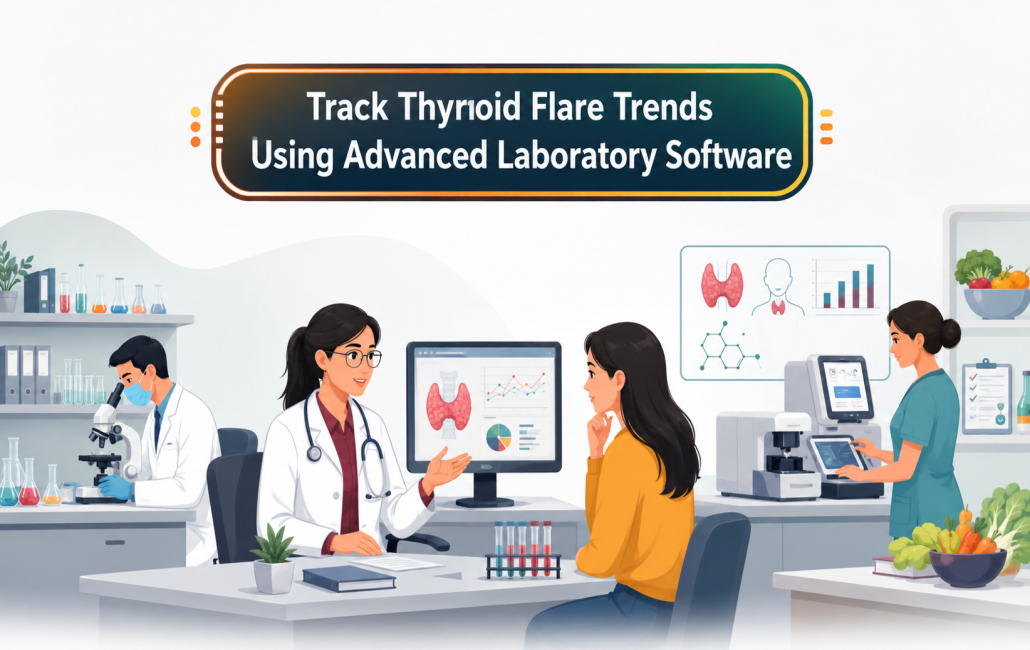
Tracking Thyroid Flare Trends
Monitoring Historical Data
Advanced laboratory information management system software is a great feature when it comes time to keep and interpret thyroid data that has been stored, or to analyze data from the past. A baseline set of results can be compared to subsequent analyses to determine significant changes of hormones.
Doctors who specialize in the treatment of hormonal imbalances, known as endocrinologists, can use this form of long-term analysis to detect patterns, for example, as TSH levels go up over time, or as many hormones get imbalanced or as hormone production is affected by changes in medication.
Detecting Early Health Changes
An early detection of thyroid flare patterns can have a positive impact on the patient’s treatment. Laboratory platforms can be used in a manner of advanced development to show unusual trends and to give useful information for a medical evaluation.
However, applying knowledge of past performance can enable endocrinologists to make preventative measures and the optimisation of treatment plans.
Benefits Of Lab Management
A comprehensive Healthray’s Lab Management Information System can enhance the day-to-day functioning of your lab by connecting all departments with a single platform. The collection, processing, processing and reporting of samples into the finished report are easily manageable.
This ensures time savings, better communication and more time spent on quality testing and patient service by laboratory staff.
Being able to get the diagnosis promptly and accurately coupled with excellent record keeping is advantageous to patients. Digital laboratory systems facilitate the retention of comprehensive laboratory histories, and are easier to access to generate reports.
Hence the use of advanced technology in the laboratory enhances laboratory performance and satisfaction with the laboratory.
Future Of Thyroid Diagnostics
In the future, more innovation with the help of AI and predictive analytics technology will be introduced in thyroid monitoring. These technologies hold promise of uncovering unknown structures in laboratory data, and helping make effective clinical choices.
AI-enabled LIMS Software can assist laboratories in analyzing vast amounts of patient data and gain greater diagnostic accuracy.
Cloud-based Laboratory Information Management System (LIMS) platforms are gaining traction as they make it easier for lab professionals to access laboratory information securely from multiple locations.
Laboratory technicians and endocrinologists can communicate effectively and use data securely yet remain accurate with respect to regulations.
Concluding Insights
To monitor trends of thyroid flares, it will be necessary to have accurate data management, efficient processes, and reliable diagnostic technology. Thyroid Testing processes are easily managed in the laboratory with the Advanced Pathology Lab Software and endocrinologists get valuable insights via historical data analysis.
By boosting workflow automation, reporting accuracy and patient management, a powerful Laboratory Information Management System enhances productivity in a laboratory. Infection diagnostic centres with the use of modern Laboratory Software and advanced LIMS Software can optimize the efficiency and ensure better health-care support.
With the ongoing advancement of thyroid care, it becomes easy for health care institutions to invest in the Best LIMS software in India and contract efficient laboratory solution providers in order to offer quick, intelligent and personalized diagnostic services to its patients.