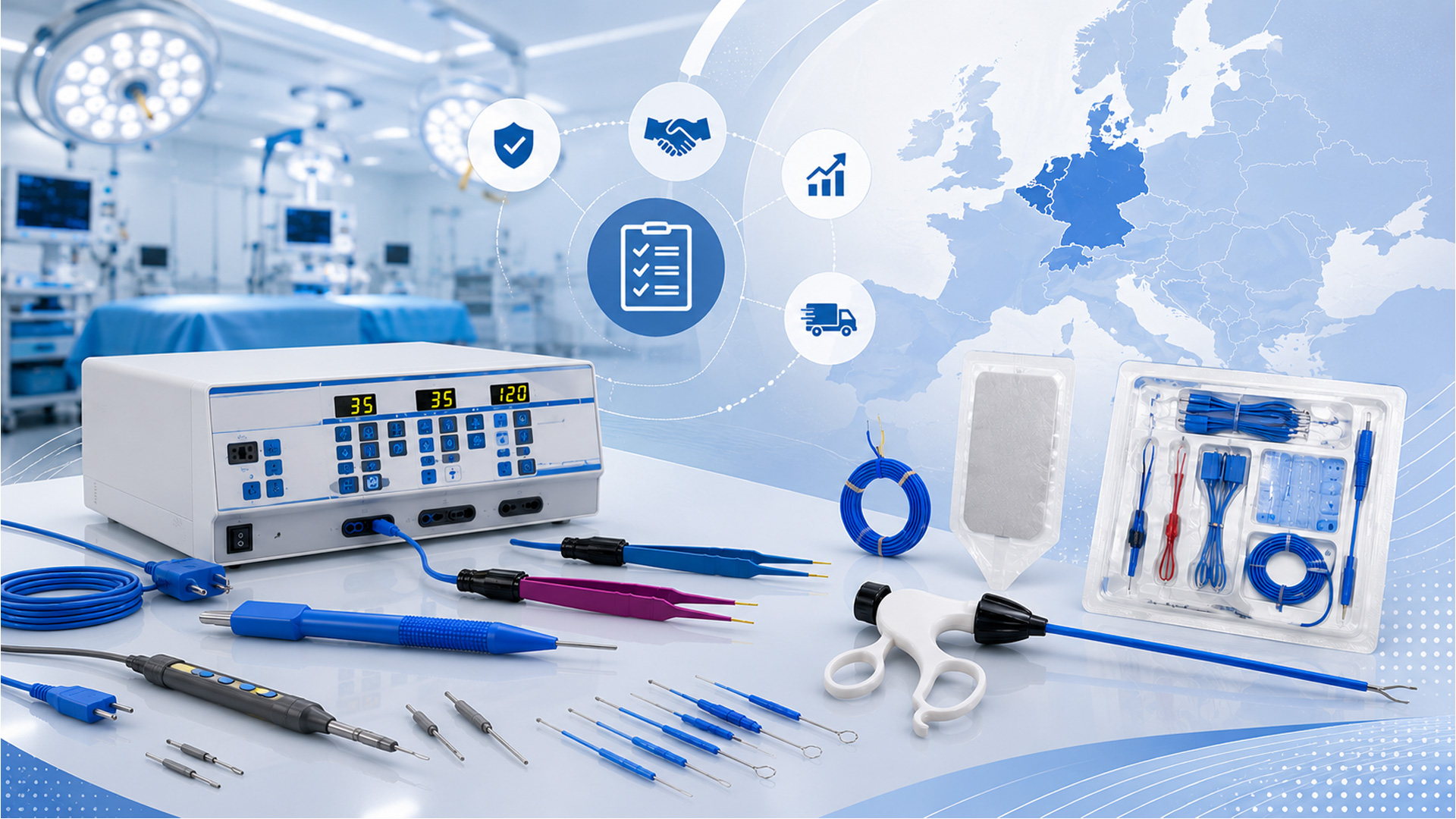
European healthcare buyers are becoming more selective about how they source surgical instruments. Across the Netherlands, Belgium, Spain, Ireland, and Finland, procurement teams are looking beyond price alone and placing stronger attention on supplier reliability, product clarity, surgical workflow needs, and long-term distributor support.
Surgical instrument procurement Europe is shifting toward reliable sourcing, clear product documentation, and stronger partnerships between hospitals, distributors, and manufacturers. In 2026, buyers are prioritizing consistent product availability, procedure-focused instrument ranges, and suppliers that understand modern surgical and electrosurgical requirements.
Why Surgical Procurement Is Changing Across Europe
Hospitals and private clinics across Europe are working under growing pressure to improve operating room efficiency while maintaining dependable supply access. This has made surgical instrument procurement Europe a more strategic decision for hospital buyers, operating room managers, and medical device distributors.
Instead of sourcing instruments only through traditional price comparisons, healthcare teams are now reviewing supplier capability, product category depth, usability, and compatibility with modern surgical procedures.
- Hospitals need reliable access to surgical and electrosurgical instruments.
- Distributors require manufacturer partners with clear product portfolios.
- Procurement teams prefer suppliers that support multiple surgical categories.
- Operating rooms are placing more value on workflow-ready instrument solutions.
- European buyers want transparent, professional communication from suppliers.
Procurement insight: In European medical sourcing, the strongest supplier relationships are built on clarity, consistency, and category understanding—not only on product pricing.
What European Buyers Now Expect from Surgical Instrument Suppliers
Medical procurement teams in the Netherlands, Belgium, Spain, Ireland, and Finland are becoming more detail-focused when evaluating surgical suppliers. Buyers want to understand whether a supplier can support daily operating room needs, specialist surgical applications, and distributor-led market growth.
Key expectations include:
- Broad surgical instrument coverage for multiple procedure types.
- Single-use HF instruments for modern electrosurgical applications.
- Reusable HF instruments where long-term usage is required.
- Bipolar forceps and monopolar electrodes for electrosurgery.
- Laparoscopic instruments, trocars, Veress needles, and clip appliers.
- Suction and irrigation systems for minimally invasive surgical settings.
- Premium retrieval bags and related surgical accessories.
For distributors, this creates an opportunity to work with manufacturing partners that can support multiple product categories under one professional supply relationship.
The Role of Distributors in European Surgical Supply Chains
Medical device distributors remain essential to hospital procurement across Europe. They help connect healthcare buyers with reliable manufacturers, product categories, and ongoing supply support. In markets such as Belgium, the Netherlands, Spain, Ireland, and Finland, distributors often act as the trusted bridge between product availability and clinical demand.
For this reason, distributors need manufacturer partners who understand both product performance expectations and procurement communication standards.
- Hospitals depend on distributors for responsive product access.
- Distributors need clear product information to support buyer decisions.
- Manufacturers must provide organized surgical product categories.
- Procurement teams value supplier consistency and professional support.
Manufacturer-side perspective: A strong distributor partnership is not only about supplying products. It is about helping distributors present surgical solutions clearly, confidently, and professionally to healthcare buyers.
Why Single-Use and HF Instruments Are Gaining More Attention
Modern operating rooms increasingly require instruments that support efficient preparation, predictable availability, and procedure-specific use. This is why single-use surgical instruments, single-use HF instruments, and electrosurgical accessories are becoming important categories for procurement teams and distributors.
HF surgery products such as bipolar forceps, monopolar electrodes, reusable HF instruments, and MIS-focused energy instruments help support a wide range of surgical needs. For buyers, the priority is not only product availability but also selecting a supplier with a focused understanding of surgical energy applications.
Important product categories for 2026 procurement planning:
- Single-use HF instruments
- Single-use MIS instruments
- Reusable HF instruments
- Bipolar forceps
- Monopolar electrodes
- Laparoscopic instruments
- Suction and irrigation systems
- Veress needles
- Trocars
- Clip appliers
- Premium retrieval bags
Regional Procurement Trends in the Netherlands, Belgium, Spain, Ireland, and Finland
Although European healthcare markets share many procurement priorities, each region has its own sourcing behavior and distributor landscape. A strong surgical instrument supplier should understand how these regional expectations influence buying decisions.
Netherlands
Healthcare procurement in the Netherlands often values organized supplier communication, clear product categorization, and dependable distributor relationships. Surgical buyers typically look for efficient sourcing options that support hospital workflow and long-term supply planning.
Belgium
Belgian healthcare buyers often require practical supplier coordination across multilingual and regional procurement environments. Distributors serving Belgium benefit from surgical product ranges that are easy to present to hospitals and private clinics.
Spain
Spain’s healthcare market includes public hospitals, private clinics, and distributor-led purchasing networks. Surgical instrument suppliers targeting Spain should provide product clarity, responsive communication, and category depth across electrosurgical and MIS-related instruments.
Ireland
Irish healthcare procurement teams often look for reliable medical technology partners that can support hospital supply needs with professional communication and practical product availability. Distributor partnerships remain highly important for market access.
Finland
Finland’s healthcare sourcing environment values reliability, precision, and supplier professionalism. Surgical procurement teams and distributors benefit from manufacturers that can provide focused product categories and consistent support.
How Seemann Technologies Supports Modern Surgical Procurement
Seemann Technologies serves healthcare buyers, distributors, OEM buyers, private clinics, and medical technology sourcing teams with a focused portfolio of surgical and electrosurgical instruments. The company’s product categories support modern surgical environments where clarity, reliability, and procedure-focused sourcing matter.
For European distributors, Seemann Technologies offers a relevant product range across surgical instruments, single-use HF instruments, single-use MIS instruments, reusable HF instruments, bipolar forceps, monopolar electrodes, laparoscopic instruments, suction and irrigation systems, Veress needles, trocars, clip appliers, premium retrieval bags, and related accessories.
Procurement guidance: European buyers should evaluate surgical suppliers not only by product availability, but also by how clearly they support distributor communication, hospital decision-making, and category-based procurement.
What Procurement Teams Should Consider Before Choosing a Supplier
Selecting a surgical instrument supplier requires more than reviewing a catalog. Hospital buyers and distributors should consider how well a supplier supports real-world sourcing requirements across multiple surgical categories.
Supplier evaluation checklist:
- Does the supplier offer relevant surgical and electrosurgical product categories?
- Can the supplier support distributor-focused communication?
- Are product categories clearly organized for procurement teams?
- Does the supplier understand HF surgery and MIS instrument requirements?
- Can the supplier support buyers across multiple European regions?
- Is the product information practical for hospital sourcing decisions?
- Does the supplier avoid vague claims and provide professional clarity?
FAQs
What is surgical instrument procurement in Europe?
Surgical instrument procurement Europe refers to the process hospitals, clinics, distributors, and healthcare buyers use to source surgical instruments, electrosurgical tools, HF instruments, MIS instruments, and related operating room accessories across European markets.
Why are European hospitals reviewing their surgical suppliers more carefully?
Hospitals are reviewing suppliers more carefully because operating rooms require reliable access to procedure-focused instruments, clear product information, and dependable support from distributors and manufacturers.
Which surgical products are important for modern procurement teams?
Important categories include single-use HF instruments, reusable HF instruments, bipolar forceps, monopolar electrodes, laparoscopic instruments, suction and irrigation systems, Veress needles, trocars, clip appliers, retrieval bags, and electrosurgical accessories.
Why are medical device distributors important in Europe?
Medical device distributors help hospitals and clinics access suitable surgical products, communicate product options clearly, and connect healthcare buyers with reliable manufacturers.
Does Seemann Technologies support European healthcare markets?
Seemann Technologies focuses on surgical and electrosurgical product categories for healthcare buyers, distributors, OEM buyers, private clinics, and medical technology sourcing teams across European markets including the Netherlands, Belgium, Spain, Ireland, and Finland.
Final Thoughts
The future of surgical instrument procurement Europe will be shaped by supplier trust, distributor strength, and clear product education. Hospitals and healthcare buyers across the Netherlands, Belgium, Spain, Ireland, and Finland need partners who understand surgical workflow, procurement expectations, and the importance of reliable medical technology sourcing.
For distributors and procurement teams looking to strengthen their surgical product portfolio, Seemann Technologies offers a focused path toward professional, category-driven sourcing across surgical instruments, HF surgery products, MIS instruments, and related electrosurgical accessories.
Partner with Seemann Technologies to explore professional surgical instrument and electrosurgical product categories for European healthcare procurement and distributor supply needs.