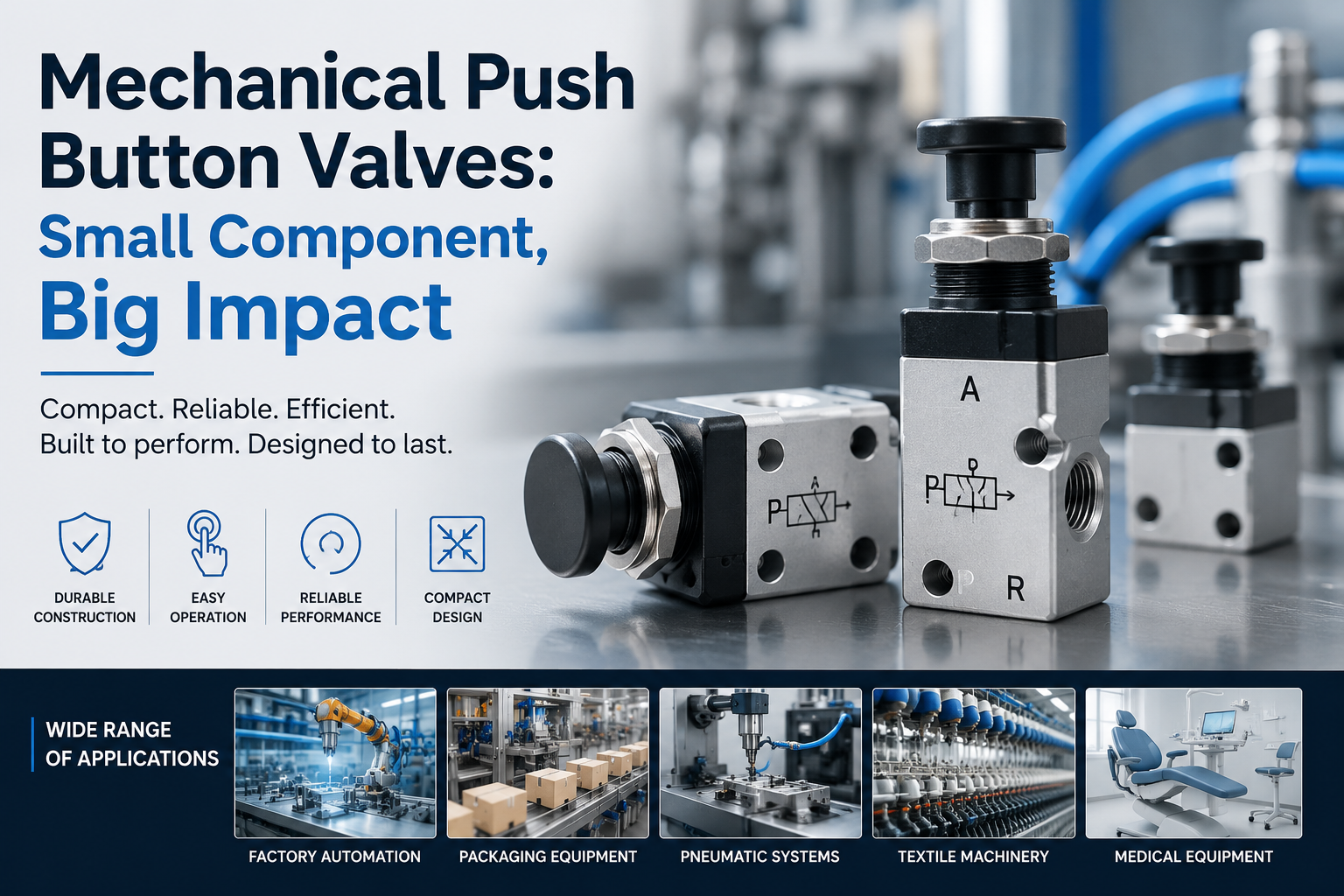
A stuck actuator during a production shift rarely fails because of the expensive equipment. More often, it comes down to a neglected control point — usually a worn-out or poorly matched Mechanical Push Button Valve that should have been replaced months earlier. Procurement teams discover this the hard way after air leakage starts affecting cycle time, operators begin bypassing controls, and maintenance teams start improvising with temporary fixes that somehow stay in place for six months.
That’s the problem with small pneumatic components. Buyers underestimate them until downtime starts costing actual money. Across packaging, automotive, food processing, and textile plants in India, demand for reliable pneumatic controls has increased sharply as factories automate semi-manual processes. According to India Brand Equity Foundation (IBEF), India’s manufacturing sector is expected to reach USD 1 trillion by 2026, pushing higher demand for dependable pneumatic systems and automation components.
Why Mechanical Push Button Valves Fail Earlier Than Buyers Expect
A surprising number of purchasing teams still compare pneumatic valves using only catalogue dimensions and price sheets.
That’s a mistake.
Two valves may look identical online yet perform very differently once exposed to vibration, oil-contaminated compressed air, or continuous operator handling on a busy production line. Many low-cost imports fail after 4–6 months because internal seals deform under inconsistent pressure loads. Suppliers rarely mention that part upfront.
Air Pressure Compatibility Matters More Than Catalogue Photos
Most Mechanical Push Button Valve Manufacturers in India design products around standard industrial pressure ranges between 0.15 MPa and 0.8 MPa. That range covers most assembly lines and automation systems. Still, buyers frequently overlook actual pressure fluctuations inside their plant.
Which means the valve works perfectly during testing but starts sticking during full production load.
A proper industrial-grade push button valve should include:
- Corrosion-resistant body material
- Consistent switching response
- Low leakage rate
- High cycle durability
- Easy manual actuation under repeated use
And yet, some suppliers continue selling lightweight valves intended for light-duty pneumatic benches into heavy manufacturing environments.
The Spec Detail Most Buyers Skip
Thread compatibility.
It sounds minor until the installation team realizes the imported valve uses incompatible threading standards that require adaptors across the line. That adds leakage points and maintenance headaches immediately.
Most experienced Mechanical Push Button Valve Suppliers now provide BSP threading options because Indian industrial systems commonly use BSP pneumatic fittings. Buyers who skip this confirmation often create avoidable integration problems.
Where Pneumatic Actuator Valves Fit Into the System
A Pneumatic Actuator Valve controls airflow direction and movement inside automated systems. Push button valves often work alongside these actuators to trigger manual overrides, emergency stops, or operator-assisted functions.
Factories using pneumatic automation commonly integrate:
- Mechanical push button valves
- Directional control valves
- Pneumatic cylinders
- Flow control valves
- Pneumatic actuator valves
That coordination directly affects machine response time.
Even a 0.5-second delay repeated thousands of times daily becomes a production issue.
Pneumatic Cylinders Are Only as Reliable as Their Air Control
Many buyers spend heavily on branded cylinders while ignoring the quality of the connected valve network.
Nobody tells you this during negotiations because cheaper valve packages help suppliers win orders faster.
A poorly performing control valve can reduce the effective life of even premium Pneumatic Cylinders by causing irregular motion, inconsistent pressure delivery, and unnecessary seal wear. Most experienced maintenance engineers understand this after seeing repeated cylinder failures tied back to unstable airflow control.
Five Supplier Checks That Prevent Expensive Procurement Mistakes
1. Ask for Cycle Testing Data
A reliable supplier should provide switching cycle information.
Bad answer:
“We haven’t had complaints so far.”
That response usually means no testing exists.
Industrial-grade valves should withstand hundreds of thousands of cycles under standard operating conditions. Serious manufacturers document this clearly.
2. Verify Raw Material Consistency
Some manufacturers change their body materials depending on changing metal costs.
This causes inconsistencies between batches.
Pose the question plainly. Do they keep material specifications the same for export and domestic orders? If they do not, or cannot, give a clear answer, take that as a red flag.
3. Check Lead Time Stability
Indian traders supplying OEMs generally have more stable shipping schedules compared to other import-based traders. During global freight disruptions in 2021 and 2022, some buyers waited 11–14 weeks for basic pneumatic inventory.
Which means your production planning suddenly depends on shipping congestion at another country’s port.
4. Evaluate Technical Support Depth
A competent supplier should understand airflow calculations, valve compatibility, and actuator matching.
Bad answer:
“Send the photo. We’ll identify the model.”
That’s not engineering support. That’s guesswork.
5. Confirm Spare Availability Before Ordering
Many buyers negotiate aggressively on unit price and completely ignore spare continuity.
Then six months later the supplier discontinues the model.
Most established Pneumatic Actuator Valve Manufacturers in India maintain better long-term spare availability because industrial clients demand continuity over years, not months.
How Reliable Valves Protect Margins on the Factory Floor
Reduced Downtime During Shift Operations
Unexpected shutdowns damage output planning fast. Industry studies from Deloitte estimate unplanned downtime costs industrial manufacturers thousands of dollars per hour depending on production scale.
A dependable valve reduces emergency stoppages caused by airflow failure or manual override malfunction.
Better Operator Safety
Push button valves are frequently integrated into emergency pneumatic release systems. Delayed actuation during maintenance creates real safety risks.
That’s harder to quantify on a spreadsheet, but every plant manager understands the consequence.
Lower Maintenance Frequency
Cheap valves often develop leakage around seals after repeated operation. Maintenance teams compensate temporarily by increasing compressor load pressure, which quietly increases energy consumption over time.
Compressed air is already one of the most expensive utilities inside industrial facilities.
Stable Pneumatic Cylinder Performance
Reliable airflow means smoother actuator movement.
That directly improves the lifespan of Pneumatic Cylinders used in automation lines, filling machines, textile systems, and packaging equipment.
Fewer Production Rejections
Inconsistent actuator movement creates dimensional variation during automated operations. That matters in packaging, automotive assembly, and precision handling applications where repeatability affects quality acceptance rates.
One unstable valve can create an entire batch problem.
Why Indian Buyers Are Prioritising Domestic Pneumatic Suppliers
India’s industrial automation market continues expanding across automotive, FMCG, pharmaceuticals, and electronics manufacturing sectors. As a result, demand for dependable Mechanical Push Button Valve Manufacturers in India and Pneumatic cylinder suppliers in India has increased steadily over the last five years.
Most buyers are no longer choosing suppliers based only on catalogue pricing.
Here’s why location matters more now:
- Faster replacement dispatch
- Easier factory audits
- Reduced import uncertainty
- Better communication during customization
- Lower freight volatility
Northern India has become particularly active because manufacturing clusters around Haryana, Delhi NCR, Rajasthan, and Punjab require faster pneumatic component supply chains for OEM and maintenance operations.
A supplier located closer to your production network usually solves problems faster than a cheaper overseas vendor replying after two time zones and three forwarding agents.
What We’ve Learned Supplying Pneumatic Components Since 2013
At V.S Enterprises, we’ve spent years working with procurement teams, machine builders, wholesalers, and industrial maintenance departments across India and export markets. We understand that most buyers are balancing three pressures at once — delivery timelines, price control, and long-term reliability.
We’ve supplied pneumatic products to clients operating across 31 countries, and one lesson repeats constantly: the smallest component usually becomes the biggest operational problem when quality slips.
In 2021, after several customers reported variable actuation in high-temperature summer conditions inside sealed production units, we ceased the use of a particular imported seal variant.We replaced it completely instead of arguing over warranty percentages. That decision cost more upfront but reduced repeat complaints significantly.
Our product range includes:
- Mechanical push button valves
- Pneumatic actuator valves
- Pneumatic cylinders
- Directional control valves
- FRL units and accessories
And yes, some custom configurations genuinely take longer than buyers expect because matching thread type, airflow requirement, and mounting dimensions across older machinery is not always straightforward.
Send Your Requirement Before the Next Maintenance Shutdown
If you’re sourcing pneumatic components for OEM production, maintenance inventory, or industrial distribution, send us:
- Valve specifications
- Working pressure range
- Port size
- Quantity requirement
- Application details
- Required delivery timeline
We typically respond within one business day.
Our MOQ depends on the product category and customization level, but we regularly support both bulk industrial orders and recurring distributor requirements across India.
Conclusion
The right Mechanical Push Button Valve rarely gets attention when everything works properly. Once inconsistent airflow begins to affect production, buyers start to see the real impact of small pneumatic components on the stability of operations. As Indian manufacturers invest more in automation each year, the demand for reliable pneumatic systems, actuator valves, and cylinders, built for the rigors of factories, rather than for a catalog photo, will also increase.
Here is another blog you might be interested in.
Inside India’s Growing Demand for Pneumatic Cylinders
FAQs
In which industries are Mechanical Push Button Valves typically employed?
They are used extensively in the packing, automotive assembly, textile, food, and semi-automated manufacturing industries. These valves are typically paired with pneumatic cylinders and the control systems of actuators in their systems for manual intervention.
What are some indicators of a good Mechanical Push Button Valve manufacturer in India?
First, look at their testing standard, material uniformity, pressure ratings, and continuity of spare parts. Vendors who only negotiate on prices become complex suppliers in case of post-installation technical support.
Are Pneumatic Actuator Valves used on high-speed automation lines?
Yes. This holds true as long as the airflow is calculated and the valves can respond fast enough to fit the cycle time. It is surprisingly common to see a properly sized actuator paired with a tight valve causing sluggish movement.
Why do some factories experience the premature failure of pneumatic valves?
Faulty compressed air is the main reason. Poor FRL maintenance wears out seals quicker than most users experience. Instability in pressure and exposure to heat also reduce their service life.
What do buyers need to check with suppliers for pneumatic cylinders in India?
They need to check seal material, the pressure rating, mounting dimension, availability of spares, and lead time. Some manufacturers send the cylinders to different factories, which leads to batch-to-batch inconsistencies.
How do Indian Pneumatic Cylinders compare to those from other countries?
Many of these are on par with foreign cylinders. Because of the high quality of many Indian manufacturers, they also service foreign markets. However, because some suppliers have different machining tolerances, it’s best to confirm the factory.
Is it possible to retrofit older machines with Pneumatic Actuator Valves for customization?
Typically that can be achieved, however modifications to older systems require adept fittings or changed positioning. Many retrofits can be more challenging than expected and justifiably so for older machines with non-standard threads.