The global industrial sector is experiencing a significant shift in its operational focus. While Industry 4.0 prioritized complete automation and machine-to-machine connection, Industry 5.0 introduces a different perspective. This new phase focuses on the collaboration between human creativity and smart machines. It also places a heavy emphasis on sustainability, energy efficiency, and operational resilience.
According to global market research, the industrial sector faces a massive integration challenge. The global Industry 5.0 market size reached $87.63 billion in 2025. It is projected to grow to $115.32 billion in 2026 and will likely cross $1 trillion by 2034. This rapid growth creates a major technical hurdle. Industrial plants must connect older factory floor hardware to modern, human-centric data systems.
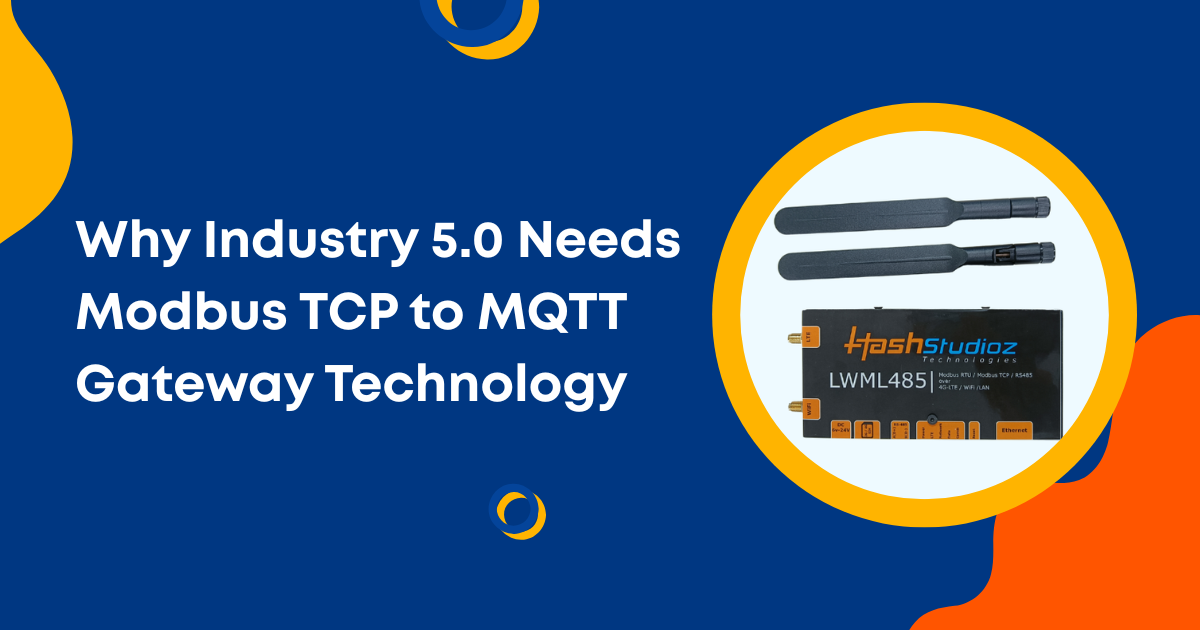
Most existing machinery relies on classic industrial protocols like Modbus TCP. However, cloud applications and collaborative tools require lightweight, web-friendly protocols like MQTT. A Modbus TCP MQTT Gateway serves as the vital link that bridges this communication gap.
Understanding the Protocol Divide
To understand why this gateway technology is necessary, engineers must look at how these two protocols function. They serve completely different environments and use conflicting architecture styles.
1. The Nature of Modbus TCP
Modbus TCP is a standard on the factory floor. It encapsulates Modbus RTU frameworks inside standard TCP/IP packets. It uses a master-slave architecture where a master device constantly polls slave devices for data.
- Data Structure: It reads and writes raw binary data directly into memory registers. These include coils, discrete inputs, input registers, and holding registers.
- Network Behavior: It requires continuous polling. This creates consistent but heavy local network traffic.
- Security: It lacks native encryption, certificate verification, or user authentication methods.
2. The Nature of MQTT
Message Queuing Telemetry Transport (MQTT) is a lightweight messaging protocol designed for the Internet of Things (IoT). It operates on a publish-subscribe model rather than a direct polling model.
- Data Structure: It transmits data as flexible payloads organized by hierarchical text topics. Engineers typically use JSON formatting for these payloads.
- Network Behavior: Devices only publish data when a change occurs. This event-driven method minimizes bandwidth consumption.
- Security: It supports modern security standards like Transport Layer Security (TLS) and robust user authentication.
The Core Technical Arguments for Gateway Integration
Industry 5.0 cannot function if data remains trapped in local register blocks. Engineers require an MQTT IoT Gateway to transform legacy data streams into meaningful, accessible information.
1. Eliminating the Bandwidth Overhead of Continuous Polling
Traditional Modbus TCP setups require a central controller to poll every device at fixed intervals. If a factory has 500 sensors, the controller queries all 500 devices multiple times per second. This happens even if the sensor values do not change at all.
An industrial gateway changes this dynamic completely. The gateway polls the Modbus TCP devices locally over the high-speed factory LAN. It then converts this data and uses MQTT to publish updates to the cloud only when a parameter changes. This approach reduces cellular or external network bandwidth consumption by up to 80% or 90%.
2. Contextualizing Raw Register Data
Modbus TCP data is highly abstract. A temperature sensor might send its reading as an integer like 3642 in holding register 40002. A human operator or an AI analytics platform cannot use this number without an external translation map.
A modern gateway performs data normalization at the network edge. It reads register 40002, applies a scaling factor of 0.1, adds the Celsius unit, and maps it to a readable MQTT topic structure. This clear format allows workers and software applications to understand the data instantly.
3. Securing Legacy Industrial Assets
Security is a primary pillar of Industry 5.0. Legacy Modbus TCP devices have no built-in defense against cyber threats. Anyone with network access can send a Modbus command to change register values, which could damage machinery.
A specialized gateway acts as a protective firewall. It isolates the vulnerable Modbus TCP network on a local port. It then communicates with the external corporate network or cloud broker using secure MQTT. The gateway utilizes TLS encryption, certificates, and access tokens to block unauthorized external commands from reaching the factory floor.
Real-World Industry 5.0 Use Cases
The practical deployment of a Modbus TCP to MQTT IoT Gateway solves real operational problems. Here are detailed examples across different sectors.
1. Automotive Assembly Lines
Automotive plants use CNC machines and robotic arms that store wear data in internal Modbus registers. The gateway translates these register bits into MQTT event messages. AI tools analyze these messages to predict tool failures before they happen, allowing humans to intervene safely.
2. Renewable Energy Microgrids
Solar inverters and battery storage systems use Modbus to track performance metrics. Remote assets publish these metrics to a central MQTT broker via cellular links. Human operators use this real-time data to manage regional energy distribution efficiently.
3. Pharmaceutical Cleanrooms
Environmental sensors monitor cleanroom humidity and temperature through PLC registers. Gateways sign data payloads with secure tokens and send them to cloud ledgers. The facility maintains tamper-proof records for regulatory compliance without altering the legacy PLCs.
Statistical Proof of the IoT Gateway Trend
The necessity of this technology is visible in current market numbers. Industrial manufacturing represents the largest single user base for gateway hardware.
- Market Scale: The broader IoT gateway market reached a value of $2.49 billion in 2026. Experts project it to reach $4.51 billion by 2031, growing at a 12.61% compound annual growth rate.
- Segment Dominance: Industrial manufacturing accounted for 29.84% of the total IoT gateway market share at the start of 2026.
- Device Lifespans: Industrial surveys show that over 75 million Modbus-enabled devices remain active worldwide. Factory owners prefer adding a gateway to these systems rather than spending millions on total machine replacement.
Technical Specifications and Hardware Selection
Selecting the right industrial hardware requires careful technical evaluation. Engineers should look for specific parameters to ensure long-term compatibility.
1. Hardware Ruggedness
Industrial environments present harsh conditions. A standard commercial gateway will fail under these circumstances. Engineers should look for devices that offer DIN-rail mounting capabilities for standard electrical cabinets. They need an extended operational temperature range, typically from -40°C to +75°C. High electromagnetic compatibility (EMC) protection is also necessary to resist electrical noise from heavy motors.
2. Software Capabilities
The internal software stack must be flexible. The gateway must manage simultaneous connections efficiently.
- Multi-Broker Support: The device should be able to publish data to multiple MQTT brokers at the same time. This allows it to send operational data to a local human-machine interface while sending maintenance logs to a cloud platform.
- Store-and-Forward Logic: Network connections can fail. The gateway must include internal storage memory. If the MQTT broker connection drops, the gateway saves the time-stamped data locally. It then publishes the cached data once the connection returns.
- Edge Computing Scripting: The gateway should support basic data processing scripts. This allows it to calculate averages, filter out signal noise, or trigger local alarms before sending data across the network.
Data Mapping Mechanics
The actual transformation of data inside the gateway involves several specific steps. The gateway configuration software creates a bridge between register memory addresses and MQTT text strings.
1. The Mapping Table
An engineer configures a mapping table inside the gateway interface. This table contains the IP address of the Modbus TCP slave, the specific register type, the register address, the polling frequency, and the target MQTT topic.
2. Payload Formatting
The gateway packs the retrieved data into a chosen format. JSON is the most common format because it is readable by humans and easily parsed by software. A single JSON payload can contain the timestamp, the device ID, the register value, and diagnostic status flags. This bundles all relevant context together.
Enhancing Human-Machine Collaboration
Industry 5.0 puts the human worker back at the center of production. This shift requires systems that communicate in ways humans can easily interpret.
1. Real-Time Alerts
Because MQTT supports instant messaging, gateways can send critical alerts directly to supervisors. If a Modbus register indicates an over-temperature condition, the gateway immediately publishes a high-priority MQTT message. This message can trigger mobile notifications or smart wearable alerts for floor managers.
2. Simplified Dashboards
Modern web dashboards read MQTT data natively. Operators do not need specialized industrial software to view machine health. They can open a web browser on a tablet to see real-time performance metrics, which improves decision-making on the factory floor.
Environmental and Sustainability Benefits
Sustainability is a core objective of the Industry 5.0 philosophy. Gateway technology contributes directly to green manufacturing goals.
1. Energy Monitoring
Many legacy factories have older power meters that communicate via Modbus TCP. A gateway brings this energy data into corporate sustainability software via MQTT. Energy managers can pinpoint which machines consume excessive power during idle times.
2. Reducing Waste
By connecting old machinery to modern analytics, plants reduce production errors. Accurate real-time data adjustments prevent material waste, lowering the environmental footprint of the manufacturing facility.
Architectural Flexibility and Scalability
Modern factories must adapt to changing market demands quickly. Rigid communication networks hinder this agility.
1. Decoupling Systems
A publish-subscribe architecture decouples data providers from data consumers. The Modbus TCP devices do not know who is reading their data. The gateway simply publishes information to the broker. If the factory adds a new analytics tool, the tool just subscribes to the existing broker topics. This requires no reconfiguration of the factory floor hardware.
2. Hybrid Cloud Deployments
Gateways allow factories to use hybrid cloud strategies. They can send sensitive production data to an on-premise MQTT broker. Simultaneously, they can send non-sensitive maintenance statistics to a public cloud service. This flexibility protects intellectual property while utilizing advanced cloud computing tools.
Conclusion
Industry 5.0 changes the relationship between industrial workers and machines. It shifts the focus from simple mass production to highly customizable, sustainable, and resilient manufacturing. This transformation depends entirely on clean, accessible data.
Relying on old, isolated communication methods slows down this evolution. A Modbus TCP to MQTT IoT Gateway removes these communication barriers. It allows older, reliable machines to interact seamlessly with modern cloud platforms. By deploying this gateway technology, industrial operators can maintain their existing machinery investments while adopting modern digital tools.