What is SAP RAP and Why It Matters in 2026
The ABAP RESTful Application Programming Model (RAP) has become the standard development framework for building cloud-ready and upgrade-safe applications in SAP environments. In 2026, RAP continues to play a critical role in both SAP S/4 HANA Cloud and on-premise implementations by enabling developers to create modern business applications using a clean-core approach. RAP combines data modeling, business logic, service exposure, and user interface generation into a unified framework, significantly reducing development effort while improving maintainability.
Key Components of a RAP Business Object
To build a complete RAP application, developers must understand the core building blocks:
- Database Tables – Store business data.
- CDS Views – Define the data model and business semantics.
- Behavior Definitions (BDEF) – Specify operations such as Create, Update, Delete, and custom actions.
- Behavior Implementations – Contain business logic.
- Service Definitions – Expose business objects as OData services.
- Service Bindings – Connect services to SAP Fiori applications.
These components work together to create a scalable and enterprise-ready application.
Step-by-Step Guide to Build a RAP Business Object
1. Create the Database Table
Begin by creating a custom database table that will store your business data. Define primary keys, data elements, and relationships carefully to ensure future scalability.
2. Build CDS Interface Views
Create Core Data Services (CDS) interface views on top of the database table. These views act as the foundation of the RAP business object and provide semantic meaning to the underlying data.
3. Create Projection Views
Projection views expose only the fields and operations required by consumers. They serve as a secure and simplified layer for applications and APIs.
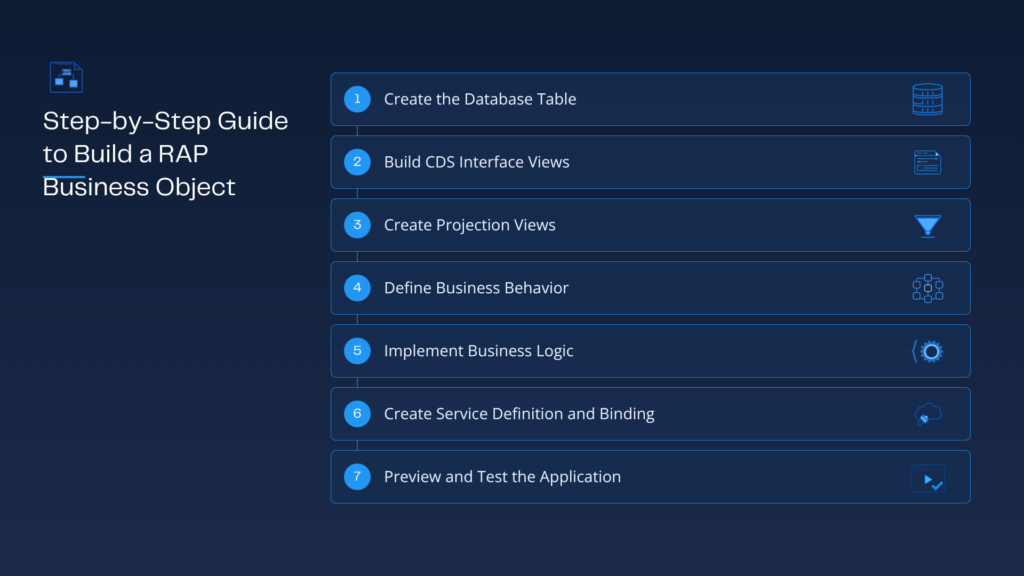
4. Define Business Behavior
Create a Behavior Definition (BDEF) to specify supported operations such as Create, Read, Update, Delete (CRUD), validations, determinations, and actions.
5. Implement Business Logic
Generate the behavior implementation class and write the required ABAP logic. This is where validations, calculations, and business rules are executed.
6. Create Service Definition and Binding
Expose the business object through a Service Definition and create a Service Binding. This automatically generates an OData service that can be consumed by SAP Fiori applications.
7. Preview and Test the Application
Use the Fiori Elements preview to test the generated application. Verify CRUD operations, validations, and user interactions before deployment.
Benefits of RAP Development in 2026
Organizations adopting RAP gain several advantages:
- Faster application development.
- Cloud-ready architecture.
- Clean-core compliance.
- Reduced upgrade risks.
- Standardized development practices.
- Seamless SAP Fiori integration.
- Improved scalability and maintainability.
These benefits make RAP the preferred development model for SAP projects focused on long-term sustainability.
Best Practices for RAP Projects
- Follow SAP clean-core principles.
- Keep custom logic inside behavior implementations.
- Use CDS annotations effectively.
- Design reusable business objects.
- Implement proper authorization controls.
- Perform extensive testing before deployment.
- Document actions, validations, and determinations clearly.
Common Challenges
Developers new to RAP often face challenges related to behavior definitions, CDS associations, authorization handling, and draft management. These issues can be minimized through proper architecture planning, adherence to SAP development standards, and continuous learning of RAP design patterns.
Conclusion
ABAP RAP has established itself as the future of SAP application development in 2026. By combining data modeling, business logic, service exposure, and Fiori UI generation within a single framework, RAP enables developers to build robust, cloud-ready business applications efficiently. Organizations investing in RAP today position themselves for smoother upgrades, better maintainability, and faster innovation across their SAP landscapes.