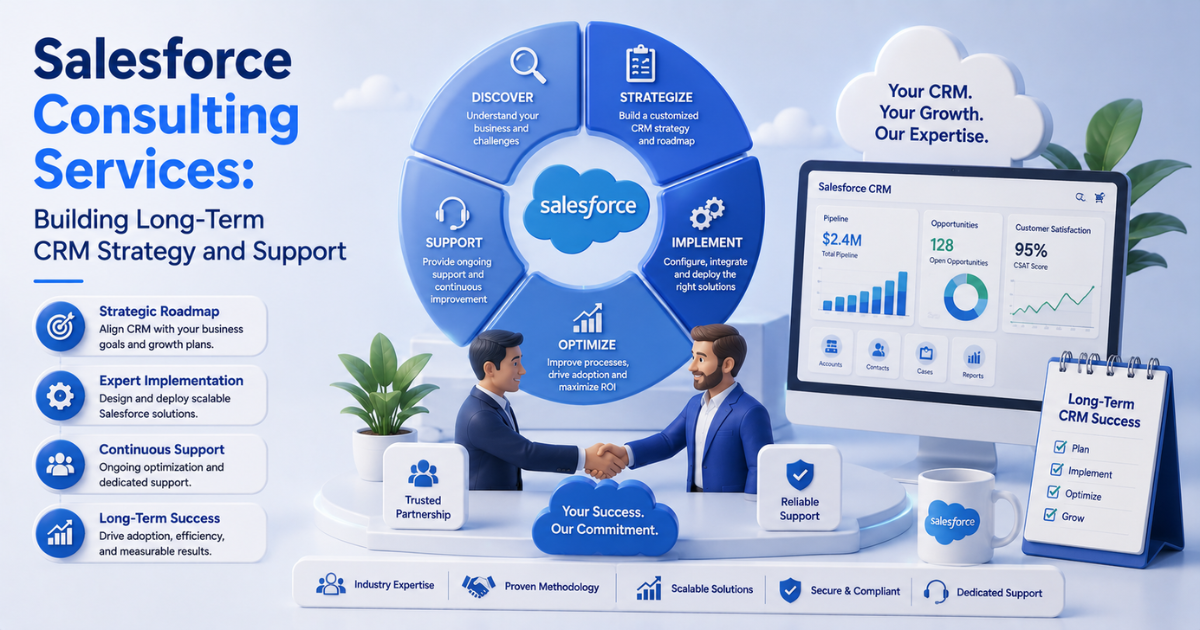
Most companies treat Salesforce as a one-time project. They configure it, train staff, and move on. That approach often fails. Salesforce Consulting brings a different model. It treats CRM as an evolving system, not a fixed product. This article looks at how Salesforce Consulting Services help businesses build strategy and support that lasts beyond the first launch.
Why CRM Projects Need Long-Term Thinking
Salesforce holds about 20.7% of the global CRM market, ahead of every competitor combined. Yet adoption alone does not guarantee success. Research shows 55% of CRM implementations fail to meet their planned objectives. The main cause is not the software. It is poor user adoption and weak long-term planning.
This gap explains why Salesforce Consulting Services exist as a distinct discipline. A consultant does more than install software. They build a roadmap that grows with the business.
The Cost of Skipping Strategy
Companies that skip strategic planning often run into the same problems:
- Features get configured but never used
- Departments build conflicting workflows in the same org
- Data quality drops as teams enter information inconsistently
- Licensing costs rise without matching value
A CRM without a clear strategy becomes expensive shelfware. Salesforce Consulting exists to prevent that outcome.
What Salesforce Consulting Actually Covers
Salesforce Consulting spans far more than installation. A full engagement typically includes:
- Discovery and requirements gathering: Understanding current workflows before touching configuration
- Solution architecture: Designing how Sales Cloud, Service Cloud, and other modules connect
- Data migration: Moving records from legacy systems without losing accuracy
- Customization and development: Building Apex code, Lightning components, or Flow automation
- Integration: Connecting Salesforce to ERP systems, marketing tools, and external databases
- Training and adoption support: Helping staff actually use what gets built
- Ongoing managed services: Monitoring, updates, and continuous improvement after launch
Implementation services account for the largest share of this market, representing about 41.7% of total demand. But the long-term value comes from what happens after implementation, not just the initial build.
Building a CRM Strategy That Lasts
A strong Salesforce strategy treats the CRM as a living system. Consultants typically follow a structured process to make that happen.
Step 1: Map Business Goals to Platform Capabilities
Every Salesforce Consulting engagement should start with business outcomes, not features. A consultant asks what the company wants to achieve: faster lead response, better forecast accuracy, or lower support resolution time. Then they map those goals to specific Salesforce capabilities.
This step matters because nearly 52% of businesses cite high implementation complexity as a barrier. Starting with clear goals reduces that complexity by narrowing the scope to what actually matters.
Step 2: Design for Multi-Cloud Growth
Many companies start with a single Salesforce cloud and expand later. Over 60% of Salesforce implementations now involve multi-cloud setups, combining Sales Cloud, Service Cloud, and Marketing Cloud together. A good consulting partner designs the initial architecture so it can absorb this growth without a costly rebuild.
Key design principles include:
- Using consistent object and field naming across clouds
- Avoiding hardcoded logic that breaks when new modules get added
- Building permission sets that scale across departments
- Documenting architecture decisions so future teams understand the system
A common scenario illustrates why this matters. A company starts with Sales Cloud only. Two years later, they add Service Cloud to manage support tickets. If the original setup used inconsistent field names or hardcoded automation tied to sales-only logic, the Service Cloud rollout becomes a partial rebuild instead of a clean expansion. Planning ahead avoids this rework entirely.
Step 3: Plan for Data Governance Early
Data quality issues compound over time. A field left blank in year one becomes thousands of blank fields by year three. Salesforce Consulting Services should include governance rules from day one:
- Required fields for critical data points
- Validation rules to catch entry errors
- Duplicate management to prevent record sprawl
- Clear ownership for who maintains each data set
Skipping this step is a common reason CRM systems lose trust internally. If sales reps do not trust the data, they stop using the system, which feeds directly into that 55% failure statistic mentioned earlier.
Step 4: Build Automation That Matches Real Workflows
Automation only helps when it mirrors how teams actually work. Consultants build Flows, Apex triggers, and approval processes based on real business logic, not generic templates. CRM automation has been shown to reduce sales cycles by 8 to 14%, but only when the automation reflects accurate process mapping.
Step 5: Set Up Measurement From the Start
A long-term strategy needs metrics built in before launch, not added later. Useful metrics include:
- Adoption rate by user and department
- Data completeness percentage
- Average case resolution time
- Lead-to-opportunity conversion rate
- License utilization versus cost
Without these baselines, it becomes hard to prove ROI or catch problems early.
The Role of Ongoing Support After Launch
Salesforce releases three platform updates every year. Each release can affect existing customizations, deprecate old features, or introduce new ones worth adopting. A consulting partner who disappears after go-live leaves clients exposed to this constant change.
What Good Long-Term Support Looks Like
Strong post-launch support from a Salesforce Consulting partner typically includes:
- Release readiness reviews: Checking how each seasonal update affects the existing org
- Performance monitoring: Watching for slow page loads, failed integrations, or automation errors
- User adoption check-ins: Identifying which teams are not using the system fully
- Incremental enhancement: Adding features gradually instead of large, risky overhauls
- Security and compliance audits: Reviewing permission sets and data access regularly
This shift from one-time projects to continuous improvement reflects where the market is heading. Salesforce services are moving from short-term implementation work into long-term operating models, where companies need partners who manage CRM, data, and automation together on an ongoing basis.
Technical Skills Needed for Long-Term Support
Sustaining a Salesforce org over multiple years requires a specific technical skill set. Consultants providing long-term support typically need:
- Apex development knowledge: To maintain and update custom code without breaking existing logic
- Declarative tool fluency: Flow Builder and Process Builder skills to handle most automation without heavy code
- API and integration expertise: REST and SOAP API knowledge for connecting external systems safely
- Data modeling experience: Understanding object relationships well enough to add fields or objects without creating data integrity issues
- Release management discipline: A clear process for testing each seasonal Salesforce update in a sandbox before pushing it to production
Teams without this technical depth often patch problems instead of solving them. A quick fix today can turn into a larger maintenance burden within a year.
Industry-Specific Considerations
Different industries need different approaches to Salesforce strategy. A generic template rarely works well across sectors.
1. Financial Services
Banks and insurers face strict compliance requirements. BFSI represents close to 29% of vertical adoption in the Salesforce services market, the largest share of any industry. Consultants in this space need to understand regulatory reporting, audit trails, and client data protection rules specific to financial institutions.
2. Healthcare
Patient data rules add complexity that general CRM consultants may not handle well. Industry-specific Salesforce clouds now come with built-in compliance features for sectors like healthcare, reducing the custom work needed to meet regulatory standards.
3. Manufacturing and Retail
These industries often need deep integration between Salesforce and inventory, supply chain, or ERP systems. The consulting work here leans heavily on integration architecture rather than front-end customization.
Choosing the Right Salesforce Consulting Partner
Not every consulting firm offers the same depth of service. Choosing the wrong partner can cost more than the original project budget once rework gets factored in.
1. Questions Worth Asking Before Signing a Contract
- Does the partner have Salesforce-certified consultants on staff, not just sales reps?
- Can they show examples of long-term support, not just initial builds?
- Do they have experience in your specific industry?
- What is their process for handling failed or stalled projects?
- How do they measure success after go-live?
2. Red Flags to Watch For
- A partner who pushes heavy customization without asking about future scalability
- No clear plan for data migration testing before go-live
- Vague answers about post-launch support pricing
- Reluctance to share past client references
Over 7,500 registered Salesforce consulting partners operate globally today, which gives companies real choice. Taking time to vet a partner properly pays off over the life of the relationship.
Common Mistakes in Salesforce Strategy
Even experienced teams make avoidable mistakes when building CRM strategy. The following issues come up often:
- Over-customization: Adding complex logic for edge cases that affect very few users
- Ignoring user feedback: Building features the way leadership imagines workflows, not how reps actually work
- Treating training as a one-time event: New hires need ongoing onboarding, not a single session at launch
- Underestimating integration complexity: Legacy systems rarely connect as easily as expected; 47% of organizations report integration challenges with older systems
- Skipping documentation: When the original consultant leaves, undocumented decisions become a maintenance nightmare
Where Salesforce Consulting Is Heading
AI is reshaping what consulting engagements look like. Around 66% of companies are now adopting AI-powered CRM tools, and a majority of new consulting projects include automation features as a core requirement, not an add-on. Adoption of Einstein and similar AI tools inside Salesforce orgs has grown sharply year over year.
This shift means consultants now need skills beyond traditional configuration. They need to understand prompt design, data grounding, and AI governance alongside standard CRM architecture. Companies hiring Salesforce Consulting Services today should ask whether a partner has real experience with these newer capabilities, not just legacy Sales Cloud setup.
Conclusion
Salesforce Consulting works best as a long-term relationship, not a single transaction. The platform changes three times a year. Business needs shift as companies grow. A consulting partner who treats CRM strategy as ongoing work, not a finished project, gives companies a real chance at lasting ROI.
Companies that invest in proper Salesforce Consulting Services from the start avoid the common failure patterns that derail over half of CRM projects. They build systems that adapt instead of breaking under change. That difference separates a CRM investment that pays off for years from one that quietly turns into wasted spend.