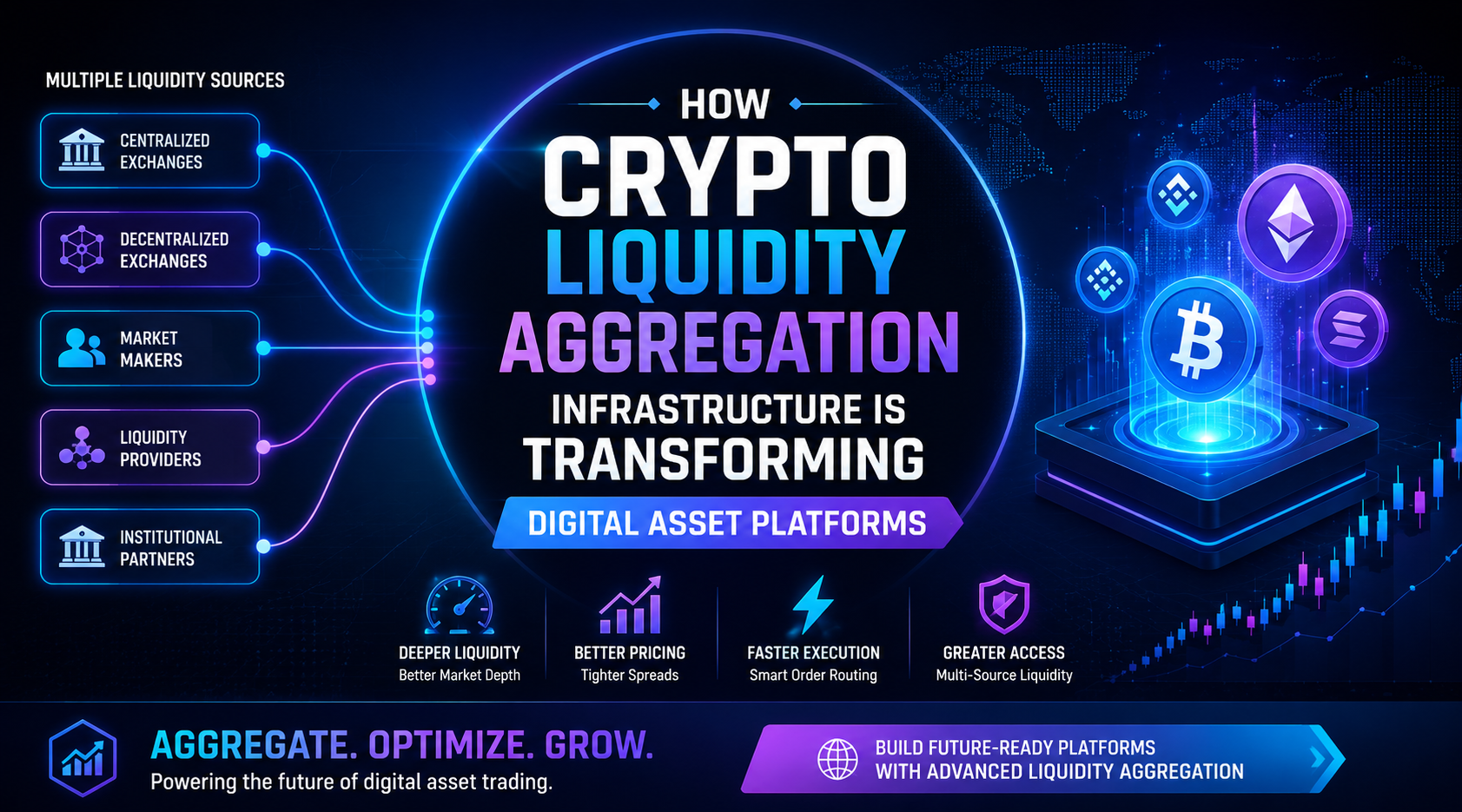
The cryptocurrency industry is moving toward a more connected, efficient, and intelligent financial ecosystem where liquidity plays a defining role in platform success. As digital asset adoption continues to grow, businesses are no longer focusing only on creating trading platforms. They are building advanced ecosystems that can deliver faster execution, accurate pricing, seamless transactions, and better user experiences. The foundation behind these improvements is crypto liquidity aggregation infrastructure, a technology solution that connects multiple liquidity sources into one unified trading environment.
In a market where thousands of digital assets are traded across different platforms, fragmented liquidity remains one of the biggest challenges. Traders often face inconsistent prices, limited order availability, and high slippage when executing transactions. Liquidity aggregation technology solves these challenges by combining liquidity from various exchanges, market makers, financial institutions, and decentralized networks. Businesses investing in cryptocurrency exchange development services are increasingly integrating liquidity aggregation solutions to create high performance trading platforms capable of handling modern market demands.
Understanding Crypto Liquidity Aggregation Infrastructure
Crypto liquidity aggregation infrastructure is a technology framework designed to collect, analyze, and distribute liquidity from multiple sources through a single platform. Instead of relying on a single exchange or liquidity provider, digital asset platforms can access a broader pool of trading opportunities.
Liquidity aggregation works by connecting multiple market sources to create a combined liquidity environment. This allows traders to access better prices, deeper markets, and faster order execution. The system continuously monitors available liquidity and automatically identifies the most suitable source for completing transactions.
For digital asset platforms, this infrastructure creates a competitive advantage because liquidity directly impacts user trust and platform performance. A trading platform with strong liquidity can provide smoother transactions, lower spreads, and improved market stability.
Why Liquidity Is Important for Digital Asset Platforms
Liquidity is one of the most important elements of any financial market. It determines how easily users can buy or sell assets without causing significant price changes. In cryptocurrency markets, liquidity affects everything from trading volume to user retention.
A platform with poor liquidity often experiences problems such as delayed transactions, large price differences, and unsuccessful order execution. These issues can negatively impact user confidence and reduce trading activity.
Crypto liquidity aggregation infrastructure helps overcome these limitations by creating access to multiple liquidity networks. Instead of building liquidity independently, platforms can connect with established sources and provide users with a more efficient trading experience.
As competition in the digital asset industry increases, liquidity has become a major factor separating successful platforms from ordinary solutions. Businesses that prioritize liquidity management are better positioned to attract professional traders, retail investors, and institutional users.
Connect Global Liquidity Networks With Expert Development Support→
How Crypto Liquidity Aggregation Works
The process of liquidity aggregation involves several advanced technologies working together to optimize trading operations. The infrastructure collects real time market information from multiple sources, including centralized exchanges, decentralized exchanges, liquidity pools, and financial networks.
When a user places a trading order, the aggregation engine analyzes available options across connected liquidity providers. It evaluates factors such as asset price, trading volume, execution speed, and market conditions before selecting the most efficient route.
This process is commonly supported by smart order routing technology. Smart order routing divides large transactions into smaller parts and executes them across multiple liquidity sources. This reduces market impact and helps users achieve better trading outcomes.
Real time data synchronization is another important component of liquidity aggregation. Since cryptocurrency prices change constantly, platforms need updated market information to provide accurate pricing. Aggregation systems ensure that users receive the latest market conditions without delays.
Transforming Cryptocurrency Exchanges Through Better Liquidity
Cryptocurrency exchanges depend heavily on liquidity because traders expect fast and reliable transactions. A platform may have advanced features and attractive design, but without sufficient liquidity, it cannot provide a competitive trading experience.
Liquidity aggregation transforms cryptocurrency exchanges by increasing market depth and improving order execution. Users gain access to multiple trading opportunities without switching between different platforms.
This technology also helps new exchanges compete with established players. Instead of spending years building independent liquidity networks, emerging platforms can integrate aggregation solutions and provide professional level trading experiences from the beginning.
Another advantage is asset expansion. Exchanges can support more cryptocurrency pairs because they are connected to multiple liquidity sources. This creates more opportunities for users and improves overall platform engagement.
Role of Liquidity Aggregation in Decentralized Finance
Decentralized finance has introduced new possibilities for blockchain based financial services. However, decentralized platforms often face liquidity challenges because liquidity is distributed across different protocols and networks.
Liquidity aggregation helps solve this issue by connecting decentralized liquidity pools and creating a more accessible trading environment. It allows users to benefit from decentralized technology while accessing improved market efficiency.
Decentralized exchanges, Web3 applications, and blockchain financial platforms are increasingly adopting liquidity aggregation models to enhance scalability and usability. This approach supports a more connected digital economy where assets can move efficiently across different ecosystems.
Improving Market Efficiency With Advanced Aggregation Technology
Market efficiency depends on how quickly and accurately transactions can be completed. Crypto liquidity aggregation improves efficiency by reducing gaps between buyers and sellers.
When multiple liquidity sources are connected, platforms can automatically identify the best available prices. This reduces unnecessary delays and improves transaction accuracy.
Advanced aggregation solutions also support automated risk management. By distributing trading activity across multiple sources, platforms can reduce dependency on a single liquidity provider and maintain greater operational stability.
For businesses building next generation digital asset platforms, liquidity aggregation is becoming an essential technology layer that supports growth and long term sustainability.
Liquidity Aggregation and Token Ecosystem Growth
The growth of blockchain based assets has created demand for better liquidity management solutions. Launching a digital asset requires more than creating a token. A successful token ecosystem requires active markets, accessible trading, and continuous liquidity support.
Companies offering token development services focus on creating secure, scalable digital assets that operate within blockchain ecosystems. However, maintaining liquidity after launch is equally important, as it affects market participation and asset usability.
Liquidity aggregation allows token projects to connect with broader trading networks. This improves accessibility and helps newly launched assets achieve better market exposure. By combining effective token strategies with liquidity solutions, blockchain projects can create stronger digital economies.
Benefits of Implementing Crypto Liquidity Aggregation Infrastructure
Crypto liquidity aggregation provides several advantages for digital asset businesses. One major benefit is improved user experience. Traders receive better pricing, faster execution, and access to deeper markets.
Another advantage is reduced trading costs. By comparing multiple liquidity sources, aggregation systems help platforms identify more competitive pricing options.
Scalability is also improved because platforms can manage increasing transaction volumes without depending on a single market source. This makes liquidity aggregation suitable for growing exchanges and blockchain applications.
Additionally, liquidity diversification creates a more stable ecosystem. Platforms are less affected by issues within one liquidity source because they have access to multiple alternatives.
The Impact of Artificial Intelligence on Liquidity Aggregation
Artificial intelligence is creating new opportunities for improving liquidity management. AI powered systems can analyze market patterns, predict liquidity changes, and optimize trading decisions.
Machine learning algorithms can identify market trends and improve order routing strategies. This helps platforms respond faster to changing market conditions.
AI integration is expected to make liquidity aggregation more intelligent by improving automation, reducing risks, and enhancing decision making processes.
Future Trends of Crypto Liquidity Aggregation Infrastructure
The future of digital asset platforms will depend heavily on advanced liquidity solutions. As blockchain adoption expands, users will demand faster transactions, better pricing, and seamless access to global markets.
Cross chain liquidity aggregation is expected to become more important as multiple blockchain networks continue to grow. Platforms will need solutions that allow assets to move efficiently between different ecosystems.
Institutional participation will also increase demand for professional liquidity infrastructure. Large investors require reliable markets with strong execution capabilities before entering digital asset markets.
The combination of blockchain innovation, artificial intelligence, and liquidity technology will continue transforming how digital asset platforms operate.
Building Future Ready Digital Asset Platforms With Liquidity Solutions
Businesses entering the cryptocurrency market need infrastructure that supports growth, security, and efficiency. Liquidity aggregation provides the foundation required to create competitive platforms that meet modern trading expectations.
Whether developing centralized exchanges, decentralized applications, or blockchain financial solutions, liquidity management should be considered a core component of platform architecture.
Companies focusing on p2p crypto exchange software development are also integrating advanced liquidity features to improve transaction efficiency and create better peer to peer trading experiences. By connecting multiple liquidity channels, these platforms can offer users improved pricing, faster settlements, and a more reliable trading environment.
Conclusion
Crypto liquidity aggregation infrastructure is transforming digital asset platforms by creating more efficient, connected, and scalable trading ecosystems. It addresses major challenges related to fragmented markets, limited liquidity, and inefficient transaction execution.
As the cryptocurrency industry continues to mature, liquidity will remain one of the most important factors influencing platform success. Businesses that adopt advanced aggregation solutions can deliver better trading experiences, improve market accessibility, and build stronger digital asset ecosystems.
The future of cryptocurrency platforms will not only depend on innovation in blockchain technology but also on how effectively they manage liquidity. Crypto liquidity aggregation infrastructure is becoming a critical component for creating high performance platforms that can support the next generation of digital finance.