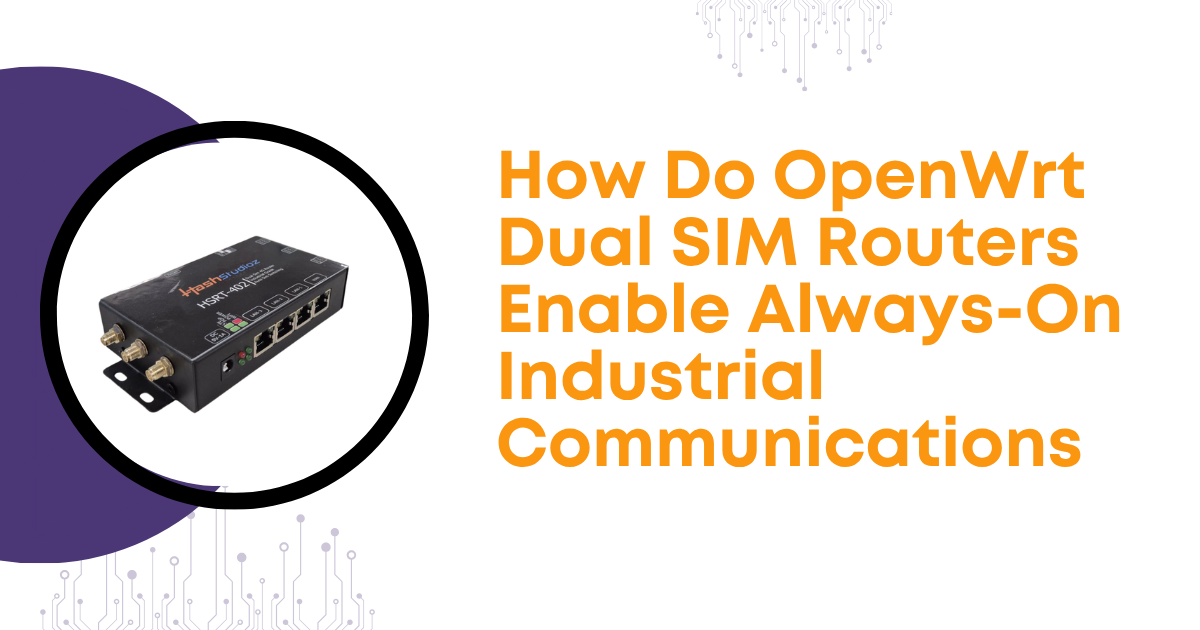
Modern industries depend on uninterrupted data flow. Automated factories, smart utility grids, and remote oil wells require continuous communication. A single network failure can cause severe financial losses. In fact, standard cellular hardware often drops connections during carrier outages or tower overloads. Industrial operators use specialized hardware to prevent these communication gaps. An OpenWrt Dual SIM Router solves the problem of network vulnerability. This device combines open-source software control with redundant hardware paths. It maintains active connections across harsh environments. This article explores how these routers function. It examines how they manage cellular links and protect data via a WireGuard VPN Router configuration.
The Need for Always-On Industrial Networks
Industrial Internet of Things applications operate around the clock. Automated systems send continuous data to control rooms. According to industrial research studies, network downtime costs large manufacturing facilities an average of 10,000 dollars per hour. Some critical infrastructure failures cost even more.
Traditional consumer routers fail in industrial environments. They lack rugged casings and cannot handle extreme temperatures. More importantly, they connect to only one cellular network at a time. If that network fails, the connected machinery loses its link to the outside world.
Industrial cellular networks face three major challenges:
- Signal Degradation: Weather or physical obstacles can weaken cellular signals suddenly.
- Carrier Outages: Core network failures can take a telecom provider offline for hours.
- Tower Congestion: High local traffic can slow down data transmission.
An OpenWrt Dual SIM Industrial Router must bypass these issues automatically. It cannot wait for a human technician to swap a SIM card or reboot the operating system.
Why OpenWrt is the Standard for Industrial Routing
OpenWrt is a Linux-based open-source operating system designed for embedded devices. Unlike restrictive proprietary firmware, OpenWrt provides complete access to the network stack. This code visibility allows engineers to build highly customized routing behaviors.
1. Total Control Over Network Routing
Proprietary routers limit how users configure failover logic. OpenWrt gives users direct access to advanced tools like Multi-WAN Policy Routing (MWAN3). Engineers can write exact rules for how the router treats network interfaces. They can set specific traffic thresholds and ping intervals. The router uses these parameters to verify if a connection is truly healthy.
2. Long-Term Security and Flexibility
Many manufacturers stop updating router firmware after a few years. This practice leaves older hardware vulnerable to cyberattacks. OpenWrt relies on a global community of developers who release regular security patches. The operating system also uses a package management system known as OPKG. Users can install specific tools without updating the entire system. For example, an engineer can install an MQTT broker or a lightweight Python script directly onto the router.
How Dual SIM Systems Achieve Zero Downtime
A dual SIM router contains two physical SIM slots. The slots hold cards from different telecommunication providers. The router treats each SIM card as a distinct WAN interface.
1. Active Failover Mechanics
Most industrial dual SIM routers use a single-standby architecture. One SIM acts as the primary link, while the second SIM remains in standby mode. OpenWrt continually checks the health of the primary link. It sends small packets of data, called heartbeats, to a reliable internet target. If the primary network drops packets or stops responding, OpenWrt triggers a failover script. The router cuts power to the first SIM interface and activates the second one. This cellular switch happens in less than five seconds.
2. Smart Load Balancing
Some advanced configurations use two separate cellular modems inside one router. This setup allows both SIM cards to stay active simultaneously. OpenWrt can balance network traffic between both carriers. For instance, the router can send low-priority telemetry data over a cheaper cellular link. It can reserve the faster, more stable link for critical control commands. If either provider suffers an outage, 100 percent of the traffic shifts to the surviving network instantly.
Securing Data with a WireGuard VPN Router Configuration
Always-on connectivity is only half of the solution. Industrial data must remain secure as it travels over public cellular infrastructure. Cyberattacks on industrial networks increased significantly over the last few years. Unencrypted traffic allows attackers to intercept sensitive data or inject malicious commands into programmable logic controllers (PLCs). An OpenWrt Dual SIM Industrial Router solves this by acting as a WireGuard VPN Router. WireGuard is a modern cryptographic protocol that runs directly inside the Linux kernel.
1. The Advantage of WireGuard Over Older Protocols
Legacy virtual private networks, like OpenVPN or IPsec, use heavy codebases. OpenVPN contains over 100,000 lines of code. This complexity slows down data speeds and consumes significant processor energy. WireGuard uses fewer than 4,000 lines of code. It is fast, lightweight, and highly efficient. It delivers much higher data throughput on low-power industrial processors.
| Performance Metric | Legacy OpenVPN | WireGuard VPN |
| Code Base Size | 100,000+ Lines | ~4,000 Lines |
| Connection Speed | Slow Handshake | Instant Handshake |
| CPU Consumption | High | Very Low |
| Roaming Stability | Frequently Drops | Maintains Tunnel |
2. Instant Re-Connection During Cellular Switches
When a standard VPN router switches from SIM 1 to SIM 2, the VPN tunnel breaks. The router must complete a slow authentication handshake to rebuild the connection. This process can freeze data transmission for 30 seconds or more.
WireGuard handles network changes differently. It uses a stateful connection model based on public keys. It does not care if the router’s public IP address changes during a cellular failover. As soon as the backup SIM establishes an internet link, WireGuard sends a data packet. The remote VPN server recognizes the cryptographic key and accepts the data immediately. The VPN tunnel does not need a formal reconnection process. This minimizes data gaps during network switches.
Hardware Features of Industrial Routers
Software needs rugged hardware to survive in industrial environments. These routers use specific physical designs to prevent hardware failure.
1. Physical Protection
Industrial routers feature heavy-duty metal enclosures. Most carry an IP30 rating. This rating proves the case protects internal components from tools and thick wires. The internal circuit boards lack cooling fans, which can fail over time. Instead, the metal body acts as a heat sink. This fanless design allows the device to operate in dusty environments without sucking in dirt.
2. Wide Temperature and Power Tolerance
Standard office routers stop working if ambient temperatures rise above 40 degrees Celsius. Industrial units operate reliably from minus 30 to plus 70 degrees Celsius. They can sit inside uncooled metal electrical boxes during hot summers or freezing winters. These routers also use industrial terminal blocks for power delivery. They accept wide DC voltage inputs, typically from 5V to 24V or up to 36V. This wide tolerance protects the internal circuits from the voltage fluctuations common in factory power grids or mobile vehicles.
Real-World Industrial Applications
Different industries use these flexible routers to keep remote equipment connected.
1. Smart Utility Grids
Solar farms and wind turbines sit in remote, rural areas. Telecom companies rarely offer perfect coverage in these regions. A dual SIM router ensures that monitoring software receives real-time power generation data. If a storm knocks down a cell tower from one provider, the router switches carriers. It keeps sending telemetry data over the backup network. The WireGuard tunnel prevents unauthorized third parties from accessing the power grid control network.
2. Automated Teller Machines (ATMs)
Financial institutions cannot afford disconnected ATMs. Retailers also lose revenue when point-of-sale systems go offline. Banks install dual SIM routers inside ATMs to guarantee constant uptime. The router encrypts all financial transactions through a secure WireGuard tunnel. The dual cellular paths protect the machine from local network outages.
3. Manufacturing and M2M Communication
Modern factories use Machine-to-Machine (M2M) communication to coordinate assembly lines. A brief network drop can desynchronize machines and stop production entirely. An OpenWrt industrial router acts as a local gateway for factory PLCs. It provides a reliable, encrypted path to cloud management platforms. This connection allows engineers to adjust machine parameters safely from remote locations.
Market Growth and Future Outlook
The demand for reliable cellular IoT hardware continues to grow rapidly. Industry analysts found that global cellular IoT connections reached 4.7 billion devices. This number makes up about 22 percent of all active IoT endpoints worldwide. Experts predict that cellular IoT connections will surpass 5.4 billion. As organizations deploy more devices, they face rising security threats. Reports show that cyberattacks on industrial infrastructure rose by 75 percent over a two-year period. These facts explain why businesses are moving away from basic, unencrypted cellular modems. They prefer secure platforms like OpenWrt that combine automated network routing with robust, kernel-level encryption.
Conclusion
An OpenWrt Dual SIM Industrial Router provides a reliable solution for critical infrastructure. The combination of open-source software and dual cellular slots eliminates single points of network failure.
When configured as a WireGuard VPN Router, the hardware delivers excellent security without sacrificing data speeds. It protects industrial data from digital threats while physical failover mechanisms protect against carrier outages. Using these tools helps industrial operators eliminate costly downtime and maintain continuous control over remote assets.