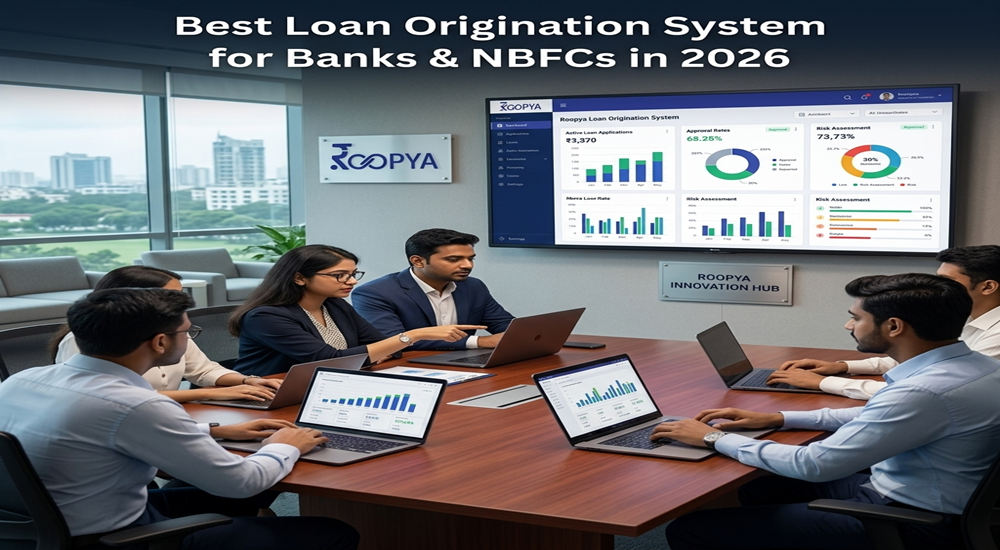
Choosing a Loan Origination System is one of the most consequential technology decisions a bank, NBFC, housing finance company, or fintech lender will make. It is the system that decides how fast you can disburse a loan, how well you manage risk, how happy your customers are, and how easily you can scale into new products and geographies. Pick the wrong one, and you will spend years fighting workarounds, manual patches, and compliance headaches. Pick the right one, and lending becomes a genuine competitive advantage.
This guide walks through everything a decision-maker — whether a CTO, Head of Lending, Chief Risk Officer, or founder of a growing NBFC — needs to evaluate before signing a contract with an LOS vendor.
What Exactly Is a Loan Origination System?
A Loan Origination System is the software backbone that manages the entire lifecycle of a loan from the moment a borrower applies to the moment funds are disbursed. It typically covers:
- Lead capture and application intake (web, mobile, branch, DSA/channel partner)
- KYC and document collection
- Credit bureau pulls and credit scoring
- Underwriting workflows and rule engines
- Approval hierarchies and sanction letter generation
- Loan agreement execution (physical or e-sign)
- Disbursement instructions to the core banking or accounting system
Many modern LOS platforms also extend into loan management (repayments, collections, NPA tracking), which is why the categories “LOS” and “LMS” (Loan Management System) are increasingly offered together, as they are on roopya.money.
Why This Decision Matters More Than It Seems
Lending institutions often underestimate how deeply an LOS shapes the business. A handful of consequences show up only after go-live:
- Turnaround time (TAT) becomes a competitive weapon. Borrowers today compare a bank’s loan approval speed to that of digital-first NBFCs and fintech lenders. An LOS that takes 15 clicks and three manual handoffs to sanction a loan will lose customers to a competitor that can pre-approve in minutes.
- Compliance is baked into workflow, not bolted on afterward. Regulatory reporting (RBI, NHB, or relevant regional regulator), fair lending practices, and audit trails must be structurally enforced by the system, not left to individual employee diligence.
- Cost of ownership compounds. A cheap LOS with poor architecture often needs constant customization, and those customization costs, plus integration maintenance, quietly become larger than the platform’s original price.
- Data quality determines your future credit models. If the LOS doesn’t capture clean, structured data at origination, your risk and analytics teams will spend years trying to reconstruct a usable dataset.
Step 1: Map Your Lending Workflow Before You Shop
Before evaluating any vendor, document your own origination journey end to end — for every loan product you offer (personal loans, MSME loans, LAP, gold loans, vehicle loans, microfinance, etc.). Capture:
- Every channel through which applications arrive (branch, DSA, web, app, co-lending partner, embedded finance partner)
- Every document and data point collected at each stage
- Every approval level and its SLA
- Every regulatory checkpoint (KYC, AML, CERSAI, credit bureau checks, RBI/NHB reporting fields)
- Every exception case your team currently handles manually
Skipping this step is the single biggest reason organizations end up unhappy with an LOS six months after implementation — they select a system based on demos rather than their own reality, then discover mid-implementation that the platform can’t handle their specific product variants or approval matrix.
Step 2: Define Your Non-Negotiable Requirements
Once your workflow is mapped, translate it into requirements across these categories.
Configurability Without Code
The best LOS platforms let business teams — not just developers — configure new loan products, change approval matrices, adjust scoring rules, and modify document checklists through a no-code or low-code interface. This matters enormously for speed: a bank that needs six weeks of vendor development time to launch a new loan variant will always lose ground to one that can configure it internally in a day.
Ask vendors directly: “If I want to launch a new secured business loan product next month with a different document checklist and approval matrix, what does that process look like — and who does it?”
Rule-Based and AI-Assisted Underwriting
A modern LOS should support:
- A configurable rules engine for eligibility and scoring (not hardcoded logic requiring vendor intervention)
- Integration with credit bureaus (CIBIL, Experian, Equifax, CRIF High Mark in India; or the relevant bureaus for your market)
- Bank statement analysis and alternate data scoring for thin-file or new-to-credit borrowers
- Fraud detection signals (device fingerprinting, document forgery detection, duplicate application flagging)
- The ability to plug in your own or third-party credit models via API, rather than being locked into the vendor’s black-box score
Integration Depth
An LOS rarely operates alone. Before choosing one, confirm it has proven, production-grade integrations (not just “technically possible via API”) with:
- Core banking systems (CBS) or core lending ledgers
- Credit bureaus and KYC/AML data providers (Aadhaar-based e-KYC, PAN validation, CKYC registry)
- Payment and disbursement rails (NACH, UPI, IMPS)
- Accounting and GL systems
- e-Sign and e-Stamp providers
- CERSAI for security interest registration (for secured lending)
- SMS/WhatsApp/email communication gateways
Ask for a reference customer who has actually built the specific integration you need, not just a claim that the API supports it.
Multi-Product and Multi-Entity Support
If you operate multiple lending entities, co-lending partnerships, or a mix of secured and unsecured products, your LOS must support multiple product configurations, multiple approval hierarchies, and multiple regulatory templates within a single platform — without needing a separate instance for each.
Scalability and Performance
Ask vendors for real performance numbers: peak concurrent applications processed, average system response time under load, and uptime SLAs (with penalties, not just promises). A system that performs well in a sales demo with five test applications can behave very differently at month-end volume spikes with thousands of live applications.
Data Security and Regulatory Compliance
Non-negotiables here include:
- Data residency compliant with your regulator’s requirements
- Role-based access control and detailed audit logs
- Encryption at rest and in transit
- Compliance with RBI’s digital lending guidelines (or equivalent regional regulation) — including outsourcing guidelines if the LOS is a third-party managed service
- ISO 27001 or SOC 2 certification of the vendor’s infrastructure
Reporting and Analytics
Your risk, finance, and compliance teams will all need dashboards and exportable reports: TAT by stage, rejection reason analysis, sourcing channel performance, portfolio-at-origination quality metrics, and regulatory MIS reports. Check whether these are built-in or require a separate BI tool and additional integration effort.
Step 3: Decide Between Build, Buy, or Hybrid
Large banks with substantial in-house engineering teams sometimes consider building a proprietary LOS. For most banks and NBFCs, though, buying a purpose-built platform is far more cost-effective and faster to market, because origination workflows, bureau integrations, and regulatory logic have already been solved by specialized vendors. A hybrid approach — buying a configurable core platform and building thin, specific integrations on top — is often the pragmatic middle ground, especially for NBFCs that want speed to market without the multi-year cost of building bureau connections, e-KYC flows, and rule engines from scratch.
Step 4: Evaluate the Vendor, Not Just the Product
A platform is only as good as the company behind it. During evaluation, examine:
- Domain expertise: Has the vendor built specifically for lending, or is this a generic workflow tool repurposed for loans? Lending-specific vendors understand nuances like co-applicant handling, guarantor workflows, and NPA classification in ways generic platforms don’t.
- Implementation track record: Ask for references from institutions similar in size and product mix to yours, and ask those references directly about go-live timelines versus what was originally promised.
- Support model: Is there a dedicated implementation team, or will you be routed through a generic ticketing queue? What are support SLAs post go-live?
- Product roadmap: Is the vendor actively investing in AI-based underwriting, alternate data scoring, and regulatory updates, or has the product visibly stagnated?
- Financial stability: A lending platform is core infrastructure. A vendor that might not exist in three years is a serious operational risk.
Step 5: Run a Structured Proof of Concept
Never select an LOS purely from a sales demo. Insist on a proof of concept (PoC) using your own real (or realistic anonymized) data and your own workflow, not the vendor’s canned demo script. During the PoC:
- Configure one real loan product end to end, including edge cases
- Test at least one live integration (bureau pull or e-KYC) rather than a mocked response
- Time how long it takes your own team (not the vendor’s implementation staff) to make a configuration change
- Stress-test the system with a realistic volume of concurrent applications
- Have your compliance and risk teams review the audit trail and reporting output, not just the sales team
Step 6: Model the Total Cost of Ownership
Sticker price is the least reliable number in an LOS decision. Build a total cost of ownership model that includes:
- License or subscription fees (per-user, per-transaction, or flat)
- Implementation and configuration fees
- Integration development costs (bureau, KYC, payment rails)
- Ongoing support and maintenance fees
- Cost of internal team time for training and change management
- Cost of any custom development the vendor quotes as “out of scope”
- Exit costs — what does it cost to migrate away if the relationship doesn’t work out?
A lower headline subscription price with expensive custom integration work often ends up costing more over three years than a slightly higher-priced platform with broader out-of-the-box coverage.
Step 7: Plan the Implementation and Change Management
Even the best LOS fails if the rollout is poorly managed. Build a realistic implementation plan with:
- A phased rollout (pilot branch or product line before full rollout)
- Clear data migration plan for existing in-pipeline applications
- Training for underwriters, credit officers, and branch staff — not just IT
- A parallel-run period where the old and new systems operate side by side before full cutover
- A clearly owned internal project sponsor, not just a vendor project manager
Common Mistakes to Avoid
- Choosing based on the longest feature checklist rather than fit for your actual products. A platform with 200 features you’ll never use is not better than one with the 30 features you need, executed well.
- Ignoring the underwriter and credit officer experience. If the day-to-day users find the interface slow or confusing, adoption suffers regardless of back-end capability.
- Underestimating integration timelines. Bureau and KYC integrations routinely take longer than vendors initially estimate; build buffer into your go-live timeline.
- Not validating regulatory reporting formats early. Discovering a gap in RBI/NHB reporting fields after go-live is far more expensive to fix than catching it during the PoC.
- Treating the LOS purchase as purely an IT decision. Credit, risk, compliance, and operations teams must be involved from requirement-gathering through PoC evaluation, not just informed after the contract is signed.
A Practical Evaluation Checklist
Before signing with any vendor, confirm you can answer “yes” to each of these:
- Can our own business team configure a new loan product without vendor development time?
- Does the platform have proven, live integrations with the specific bureaus, KYC providers, and payment rails we use?
- Have we tested the system with our own workflow and real data in a PoC, not just a demo?
- Do we have a clear three-year total cost of ownership model, including integration and support costs?
- Does the platform meet our regulator’s specific reporting and data residency requirements?
- Have credit, risk, compliance, and operations teams signed off, not just IT?
- Do we have committed implementation timelines and support SLAs in writing?
- Is there a clear exit and data-portability clause in the contract?
The best Loan Origination System is not the one with the flashiest demo or the longest feature list — it’s the one that fits how your institution actually originates loans today, can flex as your products and volumes grow, and is backed by a vendor genuinely invested in the lending domain. Take the time to map your workflow, define non-negotiable requirements, run a real proof of concept, and model total cost of ownership before you commit. That upfront discipline is what separates institutions that transform their lending operations from those that spend years fighting the system they bought in a hurry.
At Roopya, we build loan origination and loan management systems specifically for banks and NBFCs — with configurable workflows, ready-made bureau and KYC integrations, and reporting built around regulatory realities, so lending teams can move faster without giving up control.
FAQs
1. What is the difference between a Loan Origination System (LOS) and a Loan Management System (LMS)? An LOS handles the loan lifecycle from application to disbursement — including KYC, credit checks, underwriting, and approvals. An LMS takes over after disbursement, managing repayments, collections, and NPA tracking. Many lenders today prefer a combined LOS+LMS platform so data flows seamlessly from origination through the life of the loan.
2. How long does it typically take to implement a new Loan Origination System? Implementation timelines vary based on product complexity and integration needs, but a configurable, purpose-built LOS can typically go live for a single product line in a matter of weeks, while multi-product, multi-entity rollouts with several bureau and KYC integrations can take a few months. A phased, pilot-first rollout usually reduces overall risk and timeline surprises.
3. Can a Loan Origination System handle multiple loan products and lending entities? Yes — a well-architected LOS supports multiple product configurations, approval hierarchies, and regulatory templates within a single platform, which is essential for banks and NBFCs running secured and unsecured products, or operating across multiple lending entities and co-lending partnerships.
4. What integrations are essential for a Loan Origination System? At minimum, an LOS should integrate with credit bureaus, e-KYC and AML data providers, payment and disbursement rails, core banking or accounting systems, and e-sign/e-stamp providers. For secured lending, CERSAI integration for security interest registration is also important.
5. Is it better to build a Loan Origination System in-house or buy one from a vendor? For most banks and NBFCs, buying a purpose-built, configurable LOS is faster and more cost-effective than building one in-house, since bureau integrations, regulatory logic, and origination workflows are already solved. A hybrid approach — a configurable core platform with select custom integrations — is often the practical middle ground.
6. What should we test during a Loan Origination System proof of concept (PoC)? Configure a real loan product end to end, test at least one live integration (not a mocked response), time how long a configuration change takes your own team, stress-test with realistic application volumes, and have compliance and risk teams review the audit trail and reporting output.
7. How much does a Loan Origination System cost? Costs vary by vendor and deployment model, but the total cost of ownership should include license or subscription fees, implementation and integration costs, ongoing support, internal training time, and any custom development — not just the headline subscription price.