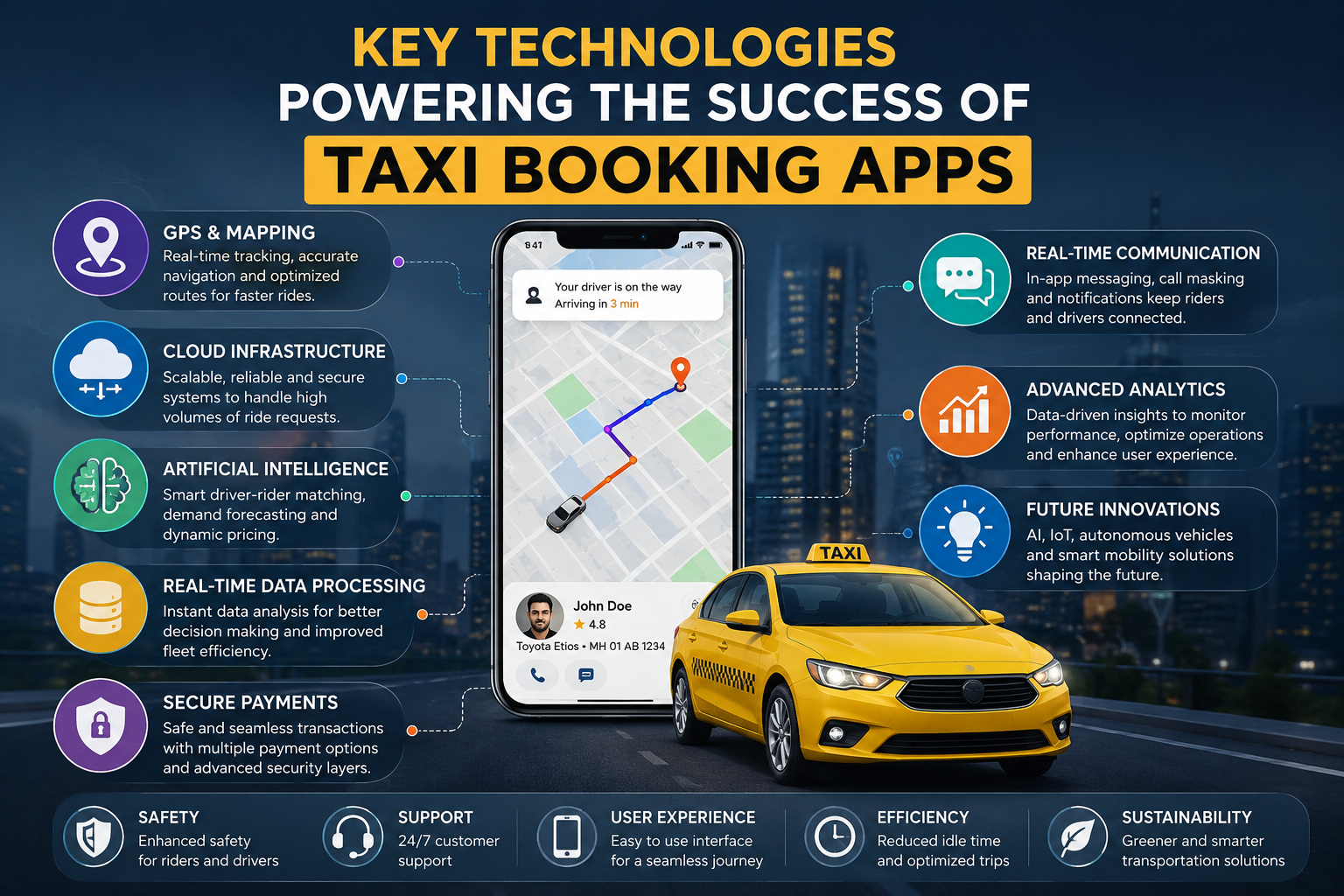
The global transportation industry has undergone a major transformation with the rise of digital ride-hailing platforms. Modern taxi applications have changed the way people book rides, interact with drivers, make payments, and track journeys in real time. Behind this seamless user experience lies a sophisticated combination of technologies working together to ensure speed, reliability, and convenience.
From intelligent routing systems to cloud infrastructure and secure payment gateways, every component plays a critical role in creating efficient mobility platforms. Businesses exploring taxi booking app development services must understand that successful applications depend not only on user-friendly interfaces but also on the technologies operating in the background.
As customer expectations continue to evolve, taxi platforms are integrating advanced technologies that improve operational efficiency while delivering faster and safer services to users. Understanding these technologies provides valuable insight into how digital transportation ecosystems continue to expand across cities worldwide.
How GPS and Mapping Engines Enable Accurate Ride Coordination
Global Positioning System technology forms the foundation of every modern ride-hailing platform. Without accurate location tracking, it would be impossible to connect riders with nearby drivers or provide estimated arrival times.
GPS technology supports several essential functions:
- Real-time driver location tracking
- Route optimization for shorter travel times
- Accurate pickup and drop-off identification
- Dynamic fare estimation based on distance
- Navigation assistance during trips
Mapping engines further enhance these capabilities by processing traffic conditions, road closures, and route alternatives. These systems continuously analyze geographical information to determine the fastest and most efficient paths for drivers.
Modern mapping technologies also reduce operational inefficiencies by minimizing idle driving time and unnecessary detours. This results in improved fuel efficiency and better resource utilization across entire fleets.
Geofencing capabilities add another layer of functionality by creating virtual boundaries around airports, business districts, and high-demand areas. Platforms can use these zones to trigger notifications, calculate surge pricing, or assign drivers more effectively during peak periods.
As urban transportation networks become increasingly complex, mapping technologies continue to evolve with more accurate positioning systems and predictive traffic analysis.
Why Cloud Infrastructure Supports Heavy Volumes of Ride Requests
Taxi applications experience highly unpredictable demand patterns throughout the day. Morning commutes, evening rush hours, public events, and weather changes can dramatically increase user activity within minutes.
Cloud computing enables platforms to scale resources automatically according to demand fluctuations. Instead of relying on fixed server capacity, cloud environments allocate additional computing resources whenever traffic increases.
The advantages of cloud infrastructure include:
- Flexible resource allocation during demand spikes.
- Faster application performance across regions.
- Improved system reliability and uptime.
- Reduced infrastructure maintenance requirements.
- Efficient backup and disaster recovery mechanisms.
These capabilities ensure uninterrupted service even when thousands of users request rides simultaneously.
Cloud architecture also enables seamless integration with third-party services such as payment providers, navigation systems, messaging tools, and customer support platforms. This interconnected ecosystem allows applications to evolve rapidly without requiring complete infrastructure redesigns.
Organizations investing in taxi booking app development services often prioritize cloud-native architectures because they provide scalability without compromising performance or security.
The widespread adoption of microservices architecture further improves cloud efficiency by separating functions into independent modules that can be updated without affecting the entire platform.
The Growing Role of Artificial Intelligence in Rider Matching
Artificial intelligence has become one of the most influential technologies in ride-hailing ecosystems. Its ability to process enormous datasets allows platforms to make smarter operational decisions in real time.
One of the most important applications of AI is rider-driver matching. Instead of assigning the nearest driver automatically, intelligent algorithms evaluate multiple variables simultaneously, including:
- Driver ratings and performance history
- Current traffic conditions
- Estimated pickup times
- Ride demand in surrounding areas
- Vehicle availability and preferences
These algorithms continuously learn from historical data to improve future decisions.
Artificial intelligence also supports demand forecasting. By analyzing weather patterns, holidays, local events, and historical trends, platforms can anticipate demand surges before they occur.
Predictive analytics enables companies to position drivers strategically across cities, reducing waiting times for passengers and increasing earnings opportunities for drivers.
Machine learning models additionally contribute to fraud detection by identifying unusual account activity, suspicious payment behavior, and fake ride requests.
The use of AI has become particularly important in large metropolitan environments where millions of location updates and ride requests must be processed every day.
How Real Time Data Processing Improves Fleet Efficiency Levels
Every interaction within a taxi platform generates valuable information. Driver locations, trip durations, customer feedback, payment status, and route information create massive streams of data that require immediate analysis.
Real-time processing technologies allow platforms to analyze this information instantly rather than waiting for batch updates.
Some important applications include:
- Monitoring driver availability.
- Updating estimated arrival times.
- Detecting service disruptions.
- Managing surge pricing events.
- Optimizing fleet distribution.
Streaming technologies process incoming information continuously, enabling systems to respond to changing conditions within seconds.
For example, if traffic congestion suddenly increases in a particular district, pricing algorithms can immediately adjust fares while navigation systems suggest alternative routes for active trips.
Operational teams also benefit from real-time dashboards that display demand trends, active rides, and service performance indicators across multiple locations.
These insights support quicker decision-making and help transportation networks maintain service quality during periods of high demand.
Accurate data processing contributes significantly to customer satisfaction because users receive up-to-date information throughout their journey rather than relying on delayed updates.
Payment Gateways and Security Layers Behind Digital Transactions
Cashless transactions have become a standard expectation among ride-hailing users. Secure and efficient payment systems therefore represent a fundamental component of every successful platform.
Modern taxi applications support multiple payment methods, including:
- Credit and debit cards
- Digital wallets
- Corporate billing accounts
- Banking applications
- Subscription services
Payment gateways process these transactions while ensuring compliance with financial security regulations.
Encryption technologies protect sensitive customer information during transmission and storage. Tokenization techniques further reduce risk by replacing payment credentials with secure digital identifiers.
Multi-factor authentication adds additional protection against unauthorized access, while fraud monitoring systems continuously evaluate transaction behavior for unusual patterns.
Security frameworks also protect driver earnings by ensuring accurate fare calculations and timely settlements.
The importance of these protections becomes even greater as platforms expand internationally and manage transactions across multiple currencies and banking systems.
When organizations estimate taxi app development cost, payment infrastructure often represents a significant technical consideration due to compliance requirements and security standards.
Reliable payment systems ultimately strengthen user confidence and contribute to long-term platform adoption.
Communication Systems Keeping Riders and Drivers Connected Daily
Effective communication is essential for reducing confusion and improving ride experiences. Integrated communication tools allow drivers and passengers to coordinate pickups without exposing personal contact information.
In-app messaging systems support quick communication while maintaining privacy protections for both parties.
Key communication features often include:
- Encrypted text messaging
- Temporary phone number masking
- Automated trip notifications
- Arrival alerts and reminders
- Customer support interactions
Voice-over-Internet technologies allow calls to occur directly within applications without revealing personal numbers.
Push notification systems also play an important role by delivering updates regarding driver arrivals, payment confirmations, cancellations, and promotions.
For businesses offering taxi booking app development services, communication infrastructure remains a priority because poor coordination often leads to missed pickups and negative customer experiences.
The emergence of multilingual support systems has further improved accessibility for international travelers and diverse urban populations.
As speech recognition technologies continue to improve, voice-based interaction features may become increasingly common in future mobility applications.
Analytics Tools That Help Platforms Improve User Experiences
Data analytics transforms raw operational information into actionable business intelligence. Every completed trip provides insights that can be used to improve platform performance and customer satisfaction.
Analytics systems typically monitor:
- Ride completion rates
- Customer retention levels
- Driver utilization metrics
- Peak demand periods
- Geographic service gaps
These insights help operators identify inefficiencies and improve decision-making processes.
Behavioral analytics can reveal where users abandon bookings, experience delays, or encounter payment difficulties. Addressing these issues contributes directly to better customer experiences.
Driver performance metrics also support quality control initiatives by highlighting training opportunities and identifying service inconsistencies.
Organizations utilizing taxi booking app development services increasingly rely on analytics dashboards to monitor key performance indicators in real time and support strategic planning initiatives.
The rise of data visualization technologies has made these insights more accessible to operations teams, enabling faster responses to market changes and customer expectations.
As platforms grow, analytics capabilities become increasingly important for maintaining competitiveness in rapidly evolving transportation markets.
Future Innovations Shaping the Next Generation of Mobility Apps
The future of ride-hailing technology extends far beyond current capabilities. Emerging innovations are expected to redefine how transportation platforms operate over the next decade.
Several technologies are attracting significant attention:
- Autonomous vehicle integration
- Advanced predictive analytics
- Vehicle-to-infrastructure communication
- Internet of Things connectivity
- Sustainable mobility optimization
Autonomous transportation systems could eventually reduce operational costs while improving efficiency and availability.
The concept of a white label taxi app is also evolving through modular architectures that allow businesses to customize features more efficiently while maintaining core platform functionality.
Similarly, advancements associated with uber like taxi app development are encouraging greater experimentation with subscription models, shared mobility services, and multimodal transportation ecosystems.
As technical complexity increases, organizations often seek to hire taxi app developers with expertise in artificial intelligence, cybersecurity, cloud infrastructure, and data engineering to address specialized implementation challenges.
Future mobility platforms will likely operate as intelligent transportation networks rather than standalone applications, connecting public transit, private vehicles, and shared services into unified ecosystems.
Conclusion
Taxi applications have become sophisticated digital ecosystems powered by a combination of location technologies, cloud computing, artificial intelligence, analytics, and cybersecurity frameworks. Each technological layer contributes to operational efficiency, customer satisfaction, and platform reliability.
As transportation networks continue evolving, innovation will remain central to improving accessibility, reducing inefficiencies, and supporting smarter urban mobility solutions. Understanding the technologies behind these platforms offers valuable insight into how digital transportation services are shaping the future of connected cities and modern travel experiences.