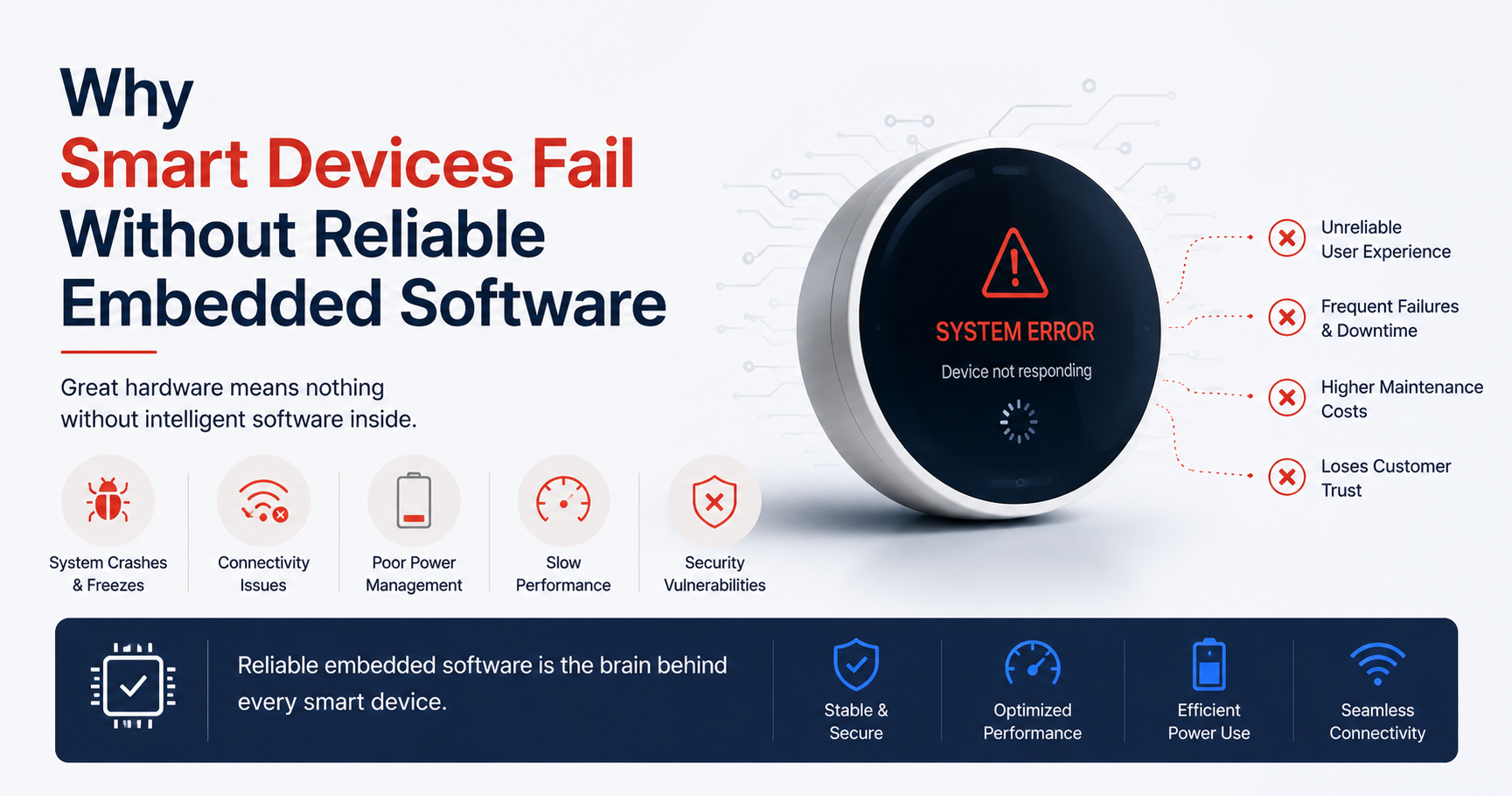
Smart devices now operate at the center of industrial systems, healthcare equipment, consumer electronics, and automotive platforms. As hardware becomes more advanced, software has become the deciding factor in whether these devices succeed in real-world conditions or fail after deployment.
Recent industry data highlights this dependency. According to IDC’s Worldwide Embedded Systems Report (2025), more than 65% of smart device failures in production environments are linked to software-related issues rather than hardware defects. A Gartner embedded systems analysis (2025) further notes that nearly 50% of IoT and smart device projects experience delayed scaling due to firmware instability and integration issues. In addition, IEEE research on embedded systems reliability (2024) shows that poorly optimized embedded software contributes to a significant increase in power inefficiency and system crashes in connected devices across industrial environments.
These statistics underline a critical point: hardware innovation alone does not guarantee device success. Embedded software determines whether smart devices perform reliably under real operating conditions.
This article explores why smart devices fail without reliable embedded software, the technical and operational factors behind these failures, and how organizations can address these challenges with structured engineering practices and support from an experienced Embedded Software Development Company.
The Central Role of Embedded Software in Smart Devices
Embedded software acts as the operational brain of smart devices. It controls how hardware components interact, manages system resources, processes sensor data, and ensures communication between devices and external systems.
Unlike general-purpose software, embedded software operates under strict constraints such as limited memory, real-time processing requirements, and energy efficiency. These constraints make reliability a critical requirement rather than an optional feature.
When embedded software performs poorly, even the most advanced hardware becomes unstable or unusable. This dependency explains why many smart devices fail in production despite successful hardware design.
System Instability Caused by Poor Firmware Design
Firmware serves as the lowest software layer in smart devices. It directly interacts with hardware components such as sensors, processors, and communication modules.
When firmware lacks proper architecture or testing, devices often experience:
- Unexpected system resets
- Sensor misinterpretation
- Memory leaks
- Inconsistent device states
These issues may not appear during early testing but become visible under real-world workloads where devices operate continuously for long durations.
System instability remains one of the most common reasons smart devices fail after deployment, especially in industrial and mission-critical environments.
Real-Time Processing Failures in Connected Systems
Many smart devices depend on real-time processing to function correctly. Examples include medical monitoring devices, automotive control systems, and industrial automation sensors.
Embedded software must process input data within strict time constraints. When it fails to meet these deadlines, system behavior becomes unpredictable.
Real-time failures often result from:
- Poor task scheduling
- Inadequate interrupt handling
- Resource contention between processes
- Unoptimized algorithm design
Even minor delays in execution can lead to inaccurate readings or system misalignment, which directly affects operational safety and performance.
Hardware-Software Mismatch in Device Architecture
Smart devices often fail when software design does not align with hardware capabilities. This mismatch typically occurs during development when teams prioritize software functionality without fully understanding hardware limitations.
For example, high-frequency sensor data may overwhelm processors that lack sufficient memory or processing bandwidth. Similarly, inefficient code can drain battery-powered devices faster than expected.
This misalignment creates long-term performance issues that are difficult to resolve after deployment. Effective embedded systems require tight coordination between hardware engineers and software developers throughout the development lifecycle.
Security Vulnerabilities in Embedded Systems
Security has become a major concern in connected devices, especially with the rise of IoT ecosystems. Embedded software often becomes the primary target for attackers because it runs continuously and has direct access to hardware functions.
Common security weaknesses include:
- Hardcoded credentials
- Unsecured communication protocols
- Lack of encryption for data transmission
- Inadequate firmware update mechanisms
Once deployed, many devices remain in the field for years without regular updates, making security vulnerabilities even more critical.
A single vulnerability in embedded software can compromise entire device networks, particularly in industrial environments.
Power Management and Efficiency Issues
Power consumption is a key constraint in embedded systems, especially for battery-operated devices. Poorly optimized embedded software can significantly reduce device lifespan and operational efficiency.
Common causes of power inefficiency include:
- Excessive background processing
- Unoptimized sensor polling intervals
- Continuous wireless communication cycles
- Inefficient sleep and wake-up mechanisms
These issues often go unnoticed during early testing but become major operational challenges in large-scale deployments where devices are expected to run for extended periods without maintenance.
Integration Challenges in Complex Ecosystems
Modern smart devices rarely operate in isolation. They connect to cloud platforms, mobile applications, industrial systems, and other IoT devices.
Embedded software must manage these interactions reliably. However, integration issues often arise due to inconsistent communication protocols, data formatting mismatches, or insufficient error handling.
When integration fails, devices may lose connectivity, fail to sync data, or behave unpredictably within larger ecosystems.
This challenge becomes more complex as device ecosystems scale across multiple vendors and platforms.
Importance of Structured Embedded Software Engineering
Reliable embedded systems require disciplined engineering practices across design, development, and testing phases. This includes modular architecture design, rigorous validation, and continuous performance monitoring.
Organizations that lack specialized expertise often struggle to maintain this discipline at scale. As a result, many turn to an experienced Embedded Software Development Company that understands hardware constraints, real-time system design, and long-term device lifecycle management.
Such expertise helps ensure that embedded software aligns with hardware specifications, operational requirements, and security standards from the beginning of the development process.
Real-World Industrial Case Example
A global industrial automation company deployed smart sensors across manufacturing plants to monitor machine vibration, temperature, and operational efficiency. The hardware design performed well in controlled testing environments, showing accurate data collection and low-latency response.
However, after large-scale deployment, several issues emerged. Devices began to lose synchronization with central systems, battery life decreased faster than expected, and some sensors produced inconsistent readings under high-load conditions.
Further analysis revealed that the embedded software was not optimized for continuous real-time processing. It also lacked efficient power management and had weak error-handling mechanisms for network interruptions.
To resolve these issues, the company restructured its firmware architecture, improved task scheduling, and implemented better power optimization strategies. It also partnered with an experienced Embedded Software Development Company to redesign critical system components and improve long-term reliability.
After these improvements, device stability increased significantly, battery performance improved by over 30%, and data accuracy across systems stabilized.
ROI and Business Impact of Reliable Embedded Software
The financial impact of embedded software reliability becomes clear at scale. Even small improvements in system stability and efficiency can produce measurable business outcomes.
For industrial deployments, reducing device failure rates leads to lower maintenance costs, fewer operational disruptions, and improved asset utilization. In large IoT networks, improving firmware efficiency can extend device lifespan and reduce replacement cycles significantly.
For example, if an organization manages 100,000 connected devices and improves failure rates by just 5%, the reduction in maintenance and replacement costs can translate into substantial annual savings. Similarly, improving power efficiency can extend device life cycles, reducing long-term operational expenditure.
Reliable embedded software also reduces downtime, which directly affects productivity in manufacturing, healthcare, and logistics environments.
Final Thoughts
Smart devices fail not because hardware is insufficient, but because embedded software does not meet the demands of real-world environments. Issues such as system instability, real-time processing failures, security vulnerabilities, and integration challenges all originate from software limitations rather than hardware design.
As devices become more connected and complex, embedded software plays an increasingly critical role in determining product success. Organizations that invest in strong engineering practices and work with an experienced Embedded Software Development Company are better positioned to build reliable, scalable, and secure smart systems.
In the long term, embedded software quality defines whether smart devices remain operational assets or become costly operational liabilities.