Walk through almost any production facility and you’ll notice the same thing happening over and over: stuff is moving: raw materials are brought into the process, lab samples are sent off to be tested, packaging materials pile up close to the fill room, and the finished products are released out through the doors. There isn’t much discussion about this. However, the way that this movement occurs determines the next steps. That’s the reason why many companies choose stainless steel carts every time. They just make the everyday grind of handling materials a little less painful.
But here’s the problem: the choice of mobile devices isn’t as simple as comparing sizes and price tags to an estimated budget. Carts or platforms can seem like a great idea in the paper but make things slower after being landed on the floor if it doesn’t meet the needs of your team. Large equipment, hard to clean floors, or even the load limit being way too optimistic can all result in the same outcome: more dealing with, more delays as well as a disgruntled team without a reason.
This matters even more in regulated environments, where every trip across the floor is essentially part of the process. Good material handling supports productivity, protects product quality, and keeps things consistent from batch to batch. So before signing off on new equipment, it makes sense to think through how it will be used, not just what it costs to bring in the door.
Carts and Platforms Aren’t Really Interchangeable
It’s possible to see them next to each other in a catalog, so from a distance, you could believe they’re designed for the exact same reason. Transfer things from point A to point B. When you look a bit deeper, it’s evident that they’re solving two distinct challenges.
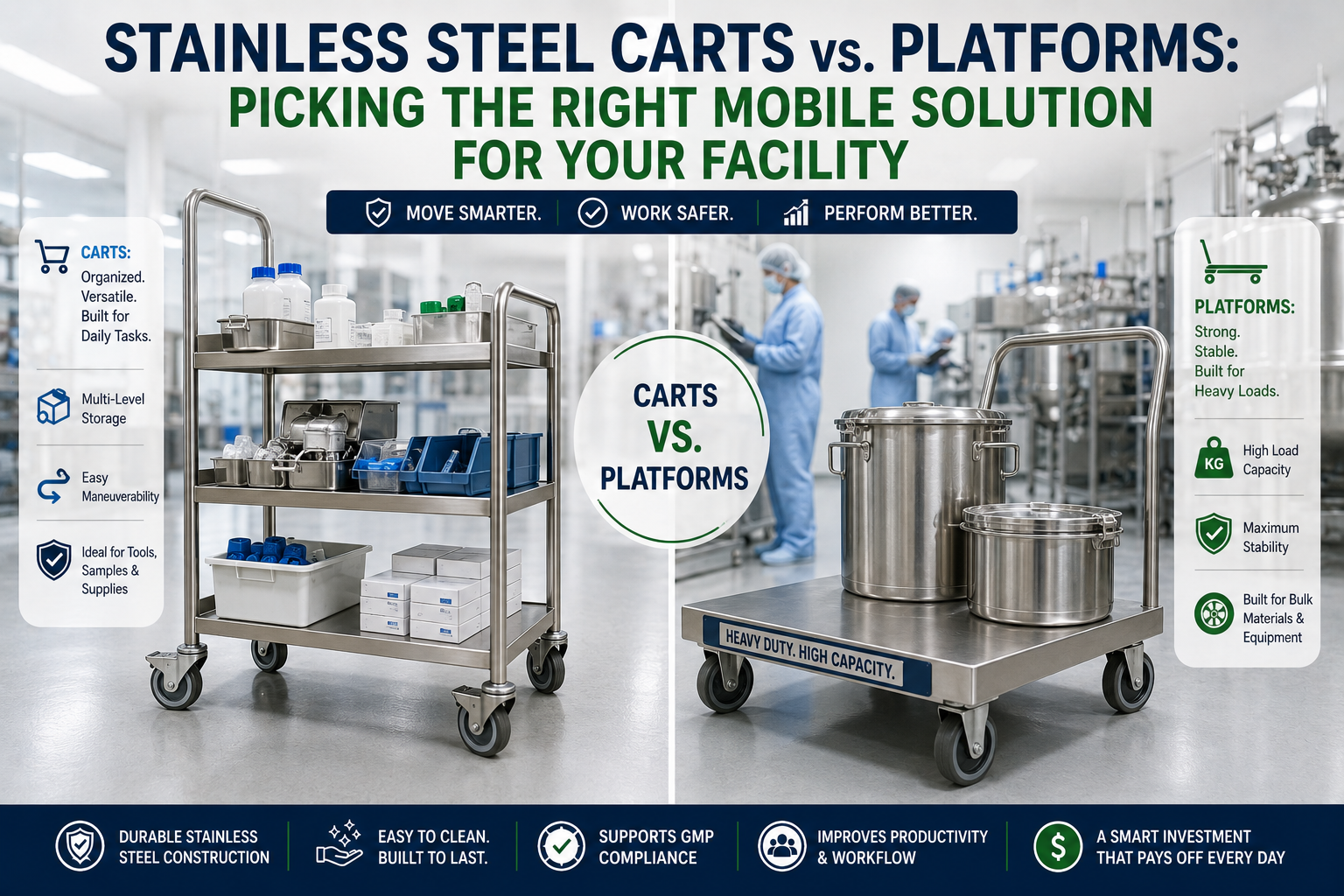
A stainless steel cart is typically constructed around a few shelves that are mounted on wheels intended to hold small items in a neat method, like laboratory equipment, hand tools or products that are packaged. Mobile platforms pharma skip the shelving altogether in favor of a single flat deck, made for carrying larger or heavier loads such as drums, bulky containers, or stacked pallets of material.
A few practical differences follow from that: carts give you multiple levels to work with, platforms give you one big surface. Carts handle tight corners and narrow aisles with ease, while platforms are built to spread heavy weight out evenly and carry a lot more of it.
In the end, it comes down to what your team hauls around most days. Small parts, tools, or packaged goods call for organized shelving. Heavy containers or oversized equipment call for a platform. If you choose the correct platform, you’ll experience fewer repeated runs and smoother handling throughout the day.
A Few Questions Worth Sitting with Before You Buy
It’s tempting to go directly into comparing specification sheets, but you’ll receive an answer that is more precise if you first examine the way your facility actually operates.
What are you shifting?
Mixing containers, lab instruments, raw materials, and maintenance gear don’t all travel the same way. Delicate instruments do better with shelving that keeps them separated, while heavier containers need something wide and stable underneath them. Once you know what’s actually being moved, the right dimensions and weight capacity tend to follow naturally.
How often is it going to be used?
A device that is pushed around for a dozen times per day will wear out much more quickly than something that is used only once per week. If you’re planning on frequent use, place your emphasis on solid design, smooth casters, strong welds and brakes you’re able to count on. A little bit more cash in advance is often better than having to pay for downtime and repairs in the future.
Where does it need to travel?
Narrow aisles, cleanrooms, elevators, storage areas, and QC labs all ask something different of your equipment. A cart shuttling between production and QC needs to turn on a dime, while something crossing a wide manufacturing floor benefits more from larger wheels and a bit of extra stability.
Why Material and Hygiene Deserve More Attention Than They Usually Get
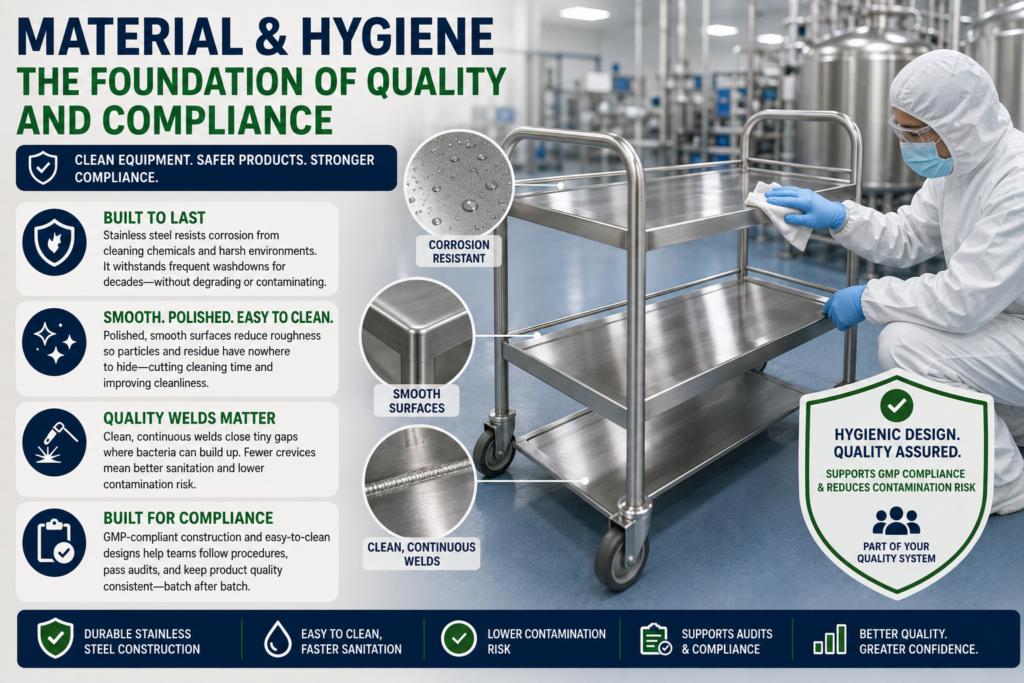
In a regulated facility, what your equipment is made from has a real, measurable effect on cleanliness and product quality, not just how it looks in a catalog photo. Stainless steel keeps showing up as the material of choice because it simply holds up. It wards off corrosion from the elements and chemicals used to clean it and can withstand frequent washdowns and does not degrade into ways that can lead to pollution, even after decades of regular usage.
Polished, smooth surfaces reduce cleaning time, too, because the surface has less roughness for particles or residue to stick to. Quality of welds contributes to this more than you’d think. Clean, continuous welding closes all the small spaces where bacteria can accumulate. The absence of flaws on the surface make sanitation easier and better.
Solid GMP mobile equipment ends up supporting compliance in a broader sense as well. Hygienic construction and easy-to-clean surfaces make it simpler for teams to follow documented cleaning procedures and keep contamination risk low. A growing number of facilities now treat their mobile equipment as part of the quality system itself, not just a way of getting things from one room to another, and it’s easy to see why once you look at the difference it makes.
When a Platform Is Clearly the Better Call
Not everything moving through a facility fits neatly on a cart shelf. Heavy, bulky, or awkward loads need something more stable underneath them, and that’s usually where a platform outperforms a standard cart.
A platform’s flat, open surface spreads weight evenly across the frame, which keeps things balanced and makes heavy loads much safer to move. In pharma settings especially, platforms tend to get used for heavy ingredient containers, production drums, bulk material bins, and processing equipment, along with general support during maintenance work on larger machinery.
Stability is really the whole point here. A heavy load that is kept low and level reduces the possibility of it falling over when it travels over the floor. This ensures that the person pushing it and the items above are protected. The better distribution of weight also results in less trips, as an individual platform run can substitute for three or more small cart runs.
Before committing to a platform, it’s worth checking maximum load capacity, wheel quality, the braking system, and whether your travel paths are actually wide enough to accommodate it comfortably.
When a Cart Still Wins
Platforms handle the big stuff well, but plenty of daily work in a facility involves smaller items that just need to stay organized while they’re on the move. That’s where carts earn their keep.
Rather than carrying one large item, a cart lets someone move several things at once while keeping everything sorted and within reach. Shelves separate products, tools, and supplies so nobody’s rifling through a jumbled pile mid-transport. You’ll see carts used constantly for production components, lab samples, testing equipment, maintenance tools, and packaging supplies moving between departments.
The smaller size of their footprint is a benefit when working in busy areas which have narrow aisles or areas for shared work. The swivel wheels are a good choice for operators who want to make corners with ease that means lesser physical stress during an extended shift. Carts can be found in different shelf sizes, many establishments can locate the one that is compatible with their current process, without needing to alter their workflow to fit the cart. For QA personnel, lab techs and maintenance teams such a system will save you time as well as the small cost savings can add up quickly over the course of a week.
Buying Mistakes That End Up Costing More Later
Mobile technology is often considered a once-only purchase; however, an unwise choice can raise expenses for maintenance and even force the need for a replacement earlier than planned.
Buying on price alone. Cheaper equipment can cost more down the line if it wears out fast or can’t handle what you’re actually asking of it. Total value matters more than the number on the invoice.
Skipping over wheel quality. Weak casters make heavy loads a chore to move. Look for smooth rolling, solid capacity, dependable brakes, and wheels suited to your floor type.
Ignoring ergonomics. Awkward handles or equipment that’s hard to push takes a real toll on operators over a full shift. Comfortable, thoughtfully designed equipment supports better posture and gets more done.
Underestimating load capacity. Pushing equipment past its rated limit hurts stability, speeds up wear, and creates safety risks nobody wants. Leave yourself some room to grow into.
Overlooking cleaning requirements. The rough welds and the difficult-to-reach edges slow down sanitation and can increase risk of contamination. Simple, clean designs help you to complete work much easier.
Failing to plan for growth. Production needs change. Investing in adaptable GMP mobile equipment now saves you from replacing it sooner than expected, and it keeps long-term maintenance costs in check.
Choosing Well Pays Off Every Day, Not Just on Day One
There’s no single right answer that works for every facility. What fits your operation depends on how materials actually move through it, how big and heavy your loads tend to be, how much space you have to work with, and where your production is headed next.
Carts and platforms each do their own job well. Stainless steel carts keep smaller items organized and within easy reach, while platforms bring the stability and strength that heavier materials demand. Knowing your daily workflow is what makes the choice obvious.
Instead of deciding only on price, take into consideration how well the machine will last through decades of continuous usage. Quality of service, cleanliness, user comfort, and regular maintenance are all factors in the price that equipment is actually costing in the long run. Companies that can evaluate their needs in the workplace tend to find technology that improves productivity and makes the work environment safe. Whether your operation calls for stainless steel carts or mobile platforms pharma teams rely on for heavier loads, the right fit is really an investment in smoother days ahead, not just a purchase you make once and forget about.
FAQs
How do stainless steel carts help facilities?
Stainless steel carts organize smaller objects and resist corrosion due to constant cleaning. They’re simple to clean and last for many years of use as well as helping facilities remain clean without additional work to any worker’s day.
When should I pick a platform instead?
Use a platform whenever you’re moving drums that weigh a lot and containers that are bulky, as well as heavy equipment. A flat surface helps distribute load evenly, keeps things in place, and helps cut down on the number of trips you and your team have to travel on.
Why does weld quality matter so much?
Rough or uneven welds cause tiny gaps through which residue and bacteria may be able to hide. Continuous, clean welds can clean properly, and that matters in places where strict cleanliness standards are followed every day.
What do mobile platforms pharma teams use?
Mobile platforms pharma teams rely on are built to handle heavy ingredient containers, drums, and bulk bins with ease. Their flat, sturdy deck keeps loads balanced and stable, reducing tipping risk and cutting down on trips.
How often should equipment be replaced?
There is no set timeframe, but equipment that is built of high-quality materials and utilized correctly can last for a long time without requiring repairs. Monitoring for worn-out wheels, loose welding or rust can help to identify replacement requirements prior to them becoming bigger issues.