
Two-stroke outboard engines remain one of the most widely used forms of marine propulsion in the world, despite the market shift toward four-stroke technology that began in earnest after the EPA’s 2006 marine emissions standards took effect. Millions of two-stroke outboards are still in active service on fishing boats, jon boats, inflatable tenders, and older performance craft — and the maintenance requirements of these engines differ fundamentally enough from modern four-stroke counterparts that confusion between the two is a consistent source of premature engine failure among boat owners who learned to maintain one platform and then applied those habits to the other.
Two-stroke engines are not simpler than four-stroke engines in the way that most boat owners assume. They are differently complex — the lubrication system, the induction system, and the combustion event itself all operate on principles that require a specific maintenance approach to keep the engine running reliably over its service life. This complete guide covers every major maintenance area for two-stroke outboard engines: the lubrication system, the fuel system, the cooling system, the power valve and exhaust system, the ignition system, and the lower unit — with the specific service procedures, intervals, and inspection criteria that keep a two-stroke outboard in reliable service for years.
How the Two-Stroke Engine Cycle Shapes Maintenance Requirements
Every maintenance decision for a two-stroke outboard should be understood in the context of how the engine actually works — specifically, the ways in which two-stroke engine architecture creates maintenance requirements that four-stroke engines do not share.
In a two-stroke engine, every downward stroke of the piston is a power stroke. The same piston movement that forces exhaust gases out of the cylinder also draws fresh air and fuel into the crankcase and compresses it before transferring it to the combustion chamber through the transfer ports. This dual-function piston movement means that:
The crankcase is part of the induction system. Unlike a four-stroke engine where the crankcase holds lubricating oil, the two-stroke crankcase handles the pre-compression of the incoming air-fuel charge. This design requires the crankshaft bearings to run in a mixture of air, fuel vapor, and oil — which is why two-stroke engines require oil in the fuel rather than a separate oil circuit.
Lubrication depends entirely on the oil-fuel delivery. Every bearing surface in the engine — crankshaft bearings, connecting rod bearings, piston pin bearings — receives lubrication only from the oil mixed into the fuel that passes through the engine. If the oil-fuel ratio is incorrect, or if the oil injection system fails, bearing lubrication drops to zero and catastrophic failure follows within minutes.
Exhaust events happen at the cylinder wall. The exhaust port in the cylinder wall is opened and closed by the piston itself. Carbon deposits that accumulate in the exhaust port and on the power valve directly restrict exhaust flow, increasing back-pressure that reduces engine power and ultimately causes overheating.
These architectural characteristics define the maintenance priorities: the oil system is the most safety-critical item, the fuel quality is more important than in a four-stroke application, and the exhaust system requires periodic cleaning that four-stroke engines do not.
1: The Lubrication System — The Most Critical Maintenance Area
Oil Injection System Service
Modern two-stroke outboards use oil injection systems that deliver TC-W3 rated oil directly to the engine’s lubrication points in a ratio that varies with engine load — providing more oil at high RPM and load, less at idle. This variable-ratio injection is more efficient than the fixed pre-mix ratio of older two-strokes and produces less visible smoke at low load conditions.
The oil injection system has three maintenance-relevant components: the oil reservoir, the injection pump, and the delivery lines.
Oil reservoir: The reservoir should be checked at every outing before starting. A two-stroke that runs out of injection oil will destroy its crankshaft bearings within minutes of the warning light activating. Most manufacturers design the low-oil warning to illuminate with approximately one quart of oil remaining — providing a buffer that allows the operator to reach the dock safely, but not a significant margin for ignoring the warning.
Use only TC-W3 certified two-stroke marine oil in the injection reservoir. The TC-W3 certification indicates that the oil has been tested and approved for two-stroke marine applications — specifically, that it burns cleanly in the combustion chamber and provides adequate lubrication at all operating conditions. Non-certified oils, automotive two-stroke oils, and two-stroke oils certified for other applications (chainsaw, dirt bike) do not meet marine TC-W3 specifications and should not be used.
Injection pump inspection: The injection pump is a precision metering device that delivers the correct volume of oil across the engine’s operating range. Pump failures are not common, but they are catastrophic — a failed injection pump that stops delivering oil produces immediate bearing failure. Inspect the pump housing for any signs of oil leakage at the fitting connections. A leaking injection pump fitting allows air into the oil delivery circuit, which can interrupt oil delivery to the bearings intermittently.
Delivery line inspection: The small-diameter plastic or rubber lines that carry oil from the pump to the engine’s injection points deteriorate with age and UV exposure. Inspect these lines annually for cracking, brittleness, or kinking. A cracked delivery line that allows air into the system or that leaks oil is a safety concern that should be addressed before the next use.
Pre-Mix Ratio for Engines Without Oil Injection
Older two-stroke outboards — particularly those manufactured before the late 1980s — do not have oil injection and require oil to be mixed directly with the gasoline in the fuel tank at a specified ratio.
Standard operating ratio: Most carbureted two-stroke outboards specify a 50:1 fuel-to-oil ratio for normal operation — 50 parts gasoline to 1 part TC-W3 oil. At this ratio, one gallon of gasoline receives approximately 2.6 ounces of oil.
Break-in ratio: New or rebuilt two-stroke engines require a richer oil ratio during the break-in period — typically 25:1 for the first ten to twenty hours of operation. The richer ratio compensates for the higher friction of un-seated bearing surfaces during break-in and is critical to preventing premature bearing wear during the most vulnerable period of the engine’s life.
Over-rich vs lean oil ratio: Running too much oil (too rich a mixture) produces excessive smoke, fouled spark plugs, carbon buildup in the exhaust ports, and power valve sticking. Running too little oil (too lean a mixture) provides inadequate bearing lubrication and causes accelerated bearing wear. Both extremes are damaging, but a lean oil mixture is far more destructive in the short term — an engine with an oil-lean mixture can sustain bearing damage within a single outing.
2: Fuel System Maintenance
Two-stroke engines are more sensitive to fuel quality than four-stroke engines because the fuel carries the engine’s lubrication directly into the combustion chamber. Degraded fuel with phase-separated ethanol or varnish deposits contaminates the lubrication system, not just the fuel delivery system.
Carburetor Service
The majority of two-stroke outboards in active service use carburetors rather than fuel injection. Two-stroke carburetors are relatively simple in construction — a float bowl, a needle valve, a main jet, a pilot jet, and associated passages — but they require periodic cleaning and adjustment to maintain correct fuel metering across the engine’s operating range.
Annual carburetor service: Disassemble the carburetor completely, clean all passages with carburetor cleaner and compressed air, inspect the float for fuel saturation or damage, verify the needle valve seats correctly, and replace all O-rings and gaskets before reassembly. Varnish deposits from degraded fuel are the most common finding in a two-stroke carburetor service — they block the small pilot jet and enrichment circuits that control fuel delivery at idle and light throttle.
Float level adjustment: The float level determines the fuel level in the carburetor bowl, which directly affects the fuel-to-air ratio throughout the engine’s operating range. An incorrect float level — typically caused by a bent or damaged float arm — produces rich or lean running that cannot be corrected by jet or needle adjustment. Check float level against the manufacturer’s specification during every carburetor rebuild.
Needle and needle position: Many two-stroke carburetors use an adjustable needle in the main metering circuit that can be repositioned on the needle clip to adjust mixture through the mid-throttle range. Lean mid-throttle stumbling is often corrected by moving the needle clip one position in the richer direction. Rich mid-throttle fumbling (black smoke, foul plugs) is corrected by moving the clip in the lean direction.
Fuel Quality Management for Two-Stroke Engines
Florida’s E10 ethanol-blended fuel is particularly problematic for two-stroke outboards because phase-separated fuel introduces water directly into the oil-fuel mixture. Water in a two-stroke’s fuel-oil mixture removes the lubricity of the oil fraction and delivers water to the crankshaft and connecting rod bearings — the same effect as running without oil, but more gradual.
Use ethanol-free (E0) fuel whenever available for two-stroke outboards. Many marine fuel docks and select gas stations in Southwest Florida stock ethanol-free recreational fuel — the premium cost of $0.50 to $1.00 per gallon is fully justified by the elimination of phase separation risk in an engine where contaminated fuel directly compromises lubrication.
When E0 fuel is not available, add a marine fuel stabilizer to every tank and keep the tank full between uses to minimize the air volume above the fuel surface where moisture absorption occurs.
3: Cooling System Maintenance
Two-stroke outboards use the same raw water cooling system architecture as four-stroke outboards — a rubber impeller water pump, passages through the midsection and powerhead, and a thermostat that regulates operating temperature. The maintenance requirements are identical, but the consequences of cooling system failure are more rapid in a two-stroke engine because two-stroke powerheads generate heat more intensively per unit displacement than four-stroke counterparts.
Water Pump Impeller
Replace the water pump impeller every two years or 200 hours in Southwest Florida’s saltwater and sand environment — regardless of the current tell-tale stream output. The vane degradation that precedes impeller failure is internal and not reflected in the tell-tale stream until the impeller is close to complete failure.
The service procedure requires lower unit separation — removing the lower unit from the mid-section to access the water pump housing. This is the same procedure whether servicing a two-stroke or four-stroke engine. Follow the manufacturer’s torque specifications for the lower unit fasteners on reassembly.
Thermostat Function
Two-stroke outboards rely on the thermostat to maintain operating temperature in the range specified for complete combustion and efficient oil burn. A thermostat that opens too early (stuck open) allows the engine to run too cool — below the temperature needed for complete combustion, which results in plug fouling, ring deposits, and oil contamination from unburned fuel.
A thermostat that does not open (stuck closed) causes rapid overheating that damages the powerhead far faster in a two-stroke than in an equivalent four-stroke. Test the thermostat annually in a pot of heated water to verify correct opening temperature.
Flushing After Saltwater Use
Flush the cooling system with fresh water after every saltwater outing. A two-stroke engine that accumulates multiple seasons of salt deposit in its cooling passages develops reduced cooling capacity that manifests first as higher operating temperatures under heavy load — a precursor to the overheating events that can destroy two-stroke powerheads faster than equivalent four-stroke engines.
4: Power Valve and Exhaust System
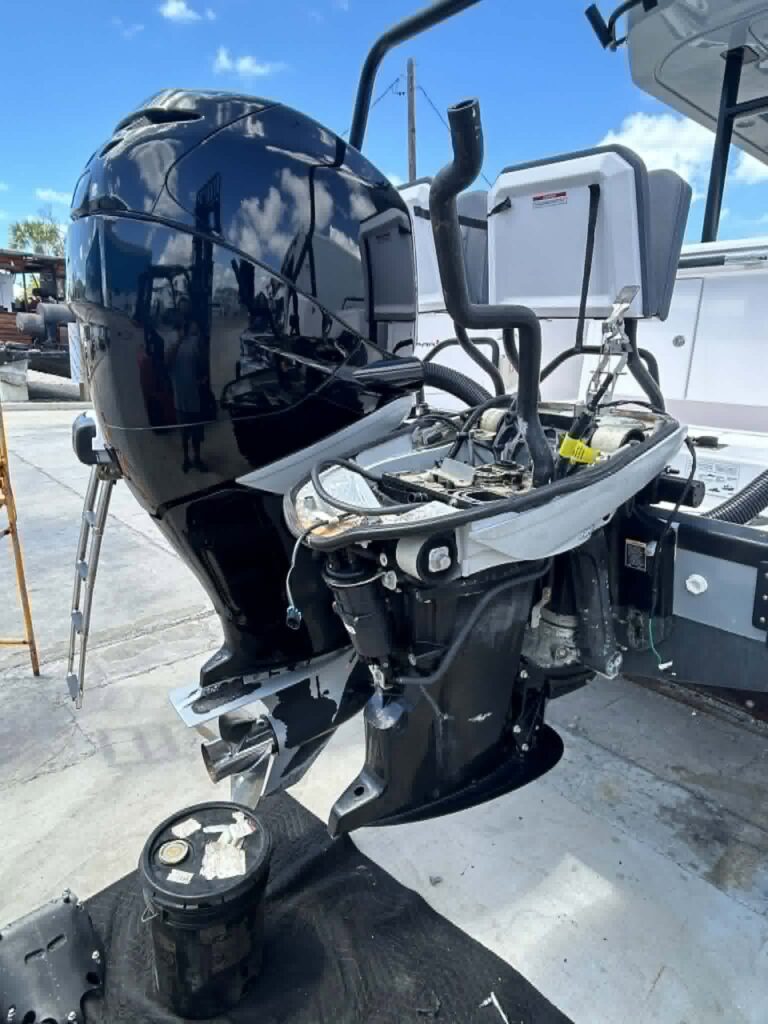
The power valve is a component unique to high-performance two-stroke outboards — particularly the Mercury 90-degree V6 designs and Yamaha’s two-stroke V4 and V6 models. The power valve is a butterfly valve or louver assembly in the exhaust port that modulates the effective exhaust port timing based on engine RPM, providing a wider effective powerband than a fixed exhaust port geometry would allow.
Power Valve Sticking: Symptoms and Causes
Power valve sticking — where the valve fails to move freely through its operating range — is one of the most common performance problems in high-performance two-stroke outboard service. The symptom is a pronounced flat spot or hesitation in a specific RPM range — typically 3,000 to 4,500 RPM — where the power valve is transitioning and becomes inconsistent.
Sticking is caused by carbon deposits that accumulate on the valve’s pivot mechanism and in the guide bores that control its movement. These deposits are a direct consequence of either oil-rich operation (too much oil in the fuel mix) or degraded fuel quality that produces incomplete combustion and elevated carbon output.
Power Valve Service Procedure
Power valve service requires removing the valve assembly from the exhaust port — typically accessible after removing the powerhead’s outer covers and the exhaust manifold. The disassembly procedure varies significantly by engine model and should be performed with the model-specific service manual.
Once removed, soak the valve assembly in a two-stroke specific power valve cleaner or carburetor cleaner to dissolve carbon deposits. Do not use abrasives or metal tools on the valve or its guides — the close tolerance of the valve mechanism means that any dimensional change from aggressive cleaning prevents the valve from moving freely.
Reinstall with new O-rings and gaskets. Test the valve movement by actuating the mechanism by hand through its full range before reassembling the engine covers.
5: Ignition System Maintenance
Two-stroke outboard ignition systems use capacitor discharge ignition (CDI) — a system where the ignition coil is charged by the engine’s magneto system and discharged at the precise moment of ignition through the spark plug. CDI systems are generally reliable, but spark plug condition is more critical in two-stroke engines than in four-stroke applications because the plug must fire consistently in a combustion chamber that contains oil as well as fuel and air.
Spark Plug Service
Two-stroke outboards consume spark plugs faster than equivalent four-stroke engines because:
- The plug fires on every revolution (twice as frequently as in a four-stroke at the same RPM)
- The combustion environment contains oil, which produces deposits on the electrode faster than clean gasoline combustion
Inspect spark plugs every 100 hours and replace every 200 hours or annually — more frequently if the engine shows any signs of rich running or plug fouling.
Reading the spark plug: In a two-stroke engine, plug condition is even more diagnostic than in a four-stroke. A wet, black plug indicates flooding or an oil-rich condition. A dry, black, sooty plug indicates a rich fuel mixture or an ignition timing problem. A tan to light grey plug indicates correct combustion. A white or chalky plug indicates a lean condition — which in a two-stroke context may also indicate inadequate oil in the fuel and should be investigated immediately.
Ignition Timing
CDI ignition timing on two-stroke outboards is generally not field-adjustable on post-1990 engines — the timing is controlled electronically by the CDI module in response to RPM and load signals from the powerhead sensors. However, the trigger pickup (the sensor that signals the CDI module) can corrode or develop air gap issues that affect timing accuracy. Inspect the trigger pickup gap against the manufacturer’s specification during any timing-related service.
6: Lower Unit Service
Gear Lube Change
Change the lower unit gear lube annually or every 100 hours. The gear lube inspection on drain is the most important element of this service — the condition of the drained lube reveals whether the lower unit seals are intact.
Fresh gear lube: Clear amber or light gold, thin consistency. Normal used gear lube: Darker amber with fine metallic particles (normal from gear mesh wear). A small amount of metallic content is expected. Milky or grey gear lube: Water contamination. This indicates a failed prop shaft seal, a failed drive shaft seal, or a cracked lower unit housing. The source must be identified and repaired before returning the engine to service.
Propeller Shaft Seal Inspection
The prop shaft seal prevents water from entering the lower unit through the propeller shaft opening. Saltwater intrusion that produces milky gear lube at the annual change indicates a failed or failing seal. Replacing the seal immediately when milky gear lube is found prevents the progressive bearing and gear damage that running on water-contaminated gear lube causes.
Monofilament fishing line, grass, and other debris wrapped around the propeller shaft is the most common cause of accelerated prop shaft seal wear. Remove all line and debris from the shaft and hub at every outing to prevent the abrasion that deteriorates the seal surface.
7: Storage Preparation
Two-stroke outboards require specific preparation before extended storage — defined as any period longer than 30 days in Florida’s warm, humid environment.
Fuel System Stabilization
Run the engine with fresh, stabilizer-treated fuel for 10 minutes at operating temperature to ensure that the stabilized fuel has displaced any older fuel in the carburetor bowl and delivery circuits. Alternatively, close the fuel valve and run the engine until it stops from fuel starvation — which ensures the carburetor bowl is dry and cannot varnish during storage.
Fogging the Cylinders
With the engine running at idle, spray two-stroke fogging oil into the carburetor intake or through the spark plug holes (with the plugs removed and the engine cranked briefly without firing) to coat the cylinder walls, piston rings, and ring lands with protective oil film. This prevents corrosion of the cylinder walls during storage.
Final Flush and External Corrosion Protection
Complete a final fresh water flush of the cooling system. Apply a silicone or protective wax spray to all external painted and bare metal surfaces. Apply corrosion-inhibiting oil to the engine’s pivot points, tilt mechanism, and any exposed metal that will not be painted.
8: Knowing When Professional Service Is Required
Two-stroke engine maintenance covers a wide range of tasks that mechanically inclined boat owners can perform with appropriate tools, service manuals, and patience. But specific failure modes require diagnostic equipment, precision tools, or technical expertise that goes beyond what an owner should reasonably attempt:
Compression testing interpretation. A compression test reveals the state of the rings, valves (not applicable in two-strokes), and head gasket. In a two-stroke, compression below the manufacturer’s minimum specification, or significant variation between cylinders, requires disassembly and inspection to determine the cause. This is professional territory.
CDI module and ignition system diagnosis. Diagnosing a failing CDI module requires specific test equipment to load-test the module’s output — a standard multimeter can confirm whether the module is producing output, but cannot determine whether the output meets specification under load. CDI diagnosis without load testing frequently misses intermittent failures.
Lower unit rebuilds. Pressing bearings, setting bearing preload, and achieving correct gear mesh contact pattern requires a hydraulic press, bearing driver sets, and dial indicator measurement capability. Lower unit rebuilds done without these tools and the associated technical knowledge consistently fail prematurely.
For Southwest Florida boat owners with two-stroke outboards needing service beyond routine maintenance, the professional field and shop service resources available through experienced outboard motor repair specialists provide the diagnostic capability, tooling, and technical experience that complex two-stroke work requires.
Summary: The Annual Two-Stroke Maintenance Schedule
| Service Item | Interval | Notes |
| Oil injection reservoir check | Every outing | Never skip — failure is immediate |
| Fuel quality inspection | Monthly | Pull sample from primary filter |
| Spark plug inspection | Every 100 hours | Replace at 200 hours |
| Water pump impeller | Every 200 hours or 2 years | More frequent in SW Florida |
| Carburetor service | Annually | Includes pilot jet cleaning |
| Lower unit gear lube | Annually / 100 hours | Inspect drained lube for water |
| Thermostat test | Every 2 years | Hot water test |
| Power valve service | Every 200 hours if equipped | Clean, do not scrape |
| Cooling system flush | After every saltwater use | Non-negotiable |
| Storage preparation | Any storage over 30 days | Fog cylinders, stabilize fuel |
Consistent execution of this maintenance schedule keeps a two-stroke outboard in reliable service significantly beyond the hours that deferred maintenance allows. The specific service intervals listed above are conservative for Southwest Florida’s saltwater and heat environment — the same engine in a freshwater, cooler-climate environment might extend some intervals safely. In Southwest Florida, erring toward the shorter interval is consistently the lower-cost decision.