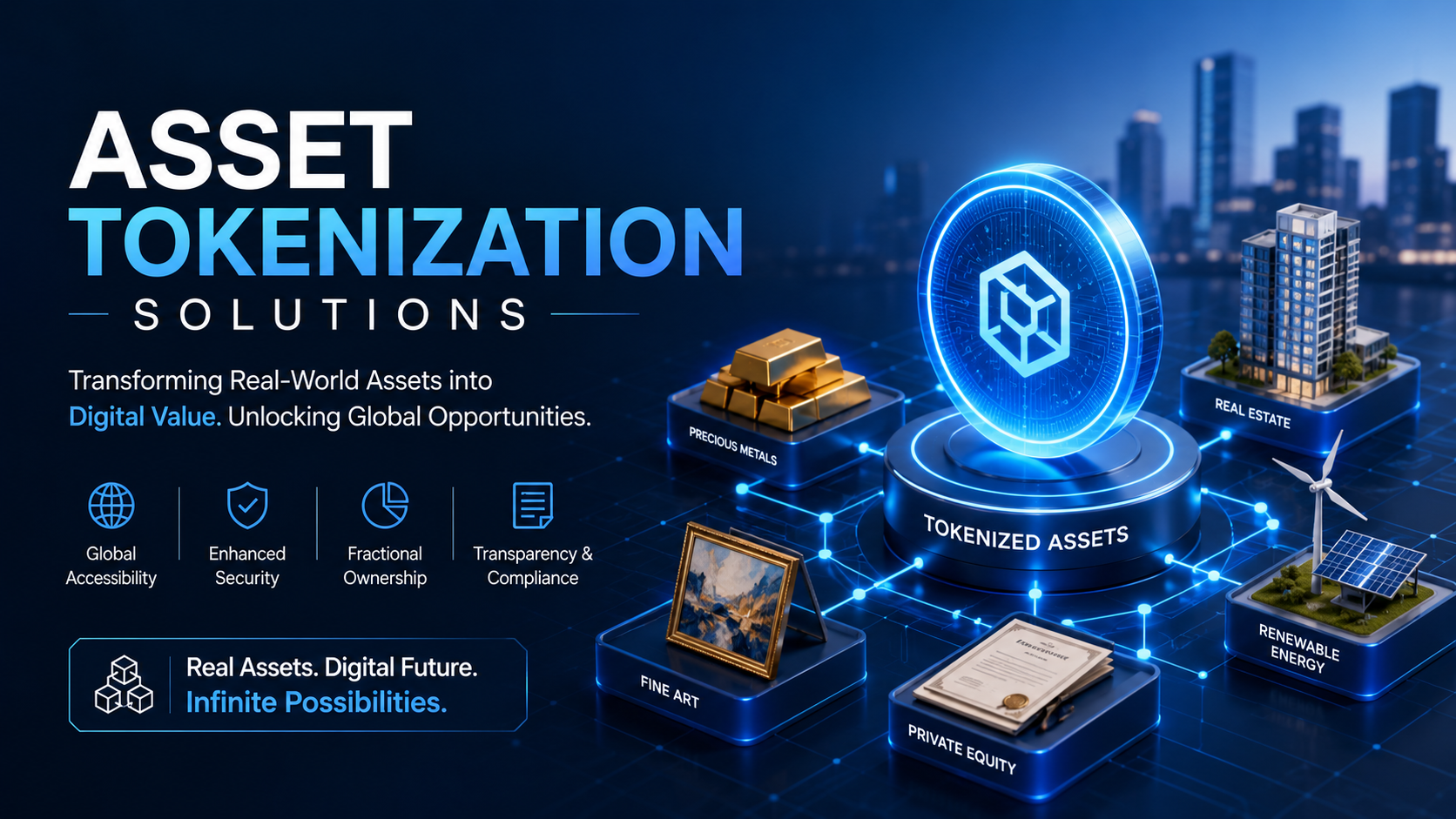
Capital markets have traditionally operated through centralized intermediaries, paper-heavy processes, and slow settlement cycles. From equities and bonds to private credit and alternative assets, the infrastructure supporting these markets has remained largely unchanged for decades.
Asset tokenization solutions are introducing a new operational layer powered by blockchain technology, where financial instruments are represented as digital tokens. This shift is modernizing how assets are issued, traded, settled, and managed, enabling capital markets to operate with greater speed, transparency, and efficiency. Rather than replacing capital markets, tokenization is upgrading their underlying infrastructure into a more programmable and interconnected system.
Understanding Asset Tokenization in Capital Markets
Asset tokenization is the process of converting rights to real-world or financial assets into digital tokens recorded on a blockchain. These tokens represent ownership, revenue rights, debt obligations, or fractional interests in underlying assets. In capital markets, tokenization applies to instruments such as equities, bonds, funds, real estate securities, and private market assets. Each token carries embedded rules governed by smart contracts, defining how it can be transferred, traded, or redeemed. This transforms static financial instruments into programmable assets that can interact directly with digital financial infrastructure.
How Tokenization Solutions Are Transforming Market Infrastructure
1. Faster Issuance of Financial Instruments
Traditional capital market issuance involves multiple intermediaries, extensive documentation, underwriting processes, and regulatory approvals. This makes capital formation slow and costly. Asset Tokenization solutions streamline issuance by digitizing asset creation through smart contracts. Financial instruments can be issued directly on-chain, reducing administrative overhead and accelerating time-to-market for new securities.
2. Real-Time Settlement and Reduced Counterparty Risk
One of the most significant inefficiencies in traditional markets is settlement delay. Transactions often take T+2 or longer to finalize, exposing participants to counterparty risk. Tokenized capital markets enable near-instant or atomic settlement, where payment and asset transfer occur simultaneously on-chain. This reduces settlement risk and increases operational efficiency across trading systems.
3. Fractional Ownership and Broader Market Access
Asset tokenization enables fractionalization of high-value financial instruments, allowing investors to purchase smaller units of ownership.
This expands market participation beyond institutional investors to include retail and global participants. It also increases liquidity in traditionally illiquid markets such as private equity, real estate funds, and infrastructure assets.
4. Improved Liquidity Across Traditionally Illiquid Assets
Many capital market assets suffer from low liquidity due to long holding periods and limited secondary markets. Tokenization introduces secondary trading capabilities for these assets through digital exchanges and marketplaces. This enhances price discovery, reduces exit barriers, and improves overall capital efficiency.
Operational Modernization Through Tokenization Solutions
1. Smart Contract Automation of Financial Processes
Smart contracts automate key capital market functions such as dividend distribution, coupon payments, compliance checks, and corporate actions. This reduces reliance on manual processing and intermediaries, ensuring faster and more accurate execution of financial operations
2. Transparent and Immutable Transaction Records
Blockchain-based systems provide a permanent and auditable record of all transactions. This enhances transparency for regulators, auditors, and investors. Unlike traditional systems that rely on fragmented databases, tokenized systems ensure a single source of truth across market participants.
3. Integrated Compliance and Regulatory Enforcement
Capital markets are heavily regulated, and compliance requirements vary across jurisdictions. Tokenization solutions embed compliance rules directly into digital assets through programmable logic. KYC, AML, investor eligibility checks, and transfer restrictions can be enforced automatically, reducing compliance risk and operational burden.
4. Streamlined Asset Servicing and Lifecycle Management
Tokenization enables continuous asset servicing, including automated dividend payments, interest distribution, and corporate actions. Lifecycle events are executed through smart contracts, ensuring consistency and reducing manual intervention across asset management operations.
Technological Foundations of Tokenized Capital Markets
Blockchain Infrastructure
Blockchain provides the foundational ledger system that records ownership, transactions, and asset states in a secure and decentralized manner.
Smart Contracts
Smart contracts act as programmable financial logic, executing predefined rules without intermediaries. They govern issuance, transfer, compliance, and settlement processes.
Interoperability Protocols
Modern tokenization systems rely on interoperability layers that allow assets to move across different blockchains and financial ecosystems, improving liquidity and accessibility.
Digital Identity Systems
Identity verification frameworks ensure that only authorized participants can interact with regulated financial assets, supporting compliance and security.
Business Benefits for Capital Market Participants
1. Reduced Operational Costs
Automation reduces the need for manual reconciliation, intermediaries, and administrative workflows, lowering operational expenses.
2. Faster Capital Formation
Tokenization accelerates fundraising cycles by enabling faster issuance and onboarding of investors.
3. Enhanced Market Transparency
Real-time transaction visibility improves trust among investors and regulators.
4. Expanded Investor Base
Fractional ownership and global accessibility increase participation across retail and institutional investors.
5. Improved Asset Liquidity
Secondary markets for tokenized assets enhance liquidity in traditionally illiquid financial instruments.
Use Cases of Tokenized Capital Market Solutions
Asset managers use tokenization to issue digital fund shares with automated dividend distribution. Banks and financial institutions explore tokenized bonds to streamline issuance and settlement processes.
Private equity firms leverage tokenization to unlock liquidity in long-term investments. Infrastructure financing projects use tokenized securities to attract global investors through fractional participation. Even governments are exploring tokenized sovereign bonds to improve transparency and efficiency in public debt markets.
Challenges in Modernizing Capital Markets Through Tokenization
Despite its advantages, tokenization faces challenges including regulatory fragmentation across jurisdictions, integration with legacy financial systems, and standardization of token formats.
Market adoption also requires coordination among regulators, exchanges, custodians, and financial institutions. Security risks and technological maturity of blockchain infrastructure remain key considerations.
Future Outlook: Fully Digital Capital Market Ecosystems
The future of capital markets is moving toward fully digital, blockchain-based ecosystems where assets are issued, traded, and settled in real time.
Artificial intelligence will enhance risk assessment and asset pricing, while interoperability between financial networks will enable seamless global liquidity.
Over time, capital markets are expected to evolve into continuously operating, programmable financial systems with minimal friction and maximum transparency.
Conclusion
Asset tokenization solutions are fundamentally modernizing capital market operations by improving speed, reducing costs, increasing transparency, and expanding investor access.
By transforming traditional financial instruments into programmable digital assets, tokenization enables a more efficient and inclusive capital market structure.
As adoption accelerates, tokenized infrastructure is likely to become a foundational layer of next-generation global financial systems, redefining how value is created, exchanged, and managed.