
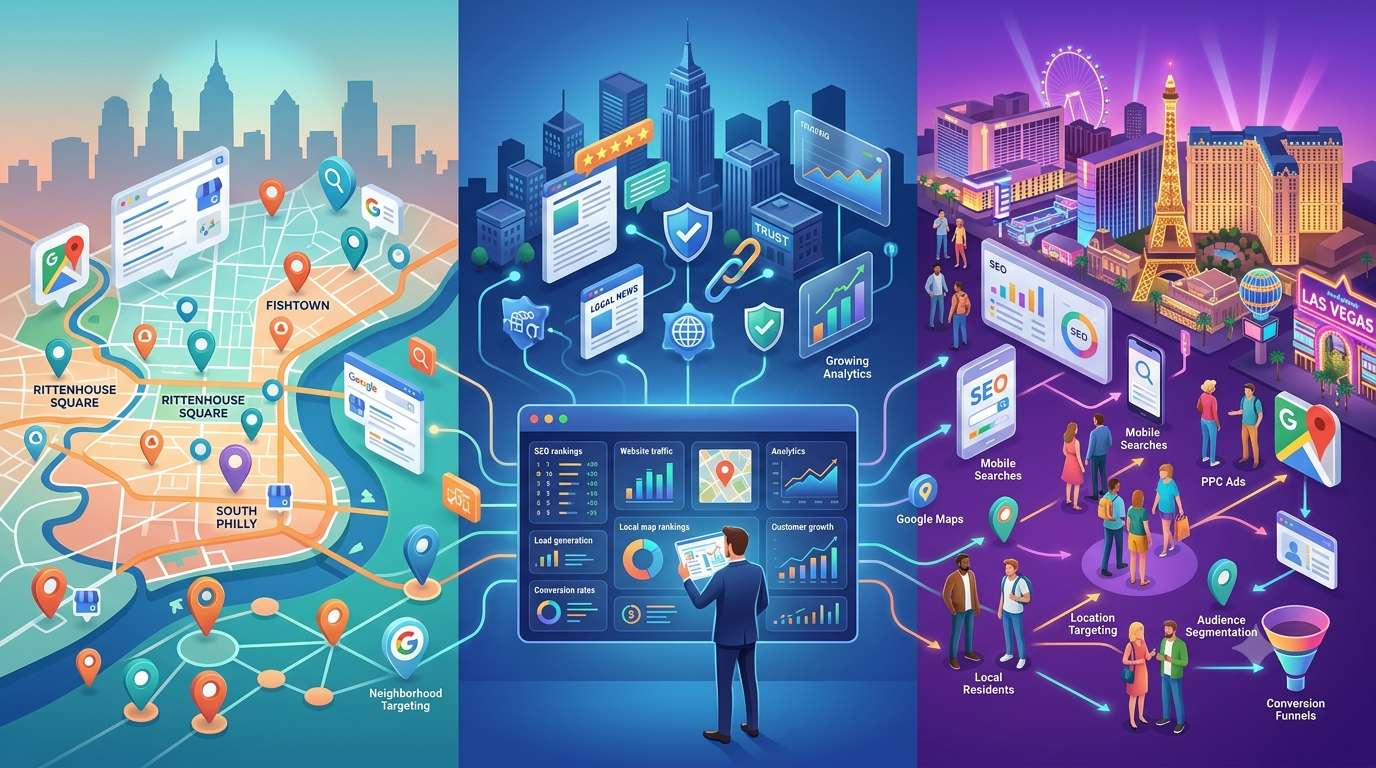
Businesses expanding into a new city often assume their existing marketing strategy will simply transfer over with a bigger budget. In practice, each city has its own competitive landscape, its own customer behavior, and its own search patterns. A strategy that performs well in one market can underperform badly in another, even when both cities are similar in size.
This article looks at three distinct US markets, Philadelphia, Baltimore, and Las Vegas, and what each one demands from a digital marketing strategy.
Why does market context matter this much?
Search engines rank results locally, which means a business is really only competing against other businesses in its own city or neighborhood, not against every business nationwide. That local competition shapes everything from keyword difficulty to what kind of content actually earns trust.
Customer behavior also shifts by city. Some markets respond well to detailed, research heavy content, while others are driven more by reviews, urgency, or brand recognition built over decades. Understanding these differences upfront prevents wasted budget on a strategy that was never suited to the market in the first place.
What does Philadelphia’s market demand from a digital marketing strategy?
Philadelphia is entering a particularly active period, with major events and anniversary celebrations expected to draw significant visitor traffic in the coming years. For businesses in hospitality, retail, and professional services, this creates a real opportunity, but only for those positioned to capture it.
The city’s local search market is shaped by strong neighborhood identity. Residents in areas like Fishtown, Rittenhouse Square, and South Philly search with a level of geographic specificity that a citywide campaign often misses entirely. A digital marketing agency in Philadelphia that understands this neighborhood level structure, along with the local publications and community signals that carry real backlink value in the city, is positioned to capture demand that a generic, broad based strategy would leave on the table.
Businesses that invest in this kind of targeted, neighborhood aware strategy now are also positioning themselves ahead of the increased competition that Philadelphia’s growing visibility is likely to bring over the next few years.
What makes Baltimore a different kind of market?
Baltimore’s digital landscape is shaped heavily by long established local institutions and a strong sense of civic identity. Unlike newer, rapidly expanding markets, Baltimore rewards businesses that build trust over time rather than those relying purely on aggressive advertising or short term visibility tactics.
This means content strategy matters more here than in some other markets. A digital marketing agency in Baltimore that understands how to build authority within the local community, through consistent, credible content and genuine local engagement, tends to outperform an approach built solely around paid visibility.
Baltimore’s business landscape also includes a mix of long standing institutions and newer, growing companies competing for the same local search terms. A strategy that accounts for this mix, rather than treating every competitor the same way, produces a much clearer path to standing out.
Why does Las Vegas require an entirely different approach?
Las Vegas presents a unique challenge that few other US cities share. A significant share of search traffic comes from tourists rather than local residents, which means businesses need a strategy that can distinguish between these two very different audiences and speak to each one appropriately.
A digital marketing agency in Las Vegas needs to filter out irrelevant tourist search traffic when targeting local residents, while also building visibility for businesses that specifically want to capture visitor spending. These are often two separate strategies running at once, something a generic national approach rarely accounts for.
Las Vegas also has a resident population that shifts more than many other cities, driven by an economy heavily tied to hospitality and service industries. This turnover means local SEO and reputation building require more consistent, ongoing attention than in cities with a more stable, long term resident base.
What patterns show up across all three markets?
Even with these differences, a few principles apply consistently. Local relevance beats generic messaging in every case. Content and campaigns built around the specific realities of a market, whether that is neighborhood identity in Philadelphia, institutional trust in Baltimore, or the resident versus tourist divide in Las Vegas, consistently outperform broad, one-size-fits-all approaches.
Consistency also matters everywhere. Businesses that maintain a steady presence, whether through content, reviews, or local engagement, tend to build stronger long term visibility than those running short bursts of activity followed by long gaps.
How should businesses adjust budget based on these market differences?
In Philadelphia, budget should account for the increased competition likely to arrive alongside the city’s growing visibility, making early investment in neighborhood specific strategy particularly valuable right now.
In Baltimore, budget is often better spent on content and reputation building over time rather than heavy short term advertising, since trust building in this market tends to pay off gradually rather than immediately.
In Las Vegas, budget frequently needs to be split between resident focused local SEO and visitor focused visibility campaigns, since these two audiences require different messaging, different keywords, and often different landing pages entirely.
What mistakes do businesses make when expanding into these markets?
One common mistake is applying a single national strategy across all three cities without adjusting for local dynamics. A campaign built around broad, citywide messaging tends to underperform in Philadelphia’s neighborhood driven search environment just as much as it does in Las Vegas’s split resident and tourist audience.
Another mistake is underestimating how much local trust matters in a market like Baltimore, where newer businesses sometimes rely too heavily on paid visibility instead of building the kind of credibility that earns long term customer loyalty.
Some businesses also fail to separate their Las Vegas strategy into resident and visitor segments, wasting budget targeting tourist search intent when their actual goal is building a loyal local customer base, or the reverse.
Should every business tailor its strategy to these specific cities?
The short answer
Yes, for any business operating in Philadelphia, Baltimore, or Las Vegas specifically, understanding these local dynamics leads to a stronger, more cost effective strategy than a generic national approach.
When it matters most
This tailored approach matters most for businesses entering a new market, businesses competing against well established local institutions, or businesses in cities with a meaningful divide between resident and visitor search behavior.
When a broader approach may still work
Businesses selling purely online, without a strong local or in-person component, may need less market specific adjustment, though local reputation and reviews still influence customer trust in most industries.
The verdict
Philadelphia, Baltimore, and Las Vegas each reward a different kind of digital marketing strategy, shaped by their own local search patterns, competitive landscape, and customer behavior. Businesses that adapt to these specific market realities, rather than applying the same playbook everywhere, consistently see stronger, more reliable results.