Search “motorbike trip to Ladakh” and you’ll find hundreds of dreamy photos of Pangong Lake at sunrise and riders posing at Khardung La with their arms up. What you won’t find easily is a straight answer to the practical question every planner eventually asks: how many days does this actually take, what does a normal day on the road look like, and what happens if things don’t go according to plan?
This blog answers exactly that. Royalbikeriders has put together this guide from the questions riders ask before booking, during planning calls, and even mid-trip when reality doesn’t quite match expectation. Consider this the practical companion to the postcard version of Ladakh.
How Many Days Should You Actually Set Aside?
The number that gets thrown around most is 10 days, but that figure only works if nothing goes wrong, no landslide-blocked roads, no extra rest day needed for altitude, no bad weather pinning you down at a mountain pass. A more realistic window is 12 to 14 days if you’re starting and ending in Delhi, which accounts for:
- Travel time to reach Manali or Srinagar from Delhi (roughly a day, sometimes overnight)
- Actual riding days through the Ladakh loop (typically 7-9 days depending on route)
- At least one full acclimatization day in Leh
- A buffer day for weather, road closures, or an off day if someone in the group isn’t feeling well
- Return travel
Riders who compress this into 7-8 days often end up skipping the acclimatization day, which is exactly the kind of shortcut that leads to altitude sickness mid-trip. If your schedule genuinely can’t stretch beyond a week, it’s worth reconsidering the trip length rather than the safety buffer.
What Does a Typical Day on the Road Actually Look Like?
Most riding days in Ladakh start early, often before 7 AM because mountain weather tends to be calmer in the morning and deteriorates by afternoon, especially around high passes where wind and cloud cover build up as the day goes on.
A normal day involves 150 to 250 kilometres of riding, which sounds short compared to highway distances back home, but mountain roads at altitude take far longer per kilometre than flat terrain. Expect frequent stops not just for photos, but for water crossings, landslide-cleared sections where BRO crews are actively working, and simple breathing breaks at higher altitudes where riders sometimes need a moment before continuing.
Lunch is usually at a roadside dhaba or a designated stop along the route, and most groups aim to reach the day’s accommodation before dark, since riding unfamiliar mountain roads at night is genuinely risky. Evenings are typically low-key early dinner, gear maintenance checks, and rest, because the next morning starts the cycle again.
Self-Planned Trip vs. Guided Expedition What’s the Real Difference?
Riders often assume the only difference between doing it yourself and booking with an operator is cost, but the gap is really about margin for error.
Planning your own trip means booking your own accommodation (which can be genuinely difficult to secure last-minute during peak season), figuring out permits yourself, carrying your own spares and tools, and having no immediate backup if your bike breaks down between towns. It also means total flexibility to stop where you want, skip what you don’t care about, and extend a stay if a place captures you.
A guided trip through an operator like Royalbikeriders removes most of the logistical uncertainty; accommodation is pre-booked, permits are handled before the group even starts, a mechanic and support vehicle travel with the group, and a road captain who has ridden the route dozens of times manages pacing and route decisions. The trade-off is less spontaneity, but for a first Ladakh trip, most riders find that trade worth making.
What’s the Honest Truth About the Cold?
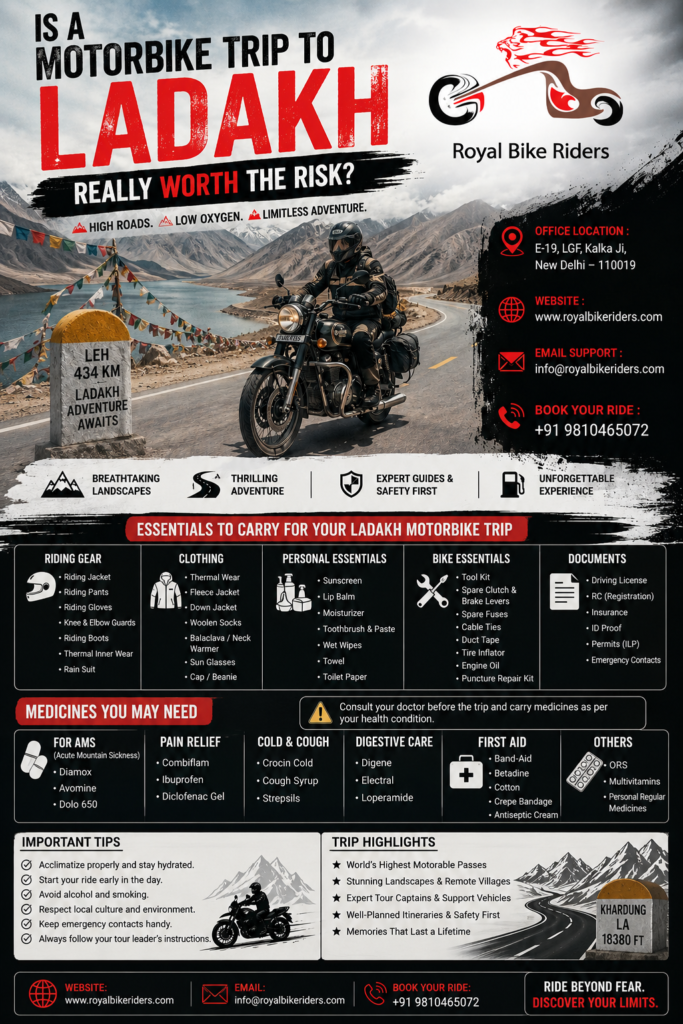
Riders read about Ladakh’s cold in theory, but the on-ground experience surprises almost everyone. Even in July and August, mornings can dip close to freezing at higher elevations, and wind chill at a pass like Khardung La can make it feel far colder than the thermometer suggests. Riding gear that felt like overkill packing at home in Delhi’s summer heat becomes essential within the first two days.
The trick isn’t just bringing warm layers, it’s layering correctly. A base thermal layer, a mid-layer for insulation, and a windproof/waterproof riding jacket outer shell handles most conditions if you can add or remove layers as the day’s temperature shifts. Cold hands are the most common complaint among first-timers, so proper riding gloves rated for cold weather, not just standard summer riding gloves, make a bigger difference than most people expect.
How Do Riders Handle the Isolation of the Ladakh Highway?
Long stretches of the Manali–Leh and Srinagar–Leh routes pass through genuinely remote terrain with no towns, sometimes no other vehicles in sight for long periods, and no phone signal. For some riders this isolation is the entire appeal of the trip; for others it takes adjustment.
Groups traveling together tend to handle this better simply because there’s company at every stop, and a support vehicle nearby means isolation doesn’t equal vulnerability. Solo riders attempting the same stretch need to be far more self-sufficient carrying extra fuel where fuel stations are sparse such as between Manali and Leh, where petrol pumps are limited , extra food and water, and a realistic mental picture of how far help actually is if something goes wrong.
What Should First-Timers Expect Emotionally From This Trip?
This part rarely gets discussed, but it matters. Ladakh isn’t just physically demanding, it’s mentally different from most travel experiences. The scale of the landscape, the silence, the thin air, and the sheer remoteness can hit riders in unexpected ways. Some describe a kind of quiet euphoria standing at a high pass; others find the isolation and physical strain more overwhelming than anticipated, especially by day four or five when fatigue accumulates.
Both reactions are normal. What helps is simply knowing beforehand that Ladakh will demand something emotionally as well as physically, so it doesn’t come as a surprise partway through the trip.
Final Thoughts
A motorbike trip to Ladakh rewards riders who plan around reality rather than the highlight reel. Give yourself enough days, respect the cold and the altitude, decide honestly whether you want the flexibility of going solo or the safety net of a guided trip, and go in knowing the isolation is part of the experience, not a flaw in it. Royalbikeriders has guided riders through this exact terrain long enough to know that the trips people remember most fondly aren’t the ones that went perfectly, they’re the ones where preparation met the unexpected, and the ride still turned out unforgettable.
Frequently Asked Questions
Q1. What is the minimum number of days needed for a Ladakh motorbike trip?
A realistic minimum is 10 days if starting and ending in Delhi, though 12-14 days is recommended to include acclimatization and buffer days for weather or road delays.
Q2. How many kilometres do riders typically cover in a day?
Between 150 and 250 kilometres per day is standard on Ladakh’s mountain routes, since altitude, road conditions, and frequent stops make progress slower than flat-road riding.
Q3. Is it better to book fuel stops in advance?
Yes, especially between Manali and Leh, where petrol pumps are limited and spaced far apart. Carrying extra fuel in a jerry can is common practice on this stretch.
Q4. What kind of gloves and jacket work best for the cold? Cold-weather-rated riding gloves and a jacket with a removable thermal liner and windproof outer shell handle Ladakh’s temperature swings far better than standard summer riding gear.
Q5. Should I choose a self-planned trip or a guided tour for my first Ladakh ride?
For first-time riders, a guided expedition with an operator like Royalbikeriders is generally recommended, since it removes major uncertainties around accommodation, permits, and emergency backup support.
Q6. Is the isolation on Ladakh’s highways dangerous?
It isn’t inherently dangerous, but it requires preparation for extra fuel, food, and water for solo riders, and ideally traveling with others or a support vehicle so help isn’t far away if something goes wrong.
OFFICE LOCATION : E-19, LGF, Kalka Ji, New Delhi – 110019
WEBSITE : www.royalbikeriders.com
EMAIL SUPPORT : [email protected]
BOOK YOUR RIDE : +91 9810465072