
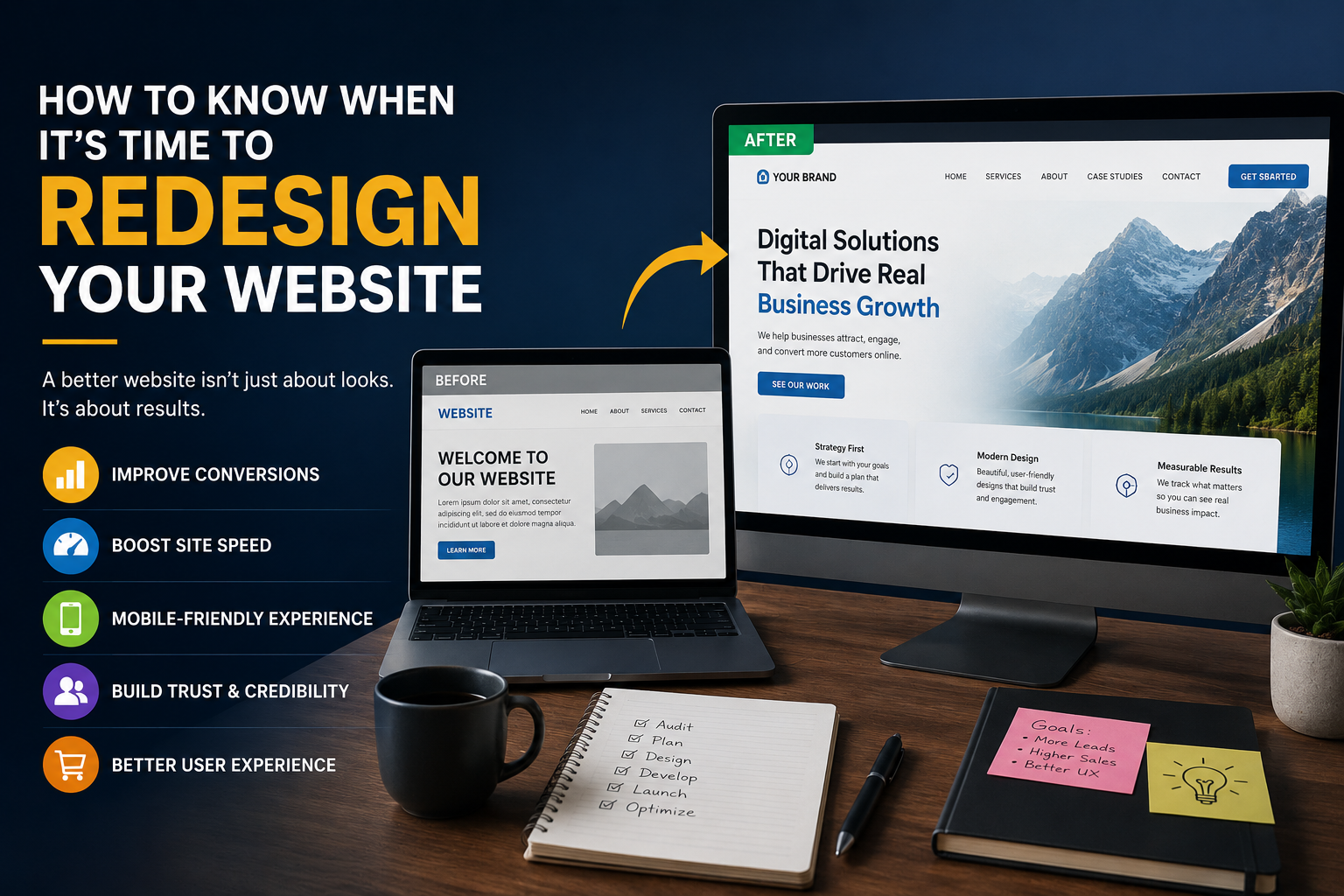
A website rarely fails all at once. It happens gradually — a slower load time here, an outdated layout there, a checkout flow that used to convert but doesn’t anymore. By the time most businesses notice, they’ve been quietly losing customers for months. Knowing when — and how — to redesign is one of the most consequential decisions a growing business makes.
The Signs You’re Overdue for a Redesign
A few warning signs tend to show up across every industry:
- Traffic is steady, but conversions are dropping
- The site looks noticeably dated compared to competitors
- It’s difficult or slow to update content
- Mobile users bounce faster than desktop users
- The design no longer reflects what the business actually does
If more than one of these sounds familiar, the site isn’t just due for a facelift — it’s likely costing you revenue.
Ecommerce: Where Redesigns Pay for Themselves Fastest
Few industries feel the cost of an outdated site as directly as ecommerce. Every extra click, every confusing menu, and every slow-loading product page translates directly into lost sales. Our ecommerce website redesign guide walks through the full process — from auditing your current funnel to rebuilding product pages, navigation, and checkout around how customers actually shop.
The most common mistake in an ecommerce redesign is treating it as a visual refresh rather than a conversion project. A redesign that doesn’t improve page speed, mobile checkout, and product discoverability isn’t solving the problem — it’s just repainting it. The businesses that get the most value out of a redesign go in with clear goals: fewer abandoned carts, faster load times, and a cleaner path from homepage to purchase.
B2B Sites Have a Different Job to Do
Not every business is selling directly to consumers, and B2B websites need to be judged by a different standard. Visitors aren’t impulse-buying — they’re researching, comparing, and often bringing a proposal back to a team before making a decision. Our guide to b2b website design covers how to build a site that supports that longer, more considered buying process: clear value propositions, credibility signals like case studies and client logos, and content that speaks to decision-makers at different stages of evaluation.
A B2B redesign done well doesn’t just look more professional — it shortens the sales cycle by answering the questions prospects would otherwise have to ask a salesperson directly.
Healthcare Sites Carry Extra Responsibility
Healthcare websites face a unique combination of pressures: patients need to find information quickly, often while anxious or in a hurry, and the site has to meet accessibility and compliance standards that most industries don’t worry about. A healthcare website redesign needs to prioritize clear navigation, fast access to appointment booking, mobile usability, and content that’s easy to scan under stress — all while staying compliant with privacy and accessibility requirements.
Getting this wrong doesn’t just hurt conversions. It can mean a patient gives up and calls a competitor instead, or worse, can’t find critical information when they need it most.
What Every Successful Redesign Has in Common
Regardless of industry, the redesigns that actually move the needle share a few traits:
- They start with data, not opinions. Analytics, heatmaps, and user behavior should drive decisions — not internal preference for a color scheme.
- They’re built around a clear goal. More leads, more sales, better patient engagement — a redesign without a defined objective tends to drift.
- They don’t ignore mobile. For most industries, mobile traffic now outweighs desktop, and a redesign that treats mobile as an afterthought is already behind.
- They plan for what comes after launch. A redesign isn’t a one-time event — ongoing testing and iteration are what turn a good launch into a lasting improvement.
Redesigning With Purpose
A website redesign is one of the few investments a business makes that touches nearly every part of the customer journey at once — first impression, trust, navigation, and ultimately, conversion. Whether you’re rebuilding an ecommerce storefront, a B2B lead-generation site, or a healthcare platform patients depend on, the goal is the same: a site that works as hard as the business behind it.