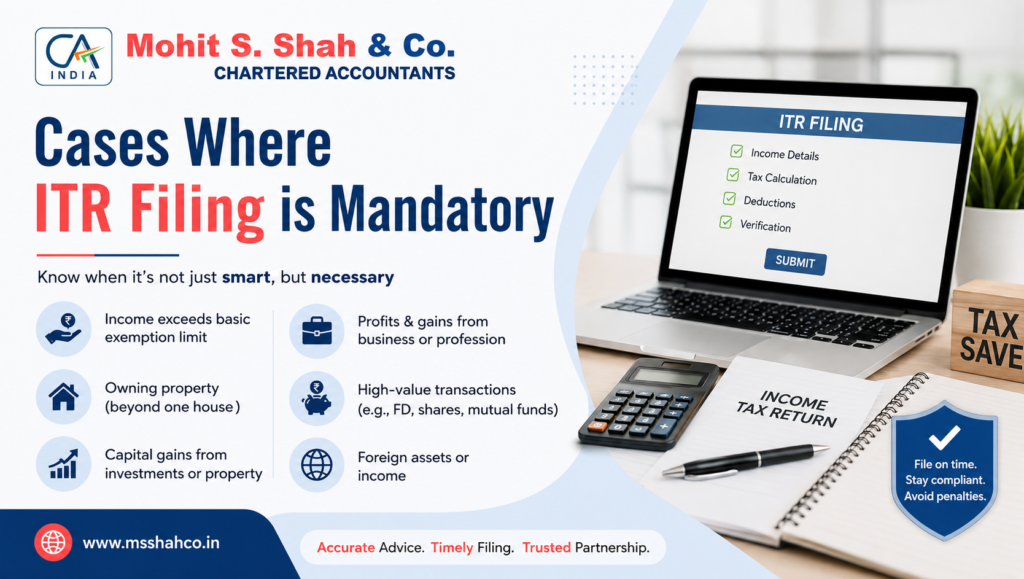
Filing an Income Tax Return (ITR) is one of the most important financial responsibilities for taxpayers in India. While many people believe that ITR filing is only required when their income exceeds the basic exemption limit, the Income Tax Act prescribes several other situations where filing an ITR becomes compulsory.
Understanding the Cases Where ITR Filing is Mandatory can help individuals, professionals, business owners, and investors remain compliant with tax regulations and avoid penalties. In this guide, Mohit S. Shah & Co explains the key scenarios where filing an Income Tax Return is mandatory in India.
What is Income Tax Return (ITR)?
An Income Tax Return (ITR) is a form submitted to the Income Tax Department that reports an individual’s or entity’s income, deductions, taxes paid, and tax liabilities for a financial year.
Filing an ITR not only ensures compliance with tax laws but also provides benefits such as:
- Easy loan approvals
- Visa processing support
- Claiming tax refunds
- Carrying forward losses
- Financial transparency
Cases Where ITR Filing is Mandatory
1. Income Exceeds the Basic Exemption Limit
The most common case where ITR filing is mandatory is when your gross total income exceeds the prescribed exemption limit before claiming deductions under Chapter VI-A.
Generally:
- Individuals below 60 years: Income exceeds the applicable threshold under the chosen tax regime.
- Senior Citizens (60-80 years): Higher exemption limits may apply.
- Super Senior Citizens (80+ years): Additional relaxation may be available under applicable provisions.
If your income exceeds the specified limit, filing an ITR becomes compulsory.
2. Deposit of Large Amounts in Bank Accounts
ITR filing is mandatory if a person has deposited substantial amounts in one or more current accounts during the financial year.
For example:
- Cash deposits exceeding prescribed limits in current accounts.
- Large financial transactions reported to tax authorities.
The Income Tax Department tracks high-value transactions, making return filing essential for compliance.
3. Foreign Travel Expenditure Exceeds Prescribed Limits
A taxpayer must file an ITR if they incur expenditure above the specified threshold on foreign travel for themselves or any other person.
This provision helps tax authorities monitor high-value spending patterns and ensure proper reporting of income sources.
4. High Electricity Consumption
Individuals who incur electricity expenses exceeding the prescribed limit during a financial year may be required to file an ITR, even if their taxable income falls below the exemption threshold.
This serves as an indicator of financial capacity and helps tax authorities identify potential non-filers.
5. Ownership of Foreign Assets
One of the important Cases Where ITR Filing is Mandatory involves foreign assets.
If an individual:
- Owns property outside India
- Holds foreign bank accounts
- Owns foreign shares or investments
- Has signing authority in a foreign account
ITR filing becomes compulsory, regardless of whether taxable income exceeds the exemption limit.
6. Foreign Income Earned During the Year
Residents earning income from foreign sources must disclose such income in their Income Tax Return.
Examples include:
- Salary received abroad
- Rental income from overseas property
- Dividends from foreign companies
- Capital gains from international investments
Proper disclosure helps avoid penalties and ensures compliance with Indian tax laws.
7. Claiming a Tax Refund
Even if your income is below the taxable threshold, filing an ITR becomes necessary if you wish to claim a refund of excess tax deducted through:
- TDS (Tax Deducted at Source)
- Advance Tax
- Self-Assessment Tax
Without filing a return, the refund cannot be processed.
8. Carry Forward of Capital Losses
Investors who incur losses in:
- Shares
- Mutual funds
- Real estate
- Other capital assets
must file their ITR within the due date to carry forward such losses for adjustment against future gains.
Failure to file on time may result in the loss of this tax benefit.
9. Companies and Firms
All companies registered under the Companies Act are required to file an Income Tax Return, irrespective of:
- Profit
- Loss
- Business activity level
Similarly, partnership firms and LLPs are generally required to file tax returns every year.
10. Individuals Holding Directorship in a Company
A person who serves as a director in any company is generally required to file an Income Tax Return, even if their income falls below the exemption threshold.
The Income Tax Department requires reporting of directorship details in the return.
11. Investment in Unlisted Equity Shares
Individuals who have invested in unlisted equity shares during the financial year are generally required to file an ITR.
The return captures details relating to:
- Purchase
- Sale
- Shareholding pattern
This helps maintain transparency in private company investments.
12. TDS or TCS Above Prescribed Limits
If Tax Deducted at Source (TDS) or Tax Collected at Source (TCS) exceeds the prescribed threshold during the financial year, filing an ITR may become mandatory.
This requirement ensures proper reconciliation between taxes deducted and income reported.
13. Business Owners and Professionals
Business owners and self-employed professionals whose turnover or receipts exceed prescribed limits must file their returns.
Examples include:
- Traders
- Consultants
- Doctors
- Architects
- Freelancers
- Chartered Accountants
ITR filing helps maintain compliance and facilitates financial credibility.
14. High Savings Bank Deposits
Individuals making aggregate deposits exceeding prescribed limits in savings accounts during a financial year may fall under mandatory filing requirements.
Banks report such transactions to tax authorities, making disclosure important.
15. Applying for Loans or Financial Products
Although not always legally mandatory, filing ITRs becomes practically essential when applying for:
- Home loans
- Personal loans
- Business loans
- Credit facilities
Most lenders require at least two to three years of ITR records.
Consequences of Not Filing ITR When Mandatory
Failing to file an Income Tax Return when required can lead to several consequences:
Late Filing Fees
A penalty may be imposed for delayed filing under applicable provisions of the Income Tax Act.
Interest on Tax Liability
Interest may be charged on unpaid taxes for delayed filing and payment.
Loss of Refund
Tax refunds may be delayed or forfeited if returns are not filed within prescribed timelines.
Inability to Carry Forward Losses
Capital and business losses may not be carried forward to future years.
Notices from Income Tax Department
Non-compliance may trigger scrutiny or notices from tax authorities.
Prosecution in Serious Cases
In cases involving substantial tax evasion, legal proceedings may be initiated.
Benefits of Timely ITR Filing
Apart from legal compliance, timely ITR filing offers multiple advantages:
- Faster refund processing
- Improved financial credibility
- Easier visa approvals
- Better loan eligibility
- Proper tax record maintenance
- Carry forward of losses
- Reduced risk of notices and penalties
Why Choose Mohit S. Shah & Co?
Understanding the various Cases Where ITR Filing is Mandatory can be challenging, especially with evolving tax regulations. Mohit S. Shah & Co provides professional tax advisory and return filing services for individuals, professionals, NRIs, businesses, LLPs, and companies.
Our team helps clients:
- Determine filing obligations
- Calculate tax liability accurately
- Maximize eligible deductions
- Ensure timely compliance
- Handle notices and assessments
- Manage international tax reporting
With years of experience in taxation and compliance, we ensure a smooth and hassle-free ITR filing process.
Conclusion
Knowing the various Cases Where ITR Filing is Mandatory is crucial for avoiding penalties and maintaining compliance with Indian tax laws. Whether your obligation arises from income levels, foreign assets, high-value transactions, directorship, investments, or business activities, timely filing remains essential.
Professional guidance can help ensure accurate reporting and compliance with changing regulations. Mohit S. Shah & Co offers expert assistance to help taxpayers navigate complex tax requirements and meet all filing obligations efficiently.
Contact Mohit S. Shah & Co
2nd Floor, Anant Building, 217, Shamaldas Gandhi Marg, Princess Street, Marine Lines (East), Mumbai – 400 002
Follow us: Registered with the Institute of Chartered Accountants of India
📞 +91-9821462283