There are some dogs that make a good first impression, and then there are dogs that quietly steal your heart before you even realize it. The Mini Cocker Spaniel belongs to the second group.
Maybe it’s those big, soulful eyes that seem to understand every emotion, or the way they excitedly greet you after you’ve been gone for only ten minutes. Whatever it is, people who own one often say the same thing: “This dog isn’t just a pet—it became part of the family.”
If you’ve been searching for a smaller version of the classic Cocker Spaniel, you’ve probably come across the term Mini Cocker Spaniel. You’ll see adorable puppies on social media, breeder websites, and pet forums, all described as “mini.” But what does that actually mean? Is it a separate breed? Is it healthy? And is it the right dog for your lifestyle?
Those are good questions because there’s plenty of confusing information online.
This guide cuts through the marketing and gives you practical, honest answers. Whether you’re thinking about bringing one home or you’re simply curious about the breed, you’ll learn what living with a Mini Cocker Spaniel is really like—from puppyhood to adulthood.
So… Is a Mini Cocker Spaniel Actually a Breed?
Let’s clear up the biggest misconception first.
The Mini Cocker Spaniel isn’t officially recognized as a separate breed. You won’t find it listed as its own breed by the American Kennel Club (AKC). Instead, the name is commonly used by breeders to describe a Cocker Spaniel that’s naturally smaller than average.
Some breeders selectively breed smaller dogs over several generations while still prioritizing health and temperament. Others simply have puppies that mature on the smaller side of the standard size range.
That’s very different from breeders who advertise “teacup,” “micro,” or “pocket” Cocker Spaniels. Those labels often focus on making the dog as tiny as possible, sometimes at the expense of its health. Extremely small puppies can be more prone to fragile bones, low blood sugar, heart problems, and other medical issues.
A healthy Mini Cocker Spaniel shouldn’t look delicate or unusually tiny. It should still have the sturdy body, cheerful personality, and athletic ability that Cocker Spaniels are known for—just in a slightly smaller package.
Why So Many Families Love Them
Every breed has its own personality, but Mini Cocker Spaniels have a way of fitting into almost any home.
They aren’t the type of dog that constantly demands attention, yet they genuinely enjoy being close to their people. If you’re working from home, don’t be surprised if they quietly settle beside your chair. If you’re watching a movie, they’ll happily curl up next to you. And if you decide it’s time for a walk, they’ll probably be waiting at the door before you’ve even picked up the leash.
That balance is what makes them so appealing.
They’re playful without being hyperactive.
Affectionate without becoming overwhelming.
Active enough to enjoy outdoor adventures but calm enough to relax indoors afterward.
It’s easy to see why they’ve become such a popular choice for families, couples, retirees, and even first-time dog owners.
A Quick Look at Their History
Long before Cocker Spaniels became beloved family companions, they had an important job to do.
Their ancestors were hunting dogs, bred to flush birds out of thick bushes so hunters could retrieve them. The name “Cocker” actually comes from the woodcock, a bird these dogs were especially skilled at finding.
As the breed became more popular in the United States, breeders gradually developed a smaller, more refined version that eventually became known as the American Cocker Spaniel.
Over time, some breeders noticed that naturally smaller dogs kept many of the breed’s wonderful qualities while being easier to manage in modern homes. That’s how the term “Mini Cocker Spaniel” began appearing, even though it’s not an official breed classification.
Despite their smaller size, they’ve never lost the cheerful, eager-to-please personality that made Cocker Spaniels famous in the first place.
First Impressions Matter—and This Breed Knows It
It’s hard to walk past a Mini Cocker Spaniel without smiling.
Their eyes are large and expressive, almost as if they’re constantly trying to start a conversation. Their ears hang low with soft, silky fur that gently swings as they walk. Add a constantly wagging tail and a happy expression, and it’s easy to understand why strangers often stop to say hello.
Unlike some toy breeds that appear fragile, Mini Cocker Spaniels have a balanced build. They look athletic rather than delicate, capable of running through the park one minute and sleeping on your lap the next.
Their coat is another feature that attracts attention.
Soft, slightly wavy, and feathered around the ears, legs, chest, and tail, it gives them an elegant appearance without looking overly fancy.
Of course, that beautiful coat also comes with responsibility—but we’ll talk about grooming later.
How Big Do Mini Cocker Spaniels Get?
One reason many people choose this breed is because it’s easier to manage than a full-sized sporting dog while still feeling like a “real dog.”
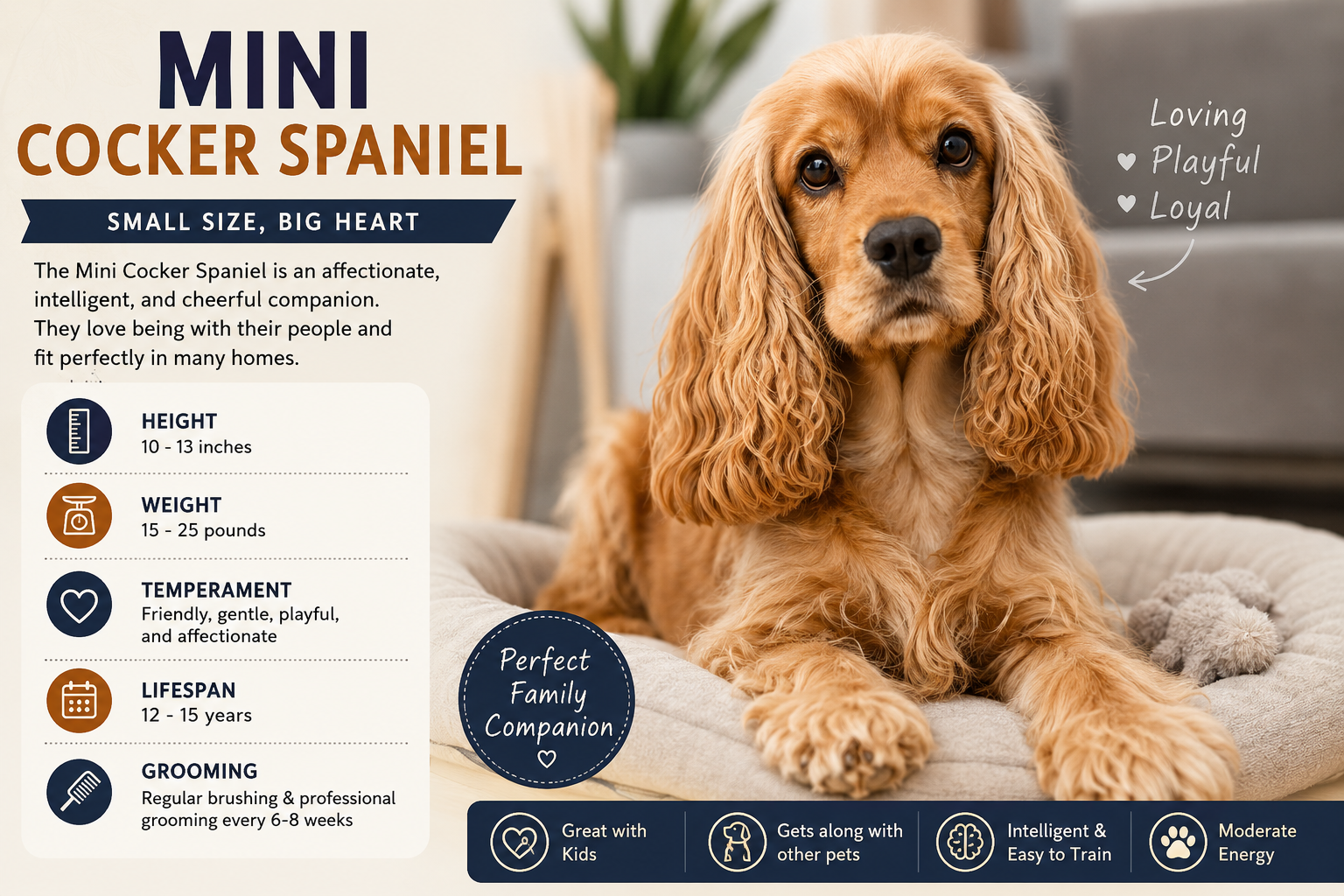
Most healthy Mini Cocker Spaniels stand somewhere between 10 and 13 inches tall and usually weigh 15 to 25 pounds once fully grown.
That size makes everyday life surprisingly convenient.
They’re light enough to lift into the car when needed, small enough to fit comfortably in most apartments, yet large enough to enjoy hiking trails, parks, and family vacations without tiring too quickly.
People sometimes expect “mini” to mean tiny enough to fit inside a handbag, but that’s not what responsible breeders aim for.
Think of them as compact rather than miniature.
Every Mini Cocker Spaniel Has Its Own Look
No two puppies are exactly alike.
Some inherit rich golden coats that almost glow in the sunlight. Others develop deep chocolate coloring with bright hazel eyes. You’ll also find black, cream, buff, silver, parti-colored, and black-and-tan variations.
As puppies, their coats are often fluffier than they will be as adults. Around six to twelve months of age, many begin developing the longer feathering that’s so characteristic of the breed.
Their ears grow more elegant.
Their coat becomes silkier.
Their face matures, but those expressive eyes never seem to lose their puppy-like charm.
Living With One Is Different Than Looking at Pictures
Photos make Mini Cocker Spaniels look adorable.
Living with one is even better—but it’s also a little messier.
They’ll probably follow you into the kitchen just in case a piece of chicken accidentally falls.
They’ll carry one favorite toy around the house for months.
They’ll greet visitors as though they’ve reunited with a long-lost friend.
And yes, they’ll occasionally forget that muddy paws and clean floors don’t go well together.
Owners often describe them as emotional dogs.
If you’re excited, they’re excited.
If you’re feeling down, they’ll quietly sit beside you without asking for anything.
That emotional awareness is one reason so many therapy programs use Cocker Spaniels. They naturally enjoy human company and often seem surprisingly tuned in to people’s moods.
Are They Good With Children?
In most homes, yes.
Mini Cocker Spaniels tend to be patient, playful, and gentle with respectful children.
They enjoy games in the backyard, walks around the neighborhood, and simply being involved in whatever the family is doing.
That said, no dog should ever be treated like a stuffed toy.
Young children should always learn how to approach dogs calmly, avoid pulling ears or tails, and give them space when they’re eating or sleeping.
Teaching children how to respect a dog is just as important as teaching the dog good manners.
When both sides understand those boundaries, Mini Cocker Spaniels often become lifelong best friends with the kids they grow up alongside.
They Don’t Just Want a Home—They Want a Family
One thing future owners sometimes underestimate is just how people-oriented this breed is.
Mini Cocker Spaniels don’t simply enjoy company.
They need it.
They’re happiest when they feel included in daily life, whether that’s joining you on errands, relaxing while you read, or simply sitting nearby while you answer emails.
If left alone for long hours every day, some may become bored or anxious. That can lead to unwanted behaviors like barking, chewing, or digging—not because they’re “bad dogs,” but because they’re lonely.
If your schedule keeps you away from home most of the day, it’s worth thinking about whether another family member, a dog walker, or doggy daycare could help break up those long hours.
A happy Mini Cocker Spaniel is usually one that spends plenty of time with the people it loves.