
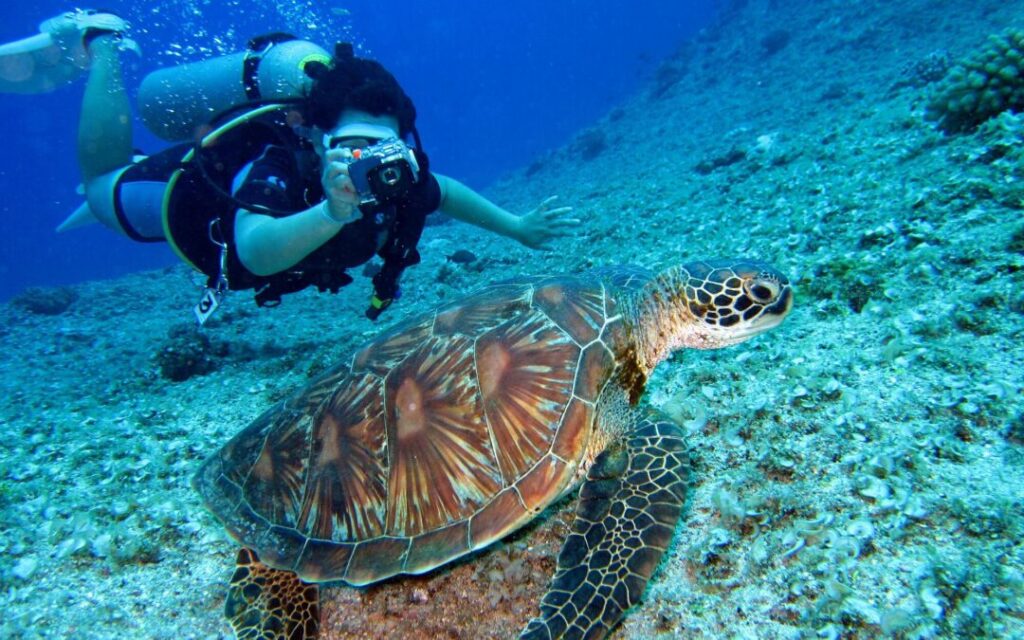
There are dive destinations, and then there is Tulamben. Sitting quietly on Bali’s northeastern coast, this small black-pebble village has built a reputation among serious divers that far outweighs its size. No crowded beach clubs, no rooftop bars facing a famous sunset, just dark volcanic shoreline, clear warm water, and marine life that rewards anyone willing to slow down and look closely.
If you have been putting off driving from Bali’s south, stop putting it off.
The Wreck That Changed Everything
No honest conversation about Tulamben dive sites begins anywhere other than the USAT Liberty. An American cargo vessel torpedoed by a Japanese submarine in January 1942, the ship was beached near the village after taking on water. Two decades later, the 1963 eruption of Mount Agung shifted the seabed and sent the hull rolling into the shallows, where it now rests at depths between five and twenty-nine metres.
That range shallow enough for beginners, deep enough to interest technical divers is part of what makes the Liberty so extraordinary. But depth alone does not explain the devotion it inspires. Six decades on the seafloor have transformed rusting steel into a living structure of genuine complexity. Giant barrel sponges anchor to the bow. Sea fans colonise the stern. Lionfish hang motionless in the dark recesses of the interior, where a dive torch reveals crayfish and blue-ringed octopus tucked into engine fittings that have not moved since 1942.
The wreck’s most dramatic residents are the bumphead parrotfish. Groups of forty or more circle the hull in the early morning, heavy prehistoric-looking fish with calcified foreheads and a grinding feeding habit audible underwater. Watching them move across the bow at dawn, lit by the first filtered light pushing through the surface, is one of those underwater moments that earns a long-haul flight on its own. Pygmy seahorses hide in the sea fans. Hawksbill turtles glide past the upper deck with complete indifference to the divers below them.
Dive the Liberty twice, once at dawn and once in the afternoon. The wreck changes completely depending on the light and the hour.
Five Sites Worth Your Time
The Liberty earns the headlines, but the surrounding coast fills out a week of diving without repetition.
Tulamben Drop-Off begins at a shallow coral terrace a short swim from the wreck and descends vertically into open blue. The wall here is dense with nudibranchs in unusual varieties, garden eels swaying from the sandy base, and schools of trevally that appear without warning and vanish just as fast. Visibility frequently stretches past twenty-five metres, and the current stays mild enough for photographers who want to hover and compose rather than drift and grab.
Coral Garden is the site to bring newer divers or anyone who wants a calmer, shallower profile. Staghorn and table corals spread across the slope in good condition. Clownfish defend their anemones with outsized aggression. Hawksbill turtles graze through the reef on their own schedule, unbothered. There is a pastoral, unhurried quality here that makes it easy to extend a dive well past the planned time.
The River Mouth, sometimes listed as Seraya Secrets by local operators, is where macro enthusiasts lose themselves entirely. The sandy rubble slope holds flamboyant cuttlefish hunting openly, mimicking octopus cycling through impressions of flatfish and lionfish, and ghost pipefish hovering near feather stars in pairs. One slow dive across this site can fill a camera card and leave a dozen subjects unfinished.
Drop Zone and Batu Kelebit extend the options for those staying longer, offering wall diving and occasional larger pelagic encounters when current conditions are right.
What Shore Diving Actually Means
One of Tulamben’s less-discussed advantages is its structure as a shore dive destination. Most of the best sites are accessible directly from the beach. You walk across the black volcanic pebbles, wade in, and descend when you are ready. There are no boat schedules, no group briefings at fixed hours, no waiting on weather windows that may or may not arrive.
This freedom changes how you dive. When there is no boat returning to shore at a set time, the pace shifts. Divers who hover in one place genuinely still, breathing slowly, watching a single section of reef for several minutes see things that constant movement erases. A frogfish sitting motionless as a rock adjusts its lure slightly. Ghost pipefish that look like drifting algae rotate just enough to reveal their true shape. Tulamben dive sites reward stillness in a way that high-current, drift-heavy destinations rarely allow.
Mimpi Resort: Where the Diving Life Comes Together
Good diving needs good rest, and Tulamben’s accommodation options span a wide range. At the top of that range sits Mimpi Resort, a property that justifies the distance between its rates and those of the guesthouses lining the village road.
The resort sits directly on the waterfront. The Liberty wreck is a ten-minute walk. Bungalows are built in traditional Balinese style with carved wooden doors, open-air bathrooms with stone soaking tubs, and garden walls dense enough to make each unit feel genuinely private. The property is not large, which works in its favour; it never takes on the anonymous quality of a resort built purely for volume.
The feature that sets Mimpi apart from any other comfortable hotel in the area is its volcanic hot springs. Natural geothermal water, mineral-rich and properly warm, fills pools available to guests throughout the day. The routine that forms here is immediate and hard to give up: finish a morning dive, rinse gear, soak in the springs while the volcano sits in the distance. Finish an afternoon dive, watch the light shift, soak again. The physical contrast between cold Pacific water and warm spring water, repeated across several days, becomes something the body adjusts to quickly and resists surrendering.
The restaurant serves Indonesian and international dishes built on fresh local produce. The grilled fish often sourced close by appears on the specials board regularly and deserves to be ordered without second thought. Breakfasts are full and unhurried, which matters when the day ahead involves three dives and long walks across volcanic stone.
Staff manage the logistics of a dive trip without needing to be asked more than once. Connections to reputable local dive operators, early arrangements for pre-dawn wreck entries, transport along the coast to sites further afield handled efficiently and without friction.
When to Visit and How Long to Stay
Tulamben accepts divers year-round. April through November brings the most settled conditions and the strongest visibility. September and October are the peak months for macro subjects; water conditions during this window seem to concentrate unusual critters in the rubble sites at higher densities than other times of year.
Three nights covers the main sites adequately. Five nights is more comfortable and allows real time at each location without rushing. Bring a dive torch regardless of how shallow you plan to go. Liberty’s interior holds dark recesses where detail disappears entirely without light, and those recesses are where the most interesting residents tend to shelter.
A Destination That Earns Loyalty
Divers who visit Tulamben once tend to come back. The combination of genuinely varied sites, shore-based freedom, exceptional biodiversity, and a base like Mimpi Resort hot springs, waterfront position, and honest food adds up to something that is difficult to replicate anywhere else in Bali. It does not announce itself. It simply delivers, dive after dive, to anyone willing to show up and pay attention.
Contact Us
MIMPI RESORT
Jl. Gunung Agung No. 105 D
Denpasar, Bali 80119, Indonesia
Phone : +62 362 94497 / +62 887 331 2201
Email : [email protected]
Visit Us: https://mimpi.com/en/