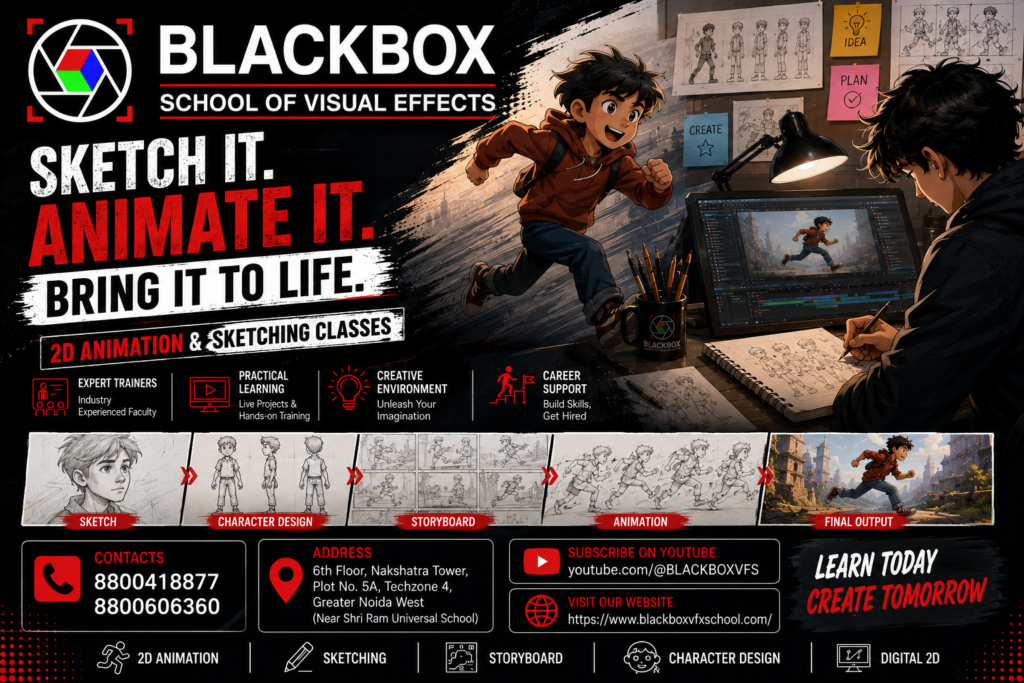
Every skilled animator you admire today started at the exact same point you are at right now: a blank page and a pencil. Before movement, before software, before showreels, there is sketching. That is why the most effective training programs don’t separate sketching from animation they teach both together, as one connected skill. If you have been asking yourself, What does a proper 2D animation sketching classes actually involve? walks through it in detail, using Blackboxvfxschool’s teaching approach as a reference point.
Why Are Sketching and 2D Animation Taught Together Instead of Separately?
A question worth asking early is, “Why not just learn animation software directly and skip sketching altogether?” The honest answer is that software cannot compensate for a weak understanding of form, proportion, and movement. Animation software helps you execute ideas faster, but it does not teach you how a character should bend at the knee, how weight shifts during a walk, or how a face communicates emotion through subtle shape changes.
Sketching builds the observational and structural skills that animation depends on. When these two are taught as one continuous discipline, students learn to think in terms of poses, motion arcs, and timing from the very first lesson, rather than treating animation as a separate technical skill bolted on afterward. This combined approach is exactly why 2D animation sketching classes tend to produce more well-rounded artists than programs that isolate software training from drawing fundamentals.
What Does a Typical 2D Animation Sketching Class Actually Cover?
Prospective students often want a clear answer to, “What will I be doing, day to day, in these classes?” A well-structured curriculum typically moves through the following areas:
Gesture and Form Sketching Students begin with quick gesture drawings that capture movement, balance, and energy rather than fine detail. This trains the eye to see the line of action in any pose, which later becomes essential when animating dynamic character movement.
Proportion and Anatomy Basics Understanding how the human or animal body is structured allows students to draw characters convincingly in any pose, rather than relying on memorized templates that fall apart under motion.
Perspective and Environment Sketching Characters do not exist in a vacuum. Learning basic perspective helps students place characters believably within a scene, which matters for both storyboarding and full scene animation.
Facial Expression and Emotion Studies Since so much of animated storytelling relies on expression, students practice sketching a wide range of emotions and expressions before animating dialogue or reaction shots.
Bridging Into Animation Principles Once sketching fundamentals are reasonably solid, students transition into applying the twelve principles of animation, starting with simple exercises like a bouncing ball, then progressing into full character walk cycles and acting sequences.
This progression ensures that by the time a student reaches animation software, they already understand what good movement and good drawing look like, rather than trying to learn both concepts simultaneously from scratch.
How Does Blackboxvfxschool Structure This Training Differently?
A fair question when comparing programs is, “What actually makes this approach different from a generic online tutorial series?” Blackboxvfxschool’s model is built around three core ideas: sequencing, feedback, and application.
Sequencing means students are never pushed into complex animation exercises before their sketching fundamentals can support them. Each stage of the course builds directly on the previous one, so nothing feels disconnected or rushed.
Feedback means every sketch and animated exercise is reviewed individually, with specific notes on what is working and what needs correction. This is a significant difference from passive video courses, where a student may practice the same mistake repeatedly without realizing it.
Application means students are not just completing isolated exercises for the sake of practice. From an early stage, sketches and animation drills are tied to small creative projects, such as designing an original character or animating a short expressive action, so students build a body of work they can actually use later.
Students who want a preview of this teaching style before enrolling can explore demonstrations and walkthroughs on the Blackboxvfxschool YouTube channel: https://www.youtube.com/@BLACKBOXVFS
Do Beginners Really Struggle Less With a Combined Sketching and Animation Approach?
This is a question backed by consistent observation in art education: yes, and the reason comes down to muscle memory and conceptual overlap. When sketching and animation are taught in isolation, students often have to translate their static drawing skills into motion later, which creates a steep and frustrating learning curve.
When taught together, students develop an intuitive sense of how a pose will look mid-motion while they are still learning to draw it. This reduces the common beginner problem of animations looking flat or lifeless, because the underlying drawings already carry a sense of weight, direction, and energy from the sketching stage.
What Materials or Tools Are Needed to Get Started?
A very practical concern for new students is, “Do I need expensive equipment before I can begin?” The reassuring answer is no. Sketching fundamentals can be practiced with something as simple as pencil and paper, and many programs, including Blackboxvfxschool, recommend starting this way to build strong hand control and observational skills without the distraction of digital tools.
As students progress into animation exercises, a basic drawing tablet becomes useful, though it is not required to begin. The focus in early stages should always be on understanding form and motion conceptually, since these principles remain identical whether a student later works digitally or traditionally.
How Do Students Know If They’re Actually Improving?
A concern many beginners quietly have is, “How will I know if I’m getting better, or just repeating the same mistakes?” This is precisely why structured feedback matters so much more than solo practice. In a well-run 2D animation sketching class, instructors track a student’s progress across specific skill markers, such as line confidence, proportion accuracy, and clarity of motion in animated exercises.
At Blackboxvfxschool, this is handled through regular review sessions where students receive direct commentary on their sketches and animation drafts, rather than a generic grade at the end of a module. This ongoing correction loop is often the single biggest factor separating students who improve rapidly from those who plateau early.
What Can You Do With These Skills Once You Finish?
Naturally, students want to know, “Where does this actually lead?” Combined sketching and 2D animation skills open doors across several creative fields, including:
- 2D Animator roles in film, television, and streaming production
- Character Designer positions for games and animated series
- Storyboard Artist work for advertising and film pre-production
- Concept Sketch Artist roles supporting larger animation or game teams
- Freelance illustration and animation work for independent clients
- Content creation for platforms that rely on original animated visuals
Because sketching is a transferable skill across nearly every visual creative field, students who build this foundation often find they have more career flexibility than those who only learn narrow, software-specific techniques.
Is It Too Late to Start Learning as an Adult or Working Professional?
This question comes up often, and the answer is reassuring: no. Sketching and animation are skills built through deliberate practice, not talent unlocked only at a young age. Many students who join 2D animation sketching classes as working professionals or older beginners progress just as effectively as younger students, provided they commit to consistent practice and follow a structured curriculum rather than trying to self-teach from scattered resources.
Final Thoughts
Sketching and 2D animation are not two separate skills bolted together for convenience; they are two halves of the same creative language. Learning them in isolation almost always leads to gaps that surface later, whether in stiff character movement or weak underlying drawings. A combined, well-sequenced approach, like the one used at Blackboxvfxschool, allows students to build both skills simultaneously, reinforcing each other at every stage.
If you have been considering where to start, exploring the demonstrations and teaching style shared on the Blackboxvfxschool YouTube channel is a practical first step before committing to formal classes ,Whether your goal is a career in animation, freelance illustration work, or simply the satisfaction of bringing your own characters to life, the path begins the same way it always has: with consistent, guided practice in both sketching and motion.
Contact Us:
Address: 6th Floor, Nakshatra Tower, Plot No. 5A, Techzone 4, Greater Noida West (Near Shri Ram Universal School)
Follow Us on YouTube: https://www.youtube.com/@BLACKBOXVFS
Phone: 8800418877, 8800606360