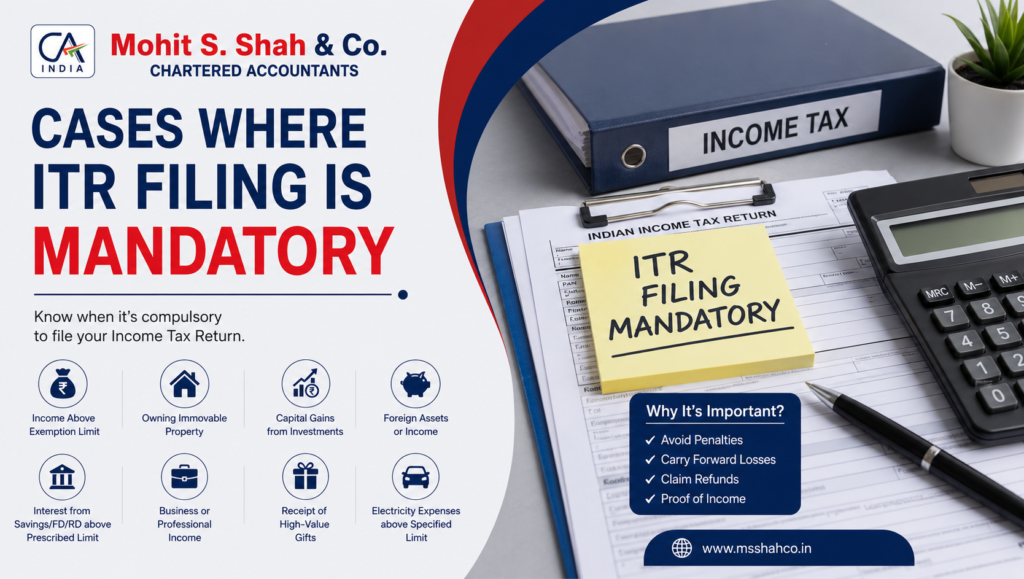
Filing an Income Tax Return (ITR) is one of the most important financial responsibilities for every taxpayer. Many people assume that if they do not have any tax liability, they are not required to file an ITR. However, this is not always true. There are several Cases Where ITR Filing is Mandatory, irrespective of whether tax is payable or not.
Understanding these situations can help you avoid penalties, maintain compliance with tax laws, and build a strong financial profile. At Mohit S. Shah & Co., we help individuals, salaried employees, professionals, NRIs, and businesses understand their tax obligations and file accurate income tax returns on time.
In this comprehensive guide, we’ll discuss the Cases Where ITR Filing is Mandatory, why filing an ITR is beneficial, and how professional guidance can make the process hassle-free.
What is an Income Tax Return (ITR)?
An Income Tax Return (ITR) is a form submitted to the Income Tax Department that reports your income, deductions, taxes paid, and tax liability for a financial year. Filing an ITR ensures transparency and compliance with the Income Tax Act.
Even if your tax liability is zero, there are several Cases Where ITR Filing is Mandatory under Indian tax laws.
Cases Where ITR Filing is Mandatory
Let’s understand the major situations where filing your Income Tax Return becomes compulsory.
1. Income Exceeds the Basic Exemption Limit
The most common case is when your gross total income exceeds the applicable basic exemption limit before claiming eligible deductions and exemptions.
This applies to:
- Salaried individuals
- Self-employed professionals
- Freelancers
- Business owners
- Pensioners
If your income crosses the prescribed exemption limit, filing an ITR is mandatory.
2. Deposits Exceeding ₹1 Crore in Current Bank Accounts
Individuals or HUFs who deposit more than ₹1 crore in one or more current bank accounts during a financial year must file an Income Tax Return, even if taxable income is below the exemption limit.
3. Savings Bank Deposits Above ₹50 Lakhs
If the aggregate amount deposited in one or more savings bank accounts exceeds ₹50 lakh during the financial year, ITR filing becomes mandatory.
4. Foreign Travel Expenses Above ₹2 Lakhs
Have you spent more than ₹2 lakh on foreign travel for yourself or another person during the financial year?
If yes, you fall under one of the Cases Where ITR Filing is Mandatory regardless of your taxable income.
5. Electricity Bills Above ₹1 Lakh
Individuals who incur electricity expenses exceeding ₹1 lakh in a financial year are required to file an Income Tax Return.
6. Business Turnover Exceeding ₹60 Lakhs
Business owners whose annual turnover exceeds ₹60 lakh are required to file an Income Tax Return.
Whether you’re operating as:
- Sole Proprietor
- Retail Business
- Trader
- Manufacturer
ITR filing becomes compulsory once the turnover threshold is crossed.
7. Professional Receipts Above ₹10 Lakhs
Professionals such as:
- Chartered Accountants
- Doctors
- Lawyers
- Architects
- Consultants
- Designers
- Freelancers
must file an Income Tax Return if their gross professional receipts exceed ₹10 lakh during the financial year.
8. Higher TDS or TCS
ITR filing is mandatory if the aggregate amount of Tax Deducted at Source (TDS) or Tax Collected at Source (TCS) exceeds the prescribed threshold during the financial year.
9. Ownership of Foreign Assets
Resident individuals who own:
- Foreign bank accounts
- Overseas investments
- Foreign shares
- Foreign property
- Financial interest outside India
must file an Income Tax Return irrespective of income level.
10. Signing Authority in Foreign Accounts
If you have signing authority in any foreign bank account, filing an ITR is mandatory under Indian tax laws.
11. Beneficiary of Foreign Assets
Even if you are merely a beneficiary of foreign assets or financial interests located outside India, you are required to file your Income Tax Return.
12. Claiming Income Tax Refund
If excess TDS has been deducted from your income, you must file an ITR to claim the refund.
Without filing an Income Tax Return, your refund cannot be processed.
13. Carry Forward Business or Capital Losses
Planning to carry forward:
- Business losses
- Capital losses
- Speculation losses
Then filing your ITR before the due date is essential under the Income Tax Act.
14. Applying for Loans or Credit Cards
Although not a legal requirement, banks generally ask for the last 2–3 years’ ITRs while processing:
- Home Loans
- Car Loans
- Business Loans
- Education Loans
- Personal Loans
Regular ITR filing strengthens your financial credibility.
15. Visa Applications
Most countries request ITR acknowledgements while processing visa applications.
These include:
- USA
- Canada
- UK
- Australia
- Schengen Countries
Regular ITR filing simplifies international travel documentation.
Benefits of Filing an Income Tax Return
Even if your income is below the taxable limit, filing an ITR provides several advantages.
Financial Proof
ITR serves as official proof of income.
Faster Loan Approval
Banks prefer applicants with a consistent ITR filing history.
Easy Visa Processing
Many embassies require Income Tax Returns as proof of financial stability.
Claim Tax Refunds
Recover excess TDS deducted by employers or banks.
Carry Forward Losses
Capital and business losses can only be carried forward through timely ITR filing.
Avoid Penalties
Timely filing helps avoid interest, penalties, and notices from the Income Tax Department.
Common Mistakes Taxpayers Should Avoid
While filing Income Tax Returns, taxpayers often make these mistakes:
- Choosing the wrong ITR form
- Incorrect PAN or Aadhaar details
- Missing income from bank interest
- Ignoring capital gains
- Not reporting foreign assets
- Forgetting to verify the ITR after filing
- Claiming incorrect deductions
- Missing the filing deadline
Professional guidance can help avoid these errors.
Why Choose Mohit S. Shah & Co.?
At Mohit S. Shah & Co., we provide comprehensive tax advisory and Income Tax Return filing services for:
- Salaried Employees
- Freelancers
- Professionals
- Business Owners
- Startups
- Partnership Firms
- Companies
- NRIs
Our experienced professionals ensure:
- Accurate tax computation
- Maximum eligible deductions
- Timely filing
- Compliance with Income Tax laws
- Professional representation before tax authorities
- End-to-end assistance with notices and assessments
Whether your return is simple or involves multiple income sources, foreign assets, or business income, our experts provide reliable and personalized solutions.
Final Thoughts
Understanding the Cases Where ITR Filing is Mandatory is essential for every taxpayer. Filing your Income Tax Return is not merely a statutory obligation—it also strengthens your financial profile, facilitates loans and visas, enables refunds, and ensures compliance with the law.
If you’re unsure whether you are required to file an ITR or need expert assistance with tax planning and return filing, Mohit S. Shah & Co. is here to help with professional, accurate, and timely tax solutions.
Contact Mohit S. Shah & Co.
📍 Office No. 26, 2nd Floor, Anant Building, 217, Shamaldas Gandhi Marg, Princess Street, Marine Lines (East), Mumbai – 400 002
📞 +91-9821462283