Introduction: What Makes a Tulamben Dive Different From Any Other Dive in Bali?
Ask ten divers where they fell in love with diving in Indonesia, and a surprising number will mention the same small fishing village on Bali’s northeast coast: Tulamben. It isn’t glamorous. It isn’t full of beach clubs or infinity pools overlooking white sand. What Tulamben has instead is something far rarer: a coastline where you can walk off a black volcanic beach, put your face in the water, and be swimming over one of the most famous shipwrecks on earth within two minutes.
That’s the short answer to why a is different. The long answer is everything else in this guide.
Tulamben sits in the shadow of Mount Agung, Bali’s tallest and most sacred volcano, on a stretch of coastline that was reshaped by the volcano’s eruption in 1963. That eruption is actually the reason Tulamben became a diving destination in the first place but we’ll get to that story shortly. For now, know this: Tulamben is not a place you visit for the town. You visit what lies beneath the surface, and once you’ve been in that water, you understand why so many people build entire Bali itineraries around a single dive site.
This guide is written for anyone typing Tulamben dive into a search bar and trying to figure out what the fuss is about first-time visitors, certified divers planning a Bali dive trip, snorkelers wondering if they can join in, and travelers trying to decide where to base themselves. We’ll walk through the dive sites, the marine life, the best time of year to go, what diving here actually costs and involves, and why so many divers choose Mimpi Resort as their home base for exploring this coastline. By the end, you should have everything you need to plan a Tulamben dive trip with confidence.
Where Is Tulamben, and Why Does Its Location Matter for Diving?
Tulamben is a small coastal village in the Karangasem regency, on the northeast side of Bali, roughly two to two-and-a-half hours by road from the airport in Denpasar, depending on traffic and which route you take. It sits along the coastal road that hugs the base of Mount Agung, between the towns of Amed and Kubu.
Geography is not a small detail here; it’s the entire reason Tulamben works as a dive destination. Three things about its location combine to create ideal diving conditions:
A steep volcanic drop-off close to shore. Because Mount Agung’s slopes continue underwater, the seabed off Tulamben drops away quickly rather than extending out as a shallow shelf. This means deep-water structure, walls, and drop-offs are accessible without a long boat ride in most cases, without any boat at all.
Shelter from the open ocean swells. The northeast coast of Bali is relatively protected compared to the surf-heavy south coast, which keeps visibility more consistent and diving conditions calmer for much of the year.
A mix of black volcanic sand and rocky rubble. This substrate is exactly what a diverse reef ecosystem and a resting place for a large shipwreck needs to establish itself and thrive.
Put those three factors together and you get what many consider the most accessible world-class dive site in Southeast Asia. You don’t need a liveaboard. You don’t need a long boat transfer. In many cases, you don’t need a boat at all; you can shore dive directly from the beach.
The Story Behind Tulamben: How a Volcanic Eruption Created a World-Famous Dive Site
To really appreciate a Tulamben dive, it helps to know the history, because it’s genuinely unusual.
The crew survived, and the ship was towed toward Bali with the intention of beaching it for salvage. It came to rest on the black sand shore at Tulamben, only partially submerged, and sat there for over two decades a rusting hulk, mostly forgotten.
The eruption sent lava flows and seismic tremors through the region, and the shockwaves pushed the wreck of the Liberty fully into the sea. It settled onto a sloping sandy bottom just off the beach, roughly parallel to the shoreline, at a depth ranging from around 5 meters at its shallowest point to about 30 meters at its deepest.
Over the following decades, nature did what nature does in tropical waters: it colonized. Soft corals, hard corals, sponges, and gorgonian fans took hold of every surface. Fish moved in. What had been a piece of wartime wreckage became, quite literally, a living reef built on a steel frame, on of the most photographed and dived shipwrecks on the planet.
That’s the story every dive guide in Tulamben will tell you on your first briefing, and it’s worth hearing, because it reframes what you’re about to see. You’re not just diving a wreck. You’re dividing eighty years of geological, historical, and biological layering, compressed into a single 120-meter stretch of coastline.
The Best Dive Sites in Tulamben: A Site-by-Site Breakdown
Tulamben’s reputation rests heavily on the USAT Liberty wreck, but treating it as a one-site destination undersells the coastline badly. There’s a string of distinct dive sites running along this stretch of shore, each with its own character, depth range, and marine life. Here’s a breakdown of the main ones you’ll encounter when planning a Tulamben dive.
USAT Liberty Wreck
This is the site that put Tulamben on the map, and for good reason. The wreck lies close to shore, broken into sections after decades of seismic activity and current, with the bow and stern still recognizable and large sections of hull collapsed and scattered across the slope. Depths range from about 5 meters near the top of the structure to roughly 30 meters at the base, which means it’s genuinely accessible to open water divers while still offering enough depth and complexity to keep advanced divers and technical wreck enthusiasts coming back.
What you’ll see: schools of bumphead parrotfish that move through the wreck in the early morning, resident giant trevally, large schools of jackfish that swirl around the deeper sections, pygmy seahorses tucked into gorgonian fans, ghost pipefish drifting near the wreck’s overhangs, and if you’re lucky, a resident bumphead wrasse or reef shark passing through. The wreck’s surface is thick with soft coral in oranges, purples, and yellows, especially on the upper structure where light penetration is stronger.
Because it’s a shore entry, the Liberty wreck is dived at almost any hour, including as a night dive, which changes the cast of characters entirely that’s when you’ll spot Spanish dancers, decorator crabs, and a variety of nocturnal reef life that hides during the day.
Coral Garden
A short walk or swim from the Liberty wreck entry point, Coral Garden is a shallower site generally in the 3 to 15 meter range built around dense coral coverage and calm conditions, making it a favorite for newer divers, snorkelers, and photographers who want to work in good light without fighting depth or current. Expect anemone fish, garden eels swaying in the sandy patches, and a healthy population of reef fish typical of a thriving shallow ecosystem.
The Drop Off
As the name suggests, this site is defined by a wall that plunges from around 5 meters down past 60 meters, attracting divers who want to drift along a vertical reef face rather than a sloping one. The wall is covered in soft coral and gorgonian sea fans, and it’s a good site for spotting pelagic visitors passing in the blue, along with reef life clinging to the wall itself.
Seraya Secrets
If your interest in a Tulamben dive leans toward macro photography, Seraya Secrets is often the site locals will point you toward. It’s a rubble and sand slope rather than a dramatic wall or wreck, but that unassuming terrain is exactly what makes it a magnet for critters: frogfish in a range of colors, nudibranchs in astonishing variety, mimic octopus, robust ghost pipefish, and the kind of tiny, camouflaged life that makes muck diving so rewarding for anyone with a macro lens.
Melasti and Batu Kelebit
Slightly further along the coast, these sites offer a mix of coral slopes and swim-throughs, with generally good visibility and a quieter feel than the more heavily dived Liberty wreck. They’re a good choice for divers who want to extend a multi-day Tulamben dive itinerary without repeating the same site.
Alamanda and the Tulamben House Reef
Many dive resorts along this stretch, including Mimpi Resort, have their own house reef directly offshore, which typically blends into the broader Tulamben coral system. House reef diving is a highlight for guests staying multiple nights, since it allows unlimited shore diving at your own pace without arranging boat transfers.
A Deeper Look at the USAT Liberty Wreck: Section by Section
Because the Liberty wreck is the centerpiece of almost every Tulamben dive trip, it’s worth breaking down its structure in more detail than a single overview paragraph allows. Divers who understand the layout tend to get far more out of repeat dives on the same wreck, since it means less time orienting yourself and more time actually looking at what’s around you.
The bow section. Sitting in the shallower part of the wreck, the bow is one of the most recognizable and photographed sections, with clear structural lines still visible beneath decades of coral growth. This is often where dive guides start a Liberty wreck dive, both because of the manageable depth and because morning light penetrates well here, making it a strong spot for wide-angle photography.
The midship section. This is the most broken-up part of the wreck, having taken the brunt of decades of seismic activity, current, and occasional storm surge. What looks like scattered rubble to an untrained eye is, on closer inspection, a maze of overhangs, small caverns, and coral-covered plating that hosts an enormous density of marine life this is often where divers find the resident schools of jackfish circling in tight, mesmerizing formations.
The stern section. Deeper and more intact in places than the midship, the stern is popular with more experienced divers and those pursuing wreck specialty training, since it offers a clearer sense of the ship’s original structure, including sections of deck and hull that are still identifiable.
The propeller and rudder area. At the deepest accessible point of the wreck, this section is typically reserved for advanced or technical divers given the depth involved, but it rewards the effort with dramatic silhouettes and a strong chance of encountering pelagic life passing along the drop-off just beyond the wreck itself.
Because the wreck runs roughly parallel to the shoreline and spans such a wide depth range, many divers find that two or three dives on the Liberty wreck across a multi-day stay barely scratch the surface — a genuinely different experience is available depending on which section you focus on, what time of day you dive, and whether you’re diving during the day or at night.
Recommended Multi-Day Tulamben Dive Itineraries
Because Tulamben rewards longer stays rather than single day-trips, it helps to see what a realistic multi-day dive itinerary looks like. Below are a few sample structures depending on how many days you have and what your priorities are.
A 2-Day / 4-Dive Itinerary Short Stay
Day 1, morning: Liberty wreck, shallow-to-mid sections, focused on wide-angle photography and schooling fish while the light and water are at their calmest. Day 1, afternoon: Coral Garden, a relaxed, shallow dive to decompress from the morning’s deeper dive and enjoy the reef’s coral coverage. Day 2, morning: Liberty wreck again, this time exploring the deeper stern and midship sections with an experienced guide. Day 2, afternoon: Seraya Secrets, for a change of pace into macro and muck diving before departure.
A 4-Day / 8-Dive Itinerary Standard Dive Trip
This structure allows for full coverage of the main sites discussed in this guide, alternating between deep and shallow dives to manage nitrogen loading sensibly, and typically includes one night dive on the Liberty wreck as a highlight, plus a rest morning built in for surface interval and recovery.
A 6-Day / 12+ Dive Itinerary Dedicated Dive Holiday
For divers treating Tulamben as the main focus of their Bali trip rather than a stopover, a six-day stay allows time to pursue a specialty certification wreck, night, or digital photography, revisit favorite sites multiple times under different conditions, explore Melasti and Batu Kelebit further along the coast, and build in proper rest days which matter more than many divers expect, both for decompression safety and for simply not burning out on gear-hauling and early mornings.
Whichever structure you choose, staying at a resort with direct shore access like Mimpi Resort is what makes these itineraries realistic without excessive daily logistics eating into your dive time.
What Marine Life Can You See on a Tulamben Dive?
One of the most common questions divers ask before booking is simple: what will I actually see? The answer is that Tulamben punches well above its weight for biodiversity, largely because the site combines wreck structure, wall, slope, and rubble habitats within a very short stretch of coastline. Here’s a realistic breakdown of what regularly shows up.
Large and mid-sized marine life:
- Bumphead parrotfish, often in schools of a dozen or more, particularly around the Liberty wreck in early morning
- Giant trevally and schools of jackfish circling the wreck’s deeper structure
- Napoleon humphead wrasse
- Reef sharks are occasional, more likely on early dives before boat and diver traffic increases.
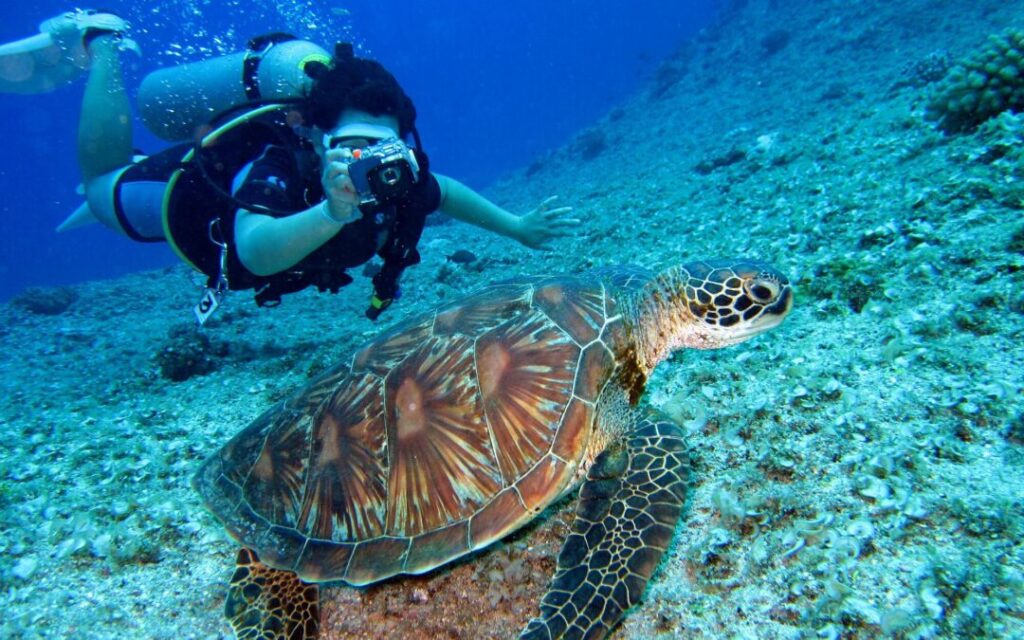
- Green and hawksbill turtles resting on the wreck or grazing on the reef
- Barracuda in loose schools along the drop-off
Macro life:
- Pygmy seahorses on gorgonian fans
- Ghost pipefish, both ornate and robust varieties
- A wide range of nudibranchs, with new species regularly spotted by dive guides who log sightings
- Frogfish, particularly at Seraya Secrets
- Mimic octopus and other cephalopods on sandy slopes
- Decorator crabs, harlequin shrimp, and mantis shrimp for those willing to look closely
Coral and reef structure:
- Dense soft coral coverage across the Liberty wreck in purples, oranges, and yellows
- Gorgonian sea fans along the walls
- Healthy hard coral coverage at Coral Garden and the house reef areas
- Garden eels on the sandy flats
The range here is the point. A single week of diving in Tulamben can move you from wreck penetration and big schooling fish to a slow, patient macro hunt on a rubble slope, all within a few hundred meters of shoreline and often without needing a boat.
A Species-by-Species Look at Tulamben’s Marine Life
The overview earlier in this guide covers the broad categories of marine life you’ll encounter, but divers researching a trip often want more specific detail on individual species what to look for, where, and why they matter to the site’s ecosystem. Here’s a closer look.
Bumphead Parrotfish
Perhaps the single most iconic sighting associated with a Tulamben dive, bumphead parrotfish are large, unmistakable reef fish that travel in schools and are known for their distinctive bulging forehead and habit of grazing on coral, which they crunch audibly as they feed. They’re most reliably seen in the early morning, often moving along the shallow sections of the Liberty wreck in loose, rolling schools that can number a dozen or more individuals. Their feeding behavior, while dramatic to watch, is also ecologically important bumphead parrotfish grazing helps control algae growth on reef structures, playing a genuine role in reef health.
Pygmy Seahorses
Among the most sought-after macro subjects in Tulamben, pygmy seahorses are tiny, often under two centimeters and near-perfectly camouflaged against the gorgonian sea fans they live on. Spotting one without a guide’s trained eye is genuinely difficult, which is one of the strongest arguments for diving with an experienced local guide rather than navigating unfamiliar sites alone, especially at macro-focused locations like the walls near The Drop Off.
Ghost Pipefish
Ornate and robust ghost pipefish both appear in Tulamben’s waters, typically drifting motionless near soft coral or rubble, their body shape and coloring mimicking the surrounding structure so effectively that they’re easy to swim straight past. Their populations tend to shift slightly with the seasons, which is part of why repeat visits to the same site can turn up genuinely different sightings.
Frogfish
Seraya Secrets in particular has built something of a reputation around its frogfish population, with individuals spotted in a wide range of colors yellow, black, white, and mottled patterns sitting motionless on the sandy rubble slope, waiting to ambush prey with a startlingly fast strike. Frogfish are a favorite subject for macro photographers precisely because of how still and approachable they are once located.
Nudibranchs
Few dive destinations anywhere rival Tulamben’s nudibranch diversity. Local dive guides frequently log new or unusual species sightings, and it’s not unusual for a single macro-focused dive at Seraya Secrets to turn up a dozen or more distinct nudibranch species in a single hour, ranging from tiny, brightly colored individuals a few millimeters long to larger, more dramatically patterned species.
Giant Trevally and Jackfish
Around the deeper sections of the Liberty wreck, schools of jackfish are a near-constant presence, circling in tight, hypnotic formations that are a favorite subject for wide-angle photographers and videographers. Giant trevally, generally larger and more solitary or found in smaller groups, patrol the wreck and surrounding reef, occasionally making fast hunting passes through smaller baitfish schools.
Turtles
Both green and hawksbill turtles are regularly sighted around Tulamben, sometimes resting directly on sections of the Liberty wreck, other times grazing along the reef at Coral Garden or the house reef areas. They tend to be relatively tolerant of divers who maintain a respectful distance and calm buoyancy, making them one of the more consistently photographable larger animals in the area.
Mimic Octopus and Other Cephalopods
The sandy slopes around Seraya Secrets and similar muck-diving terrain are prime habitat for mimic octopus, a species known for its remarkable ability to imitate the appearance and movement of other marine animals, flatfish, lionfish, and sea snakes among them as a defense mechanism. Regular octopus and cuttlefish sightings round out what is, overall, one of the most cephalopod-rich stretches of coastline in Bali.
Understanding this level of detail matters for one practical reason: it changes how you plan your dives. A diver chasing pygmy seahorses and nudibranchs wants a slow, macro-focused dive at Seraya Secrets with a guide who knows exactly where recent sightings have been logged. A diver hoping to photograph schooling bumphead parrotfish wants to be in the water at first light on the Liberty wreck. Knowing the difference in advance and communicating it to your dive guide makes a real difference in what you actually see.
What Is the Best Time of Year for a Tulamben Dive?
Bali sits close to the equator, so water temperature doesn’t swing wildly across the year, but conditions do shift enough to matter for planning.
Dry season (April to October): Generally considered the best window for diving in Bali overall, including Tulamben. Visibility tends to be at its best, seas are calmer, and this period overlaps with peak travel season, so dive centers and resorts are busiest. If your priority is the clearest possible water and the most predictable conditions, this is the window most dive operators, including Mimpi Resort’s dive team, recommend.
Wet season (November to March): Rain is more frequent, but it doesn’t mean diving stops. Tulamben’s sheltered coastline means it’s often diveable even when other parts of Bali see rough surface conditions. Visibility can be more variable, and you may encounter more plankton in the water, which some macro photographers actually prefer since it can bring in unusual pelagic visitors.
Water temperature in Tulamben typically ranges from around 26°C to 29°C 79°F to 84°F year-round, so a 3mm wetsuit is generally sufficient for most divers, though those doing multiple dives a day or night dives often prefer a 5mm for comfort.
Time of day matters as much as time of year for the Liberty wreck specifically. Early morning dives, before the day-tripper boats and dive groups arrive from South Bali, tend to offer calmer water, better light for photography, and a higher chance of seeing schooling bumphead parrotfish, which are most active at dawn. This is one of the strongest arguments for staying in Tulamben itself rather than commuting in from elsewhere you get first access to the water.
How Difficult Is Diving in Tulamben? A Guide for Every Experience Level
A common misconception is that a famous wreck dive must be an advanced-only experience. In Tulamben’s case, that’s only partly true, and it’s actually one of the site’s biggest strengths: there’s meaningful diving here for almost every certification level.
Open water divers beginner level: The upper sections of the USAT Liberty wreck sit in around 5 to 12 meters of water, well within recreational open water limits, and the entry is a straightforward, gently sloping shore entry rather than a boat drop into current. Coral Garden and the shallow house reef areas are similarly beginner-friendly, with calm, protected conditions.
Advanced open water divers: The deeper sections of the wreck, down to around 30 meters, and sites like The Drop Off, open up more dramatic terrain, along with the option to try wreck specialty or deep specialty courses.
Divers seeking specialty certifications: Tulamben is a popular place to complete a Wreck Diving specialty given the obvious subject matter right offshore , a Night Diver certification, a Fish Identification course given the sheer biodiversity, or a Digital Underwater Photography specialty thanks to the macro opportunities at sites like Seraya Secrets.
Snorkelers and non-certified travelers: You don’t need a scuba certification to experience Tulamben. The shallow upper structure of the Liberty wreck and the coral garden areas are snorkelable in calm conditions, offering a genuine glimpse of the wreck and reef life from the surface. Many resorts, including Mimpi Resort, offer guided snorkeling trips for exactly this reason.
First-time try-divers: For travelers who’ve never scuba dived before, Tulamben’s calm, shallow shore entry makes it a popular location for a supervised introductory dive often called a Discover Scuba Diving experience, letting first-timers see the wreck and reef under close instructor supervision without needing a full certification course.
This range is a big part of why Tulamben works so well as a base for a multi-day Bali dive trip a family or mixed-experience group can genuinely dive together here, at different depths and paces, without anyone being left on the beach.
A Closer Look at Dive Courses Available in Tulamben
Because Tulamben combines a famous wreck, a wall, a muck-diving site, and calm shore conditions all in one place, it’s genuinely one of the better locations in Southeast Asia to complete dive training, whether you’re starting from zero or adding specialties to an existing certification. Here’s a more detailed look at what’s typically on offer.
Discover Scuba Diving Try Dive. A half-day, no-certification-required introduction to scuba, usually including a short briefing and confined water practice followed by a supervised shallow dive, often on the upper Liberty wreck or the house reef. This is the most common entry point for travelers who’ve never dived before and want to see the wreck without committing to a full course.
Open Water Diver certification. Typically a three to four day course combining classroom or e-learning theory, confined water skills practice, and four open water dives. Completing this course in Tulamben means your certification dives happen on genuinely world-class terrain rather than a nondescript training site, which is a real advantage compared to learning in many other locations.
Advanced Open Water Diver. A natural next step for certified Open Water divers, typically involving five adventure dives, often including a deep dive on the Liberty wreck’s lower sections, a navigation dive, and elective dives chosen based on interest wreck, night, or peak performance buoyancy are popular choices given the local terrain.
Wreck Diver Specialty. Given the obvious subject matter sitting just offshore, this is one of the most popular specialty courses to take in Tulamben specifically. It typically covers wreck mapping, safe penetration limits, and specialized skills for navigating a structure like the Liberty wreck safely.
Night Diver Specialty. Covers the skills and safety considerations specific to diving after dark light discipline, buddy contact procedures, and navigation without visual landmarks and is often completed directly on the Liberty wreck, given how dramatically different the site looks at night.
Digital Underwater Photographer Specialty. With sites like Seraya Secrets built almost entirely around macro subjects, this specialty is a natural fit for Tulamben, covering camera settings, lighting techniques, and composition for underwater subjects ranging from tiny nudibranchs to wide-angle wreck shots.
Rescue Diver and Divemaster training. For divers looking to go further, Tulamben’s varied terrain and consistent conditions make it a practical location to complete rescue training or begin professional-level Divemaster training, since it offers repeat access to a range of depths and conditions within a short distance of a single dive center.
Most dive operators along the Tulamben coast, including Mimpi Resort’s dive center, run these courses through PADI-aligned instruction, with small group sizes that take advantage of the site’s shore access to keep training flexible rather than tied to rigid boat schedules.
Why Choose Tulamben Over Other Bali Dive Destinations?
Bali has several well-known dive regions Nusa Penida in the south, known for mola-mola sunfish season and manta rays; Menjangan Island in the northwest, known for its marine park walls; Amed, just up the coast from Tulamben, known for gentler house-reef diving; and Tulamben itself. Each has a case for itself, but Tulamben tends to win out for a specific combination of reasons:
Accessibility. Most Tulamben dive sites are shore dives. That means no boat schedules, no seasickness, no waiting for a dive boat to fill up you walk in when you’re ready and walk out when you’re done. For repeat divers doing multiple dives a day, this is a genuinely different experience from boat-based diving elsewhere on the island.
Consistency. Nusa Penida’s marquee attraction, the mola-mola, is seasonal and never guaranteed. Tulamben’s wreck and reef sites are there every single day, in every season, with marine life that doesn’t depend on a lucky current or a specific month.
Range within a small area. As covered above, you can move between wreck, wall, slope, and reef habitats without significant travel between sites, which isn’t true of every dive region in Bali.
Suitability for every level. As discussed, Tulamben accommodates snorkelers through technical wreck divers within the same short stretch of coast.
None of this is to say Tulamben is objectively better than Nusa Penida or Menjangan, serious divers often build a Bali itinerary that includes more than one region. But for travelers asking “where should I base myself for the most reliable, accessible, and varied diving in Bali,” Tulamben is consistently one of the top answers, and it’s why so many dive-focused travelers plan their entire trip around it.
Tulamben Compared to Other Bali Dive Regions: A More Detailed Look
Earlier in this guide, we touched on why divers often choose Tulamben over other parts of Bali. It’s worth expanding on that comparison, region by region, since serious divers often want to understand exactly how each area differs before deciding how to split their time.
Tulamben to Nusa Penida
Nusa Penida, an island off Bali’s southeast coast, is best known for seasonal mola-mola oceanic sunfish sightings, typically between July and October, and for consistent manta ray encounters at cleaning stations like Manta Point. The diving here tends to involve stronger currents, colder thermoclines, and boat-based access, which makes it a fundamentally different experience from Tulamben’s calm, shore-accessible sites. Divers chasing a specific pelagic encounter mola-mola or mantas will usually prioritize Nusa Penida, while divers wanting reliable, repeat, shore-based diving with strong macro and wreck opportunities will lean toward Tulamben. Many dive itineraries in Bali include both, treating them as complementary rather than competing destinations.
Tulamben vs Menjangan Island
Menjangan, part of West Bali National Park, offers dramatic wall diving in a marine protected area with excellent visibility and minimal current, similar in some ways to Tulamben’s Drop Off site but on a larger scale. The tradeoff is access Menjangan requires a boat trip from the mainland and is further from most accommodation options, whereas Tulamben’s walls and wrecks are reachable directly from shore.
Tulamben vs. Amed
Amed, Tulamben’s closest neighbor, offers a gentler, similarly shore-accessible diving experience, with its own house reefs and a well-known Japanese shipwreck of its own. Many divers consider Amed’s pace even more relaxed than Tulamben’s, though it lacks a site with the scale and fame of the USAT Liberty wreck. Some travelers choose to split a few days between the two, given the short 30–45 minute drive separating them.
Tulamben vs. South Bali Sanur, Padang Bai, Nusa Lembongan
South Bali’s dive sites are more accessible from the airport and major tourist hubs, making them popular for day trips. However, this convenience comes at the cost of the deeper, more immersive experience that basing yourself directly in Tulamben provides namely, repeat access to the same sites across multiple days, early-morning conditions before day-tripper boats arrive, and the ability to build a proper multi-day itinerary rather than a single rushed dive.
The overall takeaway: Tulamben isn’t necessarily the best dive region in Bali in every category it doesn’t have Nusa Penida’s mola-mola season or Menjangan’s marine park scale but it offers the most complete, accessible, and consistent single-location dive experience on the island, which is exactly why so many dive-focused travelers choose to base their entire trip there rather than treating it as a day-trip stop.
Underwater Photography Tips Specific to Tulamben
Given how frequently photography comes up in discussions of a Tulamben dive, it’s worth offering some site-specific tips rather than generic advice that could apply anywhere.
For the Liberty wreck: Shoot wide-angle in the morning when light penetration is strongest, particularly around the bow section. Position yourself below your subject when photographing schooling jackfish or bumphead parrotfish to capture them against the surface light rather than the darker reef background below this is one of the most common composition upgrades novice underwater photographers can make here.
For Seraya Secrets and macro subjects: Patience matters more than gear. Many of the site’s best subjects frogfish, ghost pipefish, pygmy seahorses are motionless and easy to overlook. Slow your pace, let your guide point out subjects, and take time to compose rather than shooting quickly and moving on.
For nudibranchs specifically: A focus light or small torch helps enormously, both for locating subjects in rubble and for bringing out true color in photographs, since red and orange wavelengths are quickly absorbed by seawater even in shallow depths.
For night dives on the Liberty wreck: A wide beam torch for navigation plus a narrower focus light for photography subjects works better than relying on a single light source. Watch for Spanish dancers in open water, a genuinely striking subject that’s rarely seen during the day.
General buoyancy note: Tulamben’s popularity means its most photogenic sites see significant diver traffic, particularly during peak season. Strong buoyancy control isn’t just an environmental courtesy here, it’s what separates a clean, well-composed photograph from one with another diver’s fin tips in the frame.
Why Mimpi Resort Is the Ideal Base for a Tulamben Dive Trip
Choosing where to stay matters more for a dive trip than it does for most vacations, because your accommodation determines how easily and how often you actually get in the water. This is where Mimpi Resort comes in.
Mimpi Resort sits directly on the Tulamben coastline, positioned to give guests immediate access to the exact dive sites covered in this guide, including the USAT Liberty wreck and the surrounding house reef. Here’s what that proximity actually means in practice for a diver planning a trip.
Direct Access to the Water, No Transfers Required
Because Mimpi Resort is located right on Tulamben’s shore, guests can walk from their room to the dive entry point in minutes. For a destination built around shore diving, this isn’t a minor convenience; it fundamentally changes how many dives you can comfortably fit into a day and how relaxed the whole experience feels. There’s no early wake-up for a boat transfer, no packing gear into a van, no waiting on other guests. You dive on your own schedule.
This matters especially for the early-morning window discussed earlier, when the Liberty wreck sees the best light, the calmest water, and the highest chance of spotting schooling bumphead parrotfish. Guests staying at Mimpi Resort can be in the water at first light without needing to coordinate a transfer from elsewhere on the island.
An On-Site, PADI-Aligned Dive Operation
Mimpi Resort’s dive center caters to the full spectrum of experience levels covered in this guide from Discover Scuba try-dives for complete beginners, through Open Water and Advanced certification courses, to specialty courses like wreck diving and night diving that make the most of the Liberty wreck right offshore. Guides are locals who know the reef intimately where the resident frogfish has been hiding this week, which morning the current is likely to be calmest, and how to time a dive so you’re not sharing the wreck with a dozen other groups.
For certified divers who simply want guided or unguided access to the house reef, Mimpi Resort’s location makes repeat shore diving genuinely practical across a multi-day stay, rather than something you have to plan and pay for as a separate excursion each time.
A Comfortable Base for Non-Divers, Too
Not every traveler in a group dives, and Mimpi Resort is built with that reality in mind. The resort’s pool, restaurant, and grounds give non-diving companions a relaxed place to spend the day, while snorkeling trips to the shallow sections of the wreck and reef offer a way for the whole group to experience Tulamben’s underwater world together, regardless of certification status.
Practical Comforts After a Day of Diving
Diving is physically demanding multiple dives a day, gear to rinse and dry, and a body that’s absorbed nitrogen and needs rest. Mimpi Resort’s setup, with rooms close to the dive center and facilities designed around returning divers rinse tanks, gear storage, and a relaxed restaurant for post-dive meals, removes the friction that can make a dive trip feel like more logistics than vacation.
Positioned for the Rest of Tulamben, Too
Staying at Mimpi Resort doesn’t limit you to the immediate house reef. Its location along the Tulamben coast puts sites like Coral Garden, The Drop Off, and Seraya Secrets within short reach, whether by an easy walk, a quick shore entry further along the beach, or a brief boat or truck transfer arranged through the resort’s dive desk.
If you’re searching for where to stay for a Tulamben dive trip, the practical case for Mimpi Resort comes down to this: location determines convenience, and convenience determines how much diving you actually get to do. You can find full details on the resort’s dive program directly at Mimpi Resort’s Diving in Tulamben page.
What a Typical Day Looks Like When Staying at Mimpi Resort for a Tulamben Dive Trip
It helps to picture the actual rhythm of a stay, rather than just a list of features. A common pattern for divers based at Mimpi Resort looks something like this:
Early morning (6:00–6:30 AM): Wake with the sound of the sea rather than an alarm tied to a boat departure time. Gear is already rinsed and dried from the previous day, stored at the dive center a short walk from your room.
First dive (7:00 AM): In the water on the Liberty wreck before the day’s boat traffic and larger groups arrive, taking advantage of the calmest conditions and the best chance of the wreck’s resident bumphead parrotfish still schooling near the surface.
Breakfast (8:30–9:30 AM): Back at the resort for a relaxed breakfast, with time to review photos or log the dive before the day’s second session.
Second dive or course session (10:30 AM): Either a second dive at a different site — Coral Garden or Seraya Secrets, for example — or a training session if you’re working through a certification course.
Midday break (12:30–3:00 PM): Lunch, pool time, or rest during the warmest part of the day, when many divers prefer a longer surface interval anyway.
Afternoon dive or snorkeling trip (3:00 PM): A third dive for those doing a full day’s diving, or a guided snorkeling trip for non-diving companions to see the shallow sections of the wreck and reef.
Evening: Dinner at the resort, with the option to arrange a night dive on the Liberty wreck for those wanting to see the site’s nocturnal marine life discussed earlier in this guide.
This rhythm of three dives a day without a single boat transfer is genuinely difficult to replicate at destinations where diving requires boarding a boat each time, and it’s the core practical argument for basing a Tulamben dive trip at a shorefront property like Mimpi Resort.
Facilities Beyond Diving
While diving is the reason most guests choose Tulamben, Mimpi Resort is built to function as a complete base for a Bali stay, not just a dive camp. Typical facilities at a shorefront Tulamben resort of this kind include a swimming pool for relaxing between dives, an on-site restaurant serving a mix of Indonesian and international dishes suited to the appetite that follows a morning of diving, gardens and common areas that make use of the coastal setting at the base of Mount Agung, and a dive shop offering equipment rental, gear servicing, and air or nitrox fills so returning divers don’t need to haul a full kit from home.
For couples or families where not everyone dives, this combination matters as much as the dive program itself — it’s what makes Tulamben workable as a shared destination rather than a diving-only detour on someone else’s Bali holiday.
What Should You Pack for a Tulamben Dive Trip?
A little preparation goes a long way in Tulamben, especially since it’s a smaller village than South Bali’s tourist hubs, with fewer shops to fill gaps in your gear at the last minute.
Diving essentials:
- Your own mask and fins, if you have a preferred fit, though rental gear is widely available
- A 3mm wetsuit for most of the year; consider a 5mm if you run cold or plan multiple dives per day
- Reef-safe sunscreen this matters more than people realize, since regular sunscreen chemicals can damage coral, and Tulamben’s reef health is part of what makes it worth diving
- Dive certification card and logbook if you’re continuing training or want dives logged
- A dive computer, if you own one, though most resorts and dive centers can rent these
Photography gear:
- An underwater camera or housing, especially given Tulamben’s reputation for macro subjects
- Spare batteries and memory cards there’s no reliable place to buy either in Tulamben itself
- A focus light or torch for macro work and for night diving on the wreck
General travel items:
- Lightweight, breathable clothing Tulamben is warm and humid year-round
- A light rain layer if traveling in the wet season
- CashTulamben is a small village, and card acceptance is less consistent than in South Bali’s tourist areas
- Basic reef and sun protection: a rash guard is genuinely useful both in and out of the water
A note on black sand: Tulamben’s beaches are volcanic black sand rather than the white sand more commonly seen in South Bali. It gets hot underfoot in direct sun, so reef shoes or sandals for the walk to the water are worth packing.
Snorkeling in Tulamben: Do You Need to Be a Certified Diver?
No and this is worth emphasizing, because it’s one of the more common misconceptions about the destination. While the deeper sections of the USAT Liberty wreck and sites like The Drop Off require certification, the shallow upper structure of the wreck, along with Coral Garden and the shallow house reef, are snorkelable in calm conditions.
Guided snorkeling trips, offered by resorts including Mimpi Resort, typically bring non-divers out to view the top of the Liberty wreck from the surface, along with the surrounding shallow reef, giving a genuine sense of the site’s scale and the marine life living on it schools of reef fish, coral coverage, and often turtles resting near the surface.
For travelers unsure whether to invest in a full certification course before their trip, snorkeling is a low-commitment way to experience Tulamben’s underwater environment and decide if diving is worth pursuing further, potentially through a Discover Scuba try-dive during the same trip.
Night Diving on the Liberty Wreck: Why It’s a Different Experience Entirely
If you only dive the Liberty wreck once, during the day, you’re seeing roughly half of what’s actually there. Tulamben’s shore-entry setup makes night diving genuinely practical in a way it often isn’t at boat-access sites, and the wreck transforms after dark.
Nocturnal marine life takes over: Spanish dancers unfurl and swim in open water, a striking sight for divers who’ve only seen them curled and hidden during the day. Decorator crabs and hermit crabs become far more active and visible. Octopus and cuttlefish, more cautious in daylight, tend to hunt more openly at night. Coral polyps on the wreck’s soft coral coverage extend fully to feed, changing the entire visual texture of the structure compared to its daytime appearance.
For divers who’ve done the classic daytime Liberty wreck dive, a night dive on the same structure is often recommended as a genuinely different not repetitive experience, and it’s one of the more popular specialty add-ons offered by dive centers based in Tulamben, including Mimpi Resort’s dive team.
Environmental Conservation: How Tulamben’s Diving Community Protects the Reef
A dive site as heavily visited as Tulamben only stays healthy through active conservation, and it’s worth understanding what’s being done, both because it affects what you’ll see and because responsible travelers increasingly want to support destinations that take this seriously.
Mooring and entry management: Because most diving here is shore-based rather than boat-based, there’s less anchor damage than at many comparable sites, which has helped preserve coral coverage on both the wreck and the surrounding reef.
Local dive guide training: Dive centers along the Tulamben coast, including Mimpi Resort, generally train guides in buoyancy-first diving practices and brief guests on no-touch, no-collection policies before entering the water critical on a site where fragile soft coral covers a historic structure that can’t regenerate quickly if damaged.
Reef monitoring and citizen science: Regular sightings of macro life, particularly nudibranch species, are logged by local dive guides, contributing informally to broader marine biodiversity records for the region.
What you can do as a visiting diver: Maintain careful buoyancy control, particularly around the wreck’s more fragile upper sections; avoid touching or standing on coral even briefly; use reef-safe sunscreen; and choose operators who brief clearly on environmental practices before each dive.
Tulamben’s continued status as one of Bali’s premier dive destinations depends on these practices holding up as visitor numbers grow, and it’s a genuinely collaborative effort between resorts, local dive operators, and the community.
Diving in Tulamben as a Family: What Parents Should Know
Tulamben’s mix of shallow, calm, shore-accessible sites and deeper, more advanced terrain makes it one of the more workable Bali dive destinations for families with a range of ages and experience levels, but a few specific points are worth knowing.
Minimum age for certification. Junior Open Water certification is generally available from around age 10, with depth limits typically restricted compared to adult certification, while younger children can often participate in a supervised, very shallow introductory experience through programs designed for younger kids, depending on the dive center’s policies.
Snorkeling as a family activity. As discussed earlier, the shallow sections of the Liberty wreck and the house reef are snorkelable, which means a family with mixed ages and certification levels can genuinely share the same site some members diving the deeper sections while others snorkel the surface above the same wreck.
Pacing. Families often do better spacing dives further apart than a hardcore dive-focused itinerary would, using the resort’s other facilities: pool, beach, restaurant to fill the time between sessions. This is another point in favor of a full-service shorefront resort like Mimpi Resort over a dive-only operation with no facilities to fall back on between sessions.
Choosing a family-friendly dive guide. It’s worth requesting a guide experienced with junior divers or first-time snorkelers specifically, since pacing, reassurance, and site selection genuinely differ when diving with children compared to a group of experienced adult divers.
Dive Safety, Insurance, and Practical Considerations
No dive guide is complete without addressing safety directly, and Tulamben, while a relatively calm and accessible destination, still requires the same baseline precautions as any dive trip.
Dive insurance. It’s strongly recommended that divers carry dive-specific travel insurance covering emergency evacuation and hyperbaric chamber treatment, since standard travel insurance policies frequently exclude scuba diving or cap coverage in ways that don’t reflect the real cost of dive-related emergencies. Organizations such as DAN Divers Alert Network offer dedicated dive insurance policies worth researching before your trip.
Nearest hyperbaric chamber. Bali has recompression chamber facilities, and any reputable dive operator in Tulamben, including Mimpi Resort’s dive center, will be able to brief you on emergency procedures and evacuation protocols as part of your dive briefing, a normal, standard part of responsible dive operations rather than a red flag.
Dive computer use. Given the range of depths available at a single site like the Liberty wreck, using a dive computer rather than relying solely on dive tables is strongly recommended, particularly for divers doing multiple dives across consecutive days, to manage nitrogen loading safely.
Fitness to dive. As with any dive destination, travelers with underlying medical conditions should consult a doctor, ideally one trained in dive medicine, before their trip, and should disclose relevant medical history to their dive operator during check-in.
Surface intervals and rest days. It’s worth resisting the temptation to dive every single session on offer across a multi-day stay. Built-in rest mornings or a full rest day, especially on longer six-day-plus itineraries, help manage decompression sickness risk and simply keep the trip enjoyable rather than exhausting.
None of this is meant to be alarming — Tulamben is, as covered throughout this guide, one of the more approachable and consistently calm dive destinations in the region. But responsible planning is part of what makes any dive trip go smoothly, and it’s worth taking seriously alongside all the more exciting parts of trip planning covered elsewhere in this guide.
How Does Tulamben Compare to Other Famous Wreck Dives Around the World?
For divers who’ve traveled to see other well-known wrecks, the SS Thistlegorm in Egypt’s Red Sea, the wrecks of Chuuk Lagoon in Micronesia, or the Yongala off Australia’s Queensland coast it’s a fair question whether the USAT Liberty holds up by comparison. It’s a different kind of site than most of those, and understanding the difference helps set expectations.
The Thistlegorm and Chuuk Lagoon wrecks are largely intact, deeper vessels requiring boat access and, in Chuuk’s case, often technical diving certification to explore fully dramatic, but logistically demanding and generally reserved for more experienced divers. The Liberty wreck, by contrast, is broken and scattered rather than intact, sitting in shallower, more accessible water reachable directly from shore. What it lacks in intact grandeur, it makes up for in accessibility and biological density few wrecks anywhere combine this much marine life this close to shore, at depths reachable by open water divers on their first wreck dive.
In other words, the Liberty wreck isn’t trying to be the Thistlegorm, and it doesn’t need to be. It occupies its own niche: the most accessible, repeatable, life-covered wreck dive many divers will ever experience, rather than the deepest or most intact. For many divers, that accessibility is precisely what makes it more meaningful a wreck dive that doesn’t require years of technical training or a liveaboard budget to experience firsthand.
How to Get to Tulamben From the Airport and Other Parts of Bali
Understanding the logistics of getting to Tulamben is a practical part of planning any dive trip here, since it’s further from the airport than South Bali’s main tourist areas.
From Ngurah Rai International Airport (Denpasar): Tulamben is roughly 80 to 90 kilometers away by road, generally taking between two and two-and-a-half hours depending on traffic, which can be significant around Denpasar and Sanur before the roads open up along the coast. Private car transfers are the most common way travelers make this trip, and many resorts, including Mimpi Resort, can arrange airport pickup directly.
From Ubud: Roughly 1.5 to 2 hours by road, making Tulamben a feasible add-on for travelers splitting a Bali trip between the cultural hub of Ubud and a coastal dive base.
From Amed: Tulamben’s closest neighboring dive town is only about 30 to 45 minutes away, and some travelers choose to split time between the two, though most find Tulamben’s combination of famous wreck diving and shore access reason enough to base themselves there for the majority of a dive-focused stay.
Getting around once you’re there: Tulamben itself is a small village, and most resorts, including Mimpi Resort, are positioned within walking distance of their primary dive sites, reducing the need for local transport once you’ve arrived. For trips to sites slightly further along the coast, dive centers typically arrange short transfers as part of their dive packages.
Transport Options Compared
Private car transfer: The most common and comfortable option for the airport-to-Tulamben journey, typically bookable directly through your resort in advance so a driver is waiting on arrival — a genuinely welcome convenience after a long flight, especially with dive gear in tow.
Rental car or scooter: Some travelers combining Tulamben with a broader Bali road trip choose to self-drive, though Bali’s traffic and driving conventions can be demanding for those unfamiliar with them, and the coastal road involves some winding sections around Mount Agung’s base.
Shared shuttle services: Budget-conscious travelers sometimes opt for shared tourist shuttles connecting South Bali to the northeast coast, though these typically involve multiple stops and a longer overall journey time than a private transfer.
Combining Tulamben with other stops: Given the roughly two-hour drive from the airport, some travelers break up the journey with a stop in Ubud or a detour to Tirta Gangga water palace en route, turning the transfer itself into part of the trip rather than pure travel time.
How to Book a Tulamben Dive Trip: A Step-by-Step Guide
Pulling together everything covered in this guide, here’s a practical, ordered process for booking a Tulamben dive trip from scratch.
Step 1: Decide on trip length. Based on the itinerary options covered earlier, decide whether you’re planning a short two-day add-on, a standard four-day dive-focused stay, or a longer six-plus day dedicated dive holiday.
Step 2: Choose your season. Cross-reference your available travel dates against the month-by-month conditions breakdown in this guide to set expectations for visibility and crowd levels.
Step 3: Book accommodation directly on the coastline. As covered throughout this guide, a shorefront property with its own dive center — such as Mimpi Resort — removes the single biggest logistical friction point in a Tulamben dive trip: daily transport to and from dive sites. You can view rooms, dive packages, and course options directly at mimpi.com.
Step 4: Confirm your certification level and course needs. If you’re not yet certified, or want to add a specialty like wreck or night diving, arrange this in advance so your dive center can plan course scheduling around your available days.
Step 5: Arrange airport transfer. Given the two-plus hour drive from Denpasar, book a private transfer in advance rather than trying to arrange transport on arrival.
Step 6: Pack according to the checklist in this guide, paying particular attention to reef-safe sunscreen and appropriate wetsuit thickness for your travel season.
Step 7: Confirm dive insurance coverage before departure, ensuring it specifically covers scuba diving and emergency evacuation.
Step 8: Build in at least one rest day if your trip is four days or longer, both for decompression safety and to leave room for one of the non-diving activities covered earlier in this guide, such as a visit to Tirta Gangga or a Mount Agung sunrise trek.
Following this sequence covers essentially every planning decision discussed throughout this guide, and should leave you with a Tulamben dive trip that’s realistic, well-paced, and genuinely takes advantage of what makes this stretch of coastline worth the journey in the first place.
Beyond Diving: What Else Is There to Do Around Tulamben?
Tulamben is a quiet village, and that’s part of its appeal but it isn’t diving or nothing. For travelers wanting to break up a dive-heavy itinerary, or for non-diving companions looking to fill a day, there are a handful of worthwhile options within easy reach.
Mount Agung. The volcano that shaped Tulamben’s entire coastline dominates the skyline from almost everywhere in the village. Sunrise trekking tours to Mount Agung’s summit are offered by local operators, typically starting in the middle of the night to reach the top for sunrise a physically demanding but genuinely memorable experience for travelers who want to pair their underwater adventure with the mountain that made it possible.
Tirta Gangga water palace. A short drive from Tulamben, this former royal water garden features ornamental pools, stone carvings, and koi-filled ponds set against a backdrop of rice terraces, a relaxed half-day outing that contrasts nicely with the intensity of a multi-dive day.
Local villages and rice terraces. The drive along Bali’s northeast coast and inland toward Mount Agung passes through traditional villages and terraced rice paddies rarely seen by travelers who stick to South Bali, offering a quieter, more authentic look at Balinese daily life.
Amed. Just up the coast, Amed is worth a visit both for its own gentler house-reef diving and snorkeling, and for its traditional salt-farming beaches, where local families still produce sea salt using methods largely unchanged for generations.
Besakih Temple. Known as Bali’s Mother Temple,this is the largest and holiest temple complex on the island, situated on the slopes of Mount Agung and accessible as a day trip from Tulamben for travelers interested in Balinese religious architecture and culture.
None of these compete with the reason most people come to Tulamben in the first place, but they round out a stay nicely, especially across a longer, multi-day dive trip where a rest day between dive sessions is a genuinely good idea for both your body and your nitrogen levels.
What Does a Tulamben Dive Trip Typically Cost?
Costs vary by operator and season, but it’s useful to understand the general categories of expense when budgeting a Tulamben dive trip.
Single shore dives at Tulamben are generally priced per dive, with multi-dive packages offering a reduced per-dive rate, a common and sensible approach for a destination built around repeat shore diving rather than single boat excursions.
Equipment rental, if you don’t travel with your own gear, is typically available either as a per-item rate or a full-set daily rate, and is worth arranging in advance during peak season.
Courses, from Discover Scuba through Divemaster training, are priced according to the scope of the course, generally including certification fees, materials, and the required number of dives.
Accommodation varies widely depending on room type and season, and this is where staying directly on the coastline, as at Mimpi Resort, offers genuine value beyond comfort it removes the recurring cost and time of daily transport to and from dive sites that guests staying further inland or in neighboring towns often have to factor in.
Transfers, if arranged privately from the airport, are typically a fixed rate for the roughly two-hour drive, and many resorts can bundle this into a booking.
The best approach for most travelers is to look at multi-dive and multi-night packages rather than pricing everything separately, since Tulamben’s whole appeal is built around repeat, unhurried access to the water rather than a single one-off dive.
Common Mistakes to Avoid on a Tulamben Dive Trip
A few recurring mistakes show up often enough among first-time visitors that they’re worth flagging directly.
Treating Tulamben as a single day-trip stop. Because it’s often included on South Bali day-tour itineraries, some travelers only get a single dive here before being bussed back. Given the range of sites and the value of early-morning conditions discussed throughout this guide, a rushed day trip genuinely undersells what Tulamben offers compared to a multi-night stay.
Skipping reef-safe sunscreen. Given how central healthy coral coverage is to what makes Tulamben worth visiting, using regular sunscreen which can contain reef-damaging chemicals works against the very thing that draws divers here in the first place.
Underestimating the black sand entry. First-time visitors sometimes expect a soft, white-sand beach entry similar to South Bali. Tulamben’s volcanic sand and rocky rubble entry is very manageable with reef shoes and a guide’s help, but it’s worth knowing in advance so it doesn’t come as a surprise.
Not booking early during the dry season. Because Tulamben’s dry-season conditions are well known among the diving community, accommodation and dive slots at well-located properties can fill up during peak months, so booking ahead is worth it if your trip falls between roughly June and September.
Diving only the Liberty wreck and skipping everything else. It’s an easy trap given the wreck’s fame, but as this guide has covered, sites like Seraya Secrets, The Drop Off, and Coral Garden offer a genuinely different experience, and skipping them means missing a large part of what makes Tulamben such a complete dive destination.
Frequently Asked Questions About Diving in Tulamben
Is Tulamben good for beginner divers?
Yes. The upper sections of the USAT Liberty wreck sit in shallow water accessible to open water certified divers, and the shore-entry setup rather than a boat drop into current makes it considerably more approachable for newer divers than many other famous wreck sites around the world. Coral Garden and house reef areas nearby are similarly beginner-friendly.
Do I need to be certified to see the Liberty wreck?
Not entirely. While the deeper and more complex sections of the wreck require open water or advanced certification, the shallow upper structure is snorkelable in calm conditions, and Discover Scuba try-dives are available for those wanting a supervised, non-certified introduction to diving on the wreck itself.
How deep is the USAT Liberty wreck?
The wreck spans roughly 5 meters at its shallowest point to about 30 meters at its deepest, meaning different sections suit different certification levels within a single dive site.
What is the best time of year to dive in Tulamben?
The dry season, roughly April through October, generally offers the clearest visibility and calmest conditions, though Tulamben’s sheltered coastline makes it diveable in the wet season as well. Early mornings, in any season, tend to offer the calmest water and the best chance of seeing schooling fish.
How do I get from the airport to Tulamben?
It’s roughly a two to two-and-a-half hour drive from Ngurah Rai International Airport, and most resorts in the area, including Mimpi Resort, can arrange a private transfer directly.
Can non-divers still enjoy a Tulamben trip?
Yes. Snorkeling trips to the shallow wreck and reef sections are widely available, and resorts positioned on the coastline, like Mimpi Resort, typically offer pool and beach facilities alongside dive services, making the destination workable for mixed groups of divers and non-divers.
Is Tulamben better than Nusa Penida for diving?
They offer different experiences rather than one being objectively better. Nusa Penida is known for seasonal mola-mola and manta ray sightings, while Tulamben offers consistent, shore-accessible wreck and reef diving year-round, suitable for a wider range of certification levels. Many divers visiting Bali choose to experience both.
What marine life will I see on a Tulamben dive?
Expect schooling bumphead parrotfish, giant trevally, occasional reef sharks and turtles, dense soft coral coverage on the wreck, and an exceptional range of macro life including pygmy seahorses, ghost pipefish, frogfish, and numerous nudibranch species, particularly at sites like Seraya Secrets.
Why should I stay at Mimpi Resort for a Tulamben dive trip?
Mimpi Resort is positioned directly on the Tulamben coastline with walk-in access to the area’s main dive sites, including the house reef and proximity to the USAT Liberty wreck, removing the need for boat transfers and making multiple daily dives including early-morning sessions genuinely practical throughout a multi-day stay.
Is Tulamben diving suitable for underwater photographers?
Very much so. The combination of a heavily coral-encrusted wreck, a dramatic wall at The Drop Off, and a dedicated muck-diving site at Seraya Secrets gives photographers a rare mix of wide-angle and macro subjects within a short stretch of coastline.
How many days should I spend diving in Tulamben?
Most divers find two to four days a reasonable minimum to properly cover the Liberty wreck’s different sections, plus at least one or two of the surrounding sites like Coral Garden, The Drop Off, or Seraya Secrets. Divers pursuing a certification course or a specialty like wreck or night diving often extend this to five or six days.
Is Tulamben safe for solo divers?
Yes, with the usual precautions that apply anywhere, diving with a local guide who knows the site, checking conditions before entry, and never diving beyond your certification level. The shore-entry setup and generally calm conditions make it a relatively approachable destination for solo travelers compared to more current-prone or boat-dependent dive regions.
Can I rent dive equipment in Tulamben, or should I bring my own?
Full equipment rental, including BCDs, regulators, wetsuits, and dive computers, is widely available through dive centers along the coast, including at resorts like Mimpi Resort. Many divers still prefer to travel with their own mask and fins for fit and comfort, but a full rental setup is a realistic option if you’d rather travel light.
Is there a currency or cash requirement I should know about before visiting Tulamben?
Tulamben is a small village compared to South Bali’s tourist centers, and while larger resorts generally accept cards, smaller local warungs family-run eateries and shops often expect cash in Indonesian rupiah. It’s worth carrying some cash for smaller purchases outside your resort.
What should I do if I’m traveling with a mix of divers and non-divers?
Looking for a resort with facilities beyond diving a pool, restaurant, and guided snorkeling options are the key things to check for. This is one of the practical advantages of a shorefront property like Mimpi Resort, which is set up to serve both a serious dive itinerary and a more relaxed non-diving stay within the same stretch of coastline.
Are there jellyfish or dangerous marine life to worry about in Tulamben?
As with most tropical dive destinations, standard precautions apply avoiding contact with coral and any unfamiliar marine life, wearing a wetsuit for a layer of protection, and following your dive guide’s briefing. Serious incidents are uncommon when standard diving practices and guide instructions are followed.
Does Mimpi Resort offer packages that combine accommodation and diving?
Resorts positioned directly on the Tulamben coastline, including Mimpi Resort, commonly offer combined accommodation and dive packages that bundle multiple nights with a set number of dives, which is generally more cost-effective than booking rooms and dives separately. Full current package details are available on Mimpi Resort’s diving page.
What to Expect on Your First Tulamben Dive: A Walkthrough
If you’ve never dived Tulamben before, it helps to know roughly what the experience feels like from start to finish, beyond just a list of facts about depth and marine life. Here’s a realistic walkthrough of a typical first dive on the Liberty wreck.
Before you enter the water: Your guide will run a briefing on the beach or dive center deck, covering the day’s dive plan, entry and exit points, expected conditions, and a reminder of hand signals and buoyancy expectations given the site’s fragile coral coverage. Because it’s a shore entry, there’s no boat rocking beneath you. While you gear up you assemble your kit on solid ground, which is a small but genuinely calming difference for divers used to boat-based entries.
The entry: Tulamben’s black sand beach slopes gently into the water, and the entry itself is typically a simple walk-in, fins in hand until you’re in waist-to-chest-deep water, at which point you’ll put fins on and begin a surface swim out toward the wreck, following your guide.
The descent: Depending on which section of the wreck you’re diving, the bottom will come into view relatively quickly, often within the first few meters of descent as the wreck’s silhouette starts to resolve out of the blue-green water. This first sighting, watching a scattered, coral-encrusted shape gradually resolve into recognizable ship structure, is genuinely one of the most memorable moments many divers report from their first Tulamben dive.
On the wreck: Your guide will lead you along a planned route, pointing out key features a school of jackfish circling in the midship section, a resident frogfish tucked into a crevice, perhaps a turtle resting on a plated section of hull. Expect a slow, deliberate pace; rushing through a site this dense in marine life means missing most of what makes it worth diving in the first place.
The ascent and safety stop: As with any dive, you’ll conduct a safety stop at around 5 meters before surfacing, often over the shallower, brightly lit sections of the wreck, which makes for a naturally scenic spot to spend those final few minutes underwater.
The exit: A reverse of the entry, a surface swim back to the beach, followed by a walk out through the shallows, gear in hand, often greeted by resort staff ready to help rinse equipment and log the dive.
Afterward: Most divers describe a mix of exhilaration and slight disbelief at how much marine life was packed into a single, relatively shallow, shore-accessible site a reaction that explains why so many first-time Tulamben divers become repeat visitors, often building future Bali trips specifically around returning to this same stretch of coastline.
A Quick Glossary of Diving Terms for First-Time Visitors
If some of the terminology in this guide is unfamiliar, here’s a quick reference for readers newer to diving.
Open Water Diver: The entry-level scuba certification, typically allowing dives to a maximum depth of around 18 meters with a certified buddy.
Advanced Open Water Diver: A follow-on certification that raises the typical depth limit to around 30 meters and introduces skills like navigation and deep diving.
Buoyancy control: The skill of maintaining a stable depth in the water without excessive fin kicking or hand movement critical around fragile coral and wreck structures like those in Tulamben.
Nitrox: An enriched-air gas mix with a higher oxygen percentage than standard air, allowing longer no-decompression dive times at certain depths, commonly available as a fill option at dive centers along the Tulamben coast.
Safety stop: A precautionary pause, typically at around 5 meters for three to five minutes, performed near the end of a dive to help off-gas absorbed nitrogen before surfacing.
Muck diving: A style of diving focused on sandy or rubble seabeds rather than dramatic reef structure, prized for the unusual, well-camouflaged macro life it often hosts — exactly the appeal of a site like Seraya Secrets.
House reef: A reef directly accessible from a resort’s shoreline, allowing guests to dive without a boat transfer, a defining feature of shorefront properties like Mimpi Resort in Tulamben.
Wreck penetration: Entering the interior of a sunken vessel, a higher-risk activity generally reserved for divers with specific wreck training, distinct from simply diving around the exterior of a wreck like the Liberty.
Drift dive: A dive conducted while moving with a prevailing current rather than against it, common at wall sites like The Drop Off depending on conditions.
Surface interval: The time spent out of the water between two dives, required to allow the body to off-gas nitrogen safely before a second descent.
Planning Your Tulamben Dive Trip: A Simple Checklist
Before you book, here’s a condensed checklist pulling together the key planning points covered in this guide:
- Confirm your certification level and decide whether you’re diving the shallow or deep sections of the Liberty wreck, or pursuing a specialty course while you’re there
- Choose your season based on whether clear visibility (dry season) or fewer crowds (wet season) matters more to your trip
- Book accommodation directly on the Tulamben coastline, such as Mimpi Resort, to maximize shore-diving access and minimize transfer logistics
- Pack reef-safe sunscreen, your own mask/fins if preferred, and a 3–5mm wetsuit
- Arrange airport transfer in advance, given the two-plus hour drive from Denpasar
- Plan at least two to three days of diving to properly cover the range of sites Liberty wreck, Coral Garden, The Drop Off, and Seraya Secrets rather than treating it as a single-dive stop
- Consider a night dive on the Liberty wreck as a distinct addition to your itinerary, not a repeat of the daytime dive
- Bring cash, as card acceptance is less consistent in this smaller village setting
A Month-by-Month Look at Tulamben Diving Conditions
For travelers planning around specific dates, here’s a more granular breakdown of what to generally expect throughout the year, building on the dry-season/wet-season overview earlier in this guide.
January–March: Tail end of the wet season. Rain showers are common but typically brief, and Tulamben’s sheltered coast usually remains diveable even when other parts of Bali see rougher conditions. Fewer crowds at dive sites during this window.
April–May:Transitional months into the dry season, often bringing some of the best combination of good visibility and lower visitor numbers before the peak European and Australian travel season begins.
June–August: Peak dry season and peak Bali tourism season overall. Expect the clearest visibility of the year, calm seas, and the busiest dive sites another reason early-morning dives, made practical by staying at a shorefront property like Mimpi Resort, are worth prioritizing during these months.
September–October: Dry season conditions generally continue, often with slightly fewer visitors than the July–August peak, making this a favored window among experienced repeat visitors to Bali’s dive regions.
November–December: Transition back into the wet season, with increasing rain but still generally diveable conditions along Tulamben’s coast, and a noticeably quieter atmosphere at dive sites compared to peak months.
Regardless of month, water temperature stays in a relatively narrow, comfortable range year-round, which is part of why Tulamben doesn’t have a true closed season the way some more current- or swell-exposed dive destinations do.
What Returning Divers Often Say About Tulamben
Talk to enough dive guides and repeat visitors along this coastline, and a few consistent themes come up again and again about what keeps people coming back to a Tulamben dive over other Bali destinations.
The convenience genuinely changes the experience. Divers who’ve spent time doing boat-based diving elsewhere consistently point to the shore-access format as a defining difference, not needing to plan a day around a boat departure time removes a layer of friction that’s easy to underestimate until it’s gone.
The wreck never gets old. Even divers who’ve been to the Liberty wreck a dozen times across multiple trips describe it as a site that keeps revealing new details, a nudibranch they hadn’t spotted before, a different current bringing in unexpected pelagic visitors, a different quality of light depending on the time of day and season.
It rewards slowing down. Divers who rush through Tulamben’s sites on a single day trip often come away less impressed than those who spend several days getting to know the terrain, learning where the resident frogfish likes to hide this week, or timing an early-morning session for the best chance at schooling bumphead parrotfish.
It’s a genuinely complete destination, not just one famous site. First-time visitors often arrive expecting to dive the Liberty wreck and leave; repeat visitors typically describe Coral Garden, The Drop Off, and Seraya Secrets as equally worth the trip in their own right.
These themes line up closely with the practical case made throughout this guide: Tulamben rewards a multi-day, shore-based approach far more than a rushed single visit, which is exactly the kind of stay a coastal, dive-focused property like Mimpi Resort is built to support.
Final Thoughts: Why a Tulamben Dive Belongs on Every Diver’s Bali Itinerary
There are prettier beaches in Bali. There are flashier resort towns, louder nightlife, and more Instagrammed sunsets. Tulamben doesn’t compete on any of that, and it doesn’t need to, because what happens below the surface here does the talking. A wreck reshaped by a volcanic eruption, now carrying eight decades of coral growth on its steel frame. A coastline where you can shore-dive four times a day without ever boarding a boat. A stretch of reef that shifts, within a few hundred meters, from a school of bumphead parrotfish to a frogfish the size of a thumbnail hiding in the rubble.
That’s the case for a Tulamben dive, built from everything covered in this guide the history, the sites, the marine life, the seasons, and the logistics of actually getting in the water. And for travelers weighing where to base themselves for it, staying directly on the coastline with a dedicated dive operation, like the one at Mimpi Resort, is what turns a good dive trip into one where you’re in the water at first light, walking back for breakfast, and debating whether to fit in a third dive before lunch.
You can find full details on rooms, dive packages, and courses directly through Mimpi Resort’s dedicated page: Diving in Tulamben Mimpi Resort.
This guide was written to help travelers understand what a Tulamben dive actually involves: the sites, the marine life, the seasons, and the practical logistics so you can plan a trip that makes the most of one of Bali’s most rewarding dive destinations.
Contact Us:
MIMPI RESORT
Address:Jl. Gunung Agung №105 D, Denpasar, Bali 80119, Indonesia
Phone : +62 362 94497 / +62 887 331 2201
Email : [email protected]
Visit Us: https://mimpi.com/