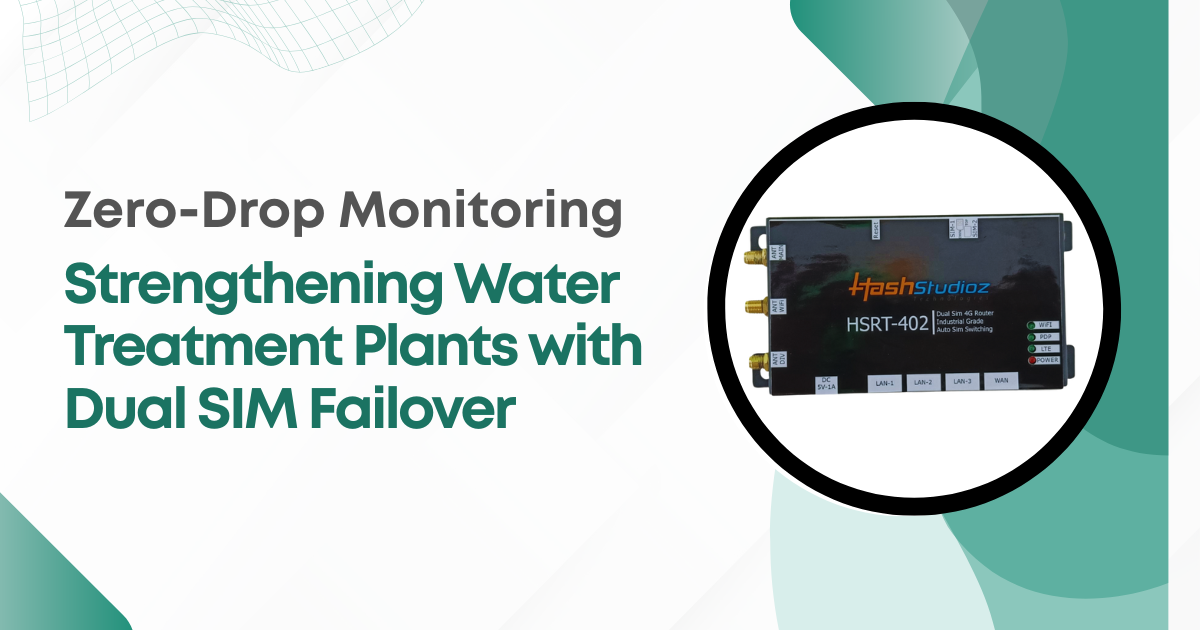
Water treatment plants form the backbone of public health and safety. These facilities must operate every second of every day without fail. Modern plants rely on digital sensors to monitor flow, pressure, and chemical levels. A single minute of data loss can lead to regulatory fines or safety risks. This article explores how a Dual SIM Industrial Router ensures continuous connectivity through zero-drop monitoring. We will look at the technical needs and real-world impacts of this technology.
The Critical Role of Connectivity in Water Systems
Modern water management uses SCADA (Supervisory Control and Data Acquisition) systems. These systems collect data from remote pump stations and filtration units. Engineers use this data to make real-time decisions about water safety. If the connection fails, the “eyes” of the plant go dark.
Traditional wired connections often fail during storms or road construction. Fiber optic cables are strong but take time to repair. Relying on a single cellular carrier is also a risky move. Cell towers undergo maintenance or face heavy network congestion. For a water plant, a “no signal” icon is not an option. This is where the Industrial Router becomes a vital piece of infrastructure. It bridges the gap between remote sensors and the central control room.
Understanding Zero-Drop Monitoring
Zero-drop monitoring refers to a network state where data transmission never stops. It uses redundant paths to move vital information across the network. If one path fails, the system switches to another path instantly. This ensures that the SCADA system never misses a single data packet.
Why Reliability Matters
- Contamination Alerts: Sensors detect sudden spikes in bacteria or dangerous chemicals.
- Flood Prevention: Monitoring water levels prevents reservoir overflows in urban areas.
- Asset Protection: Pumps can burn out if they run dry without a sensor trigger.
- Regulatory Audits: Plants must prove water quality with constant, unbroken data logs.
The Power of the Dual SIM Industrial Router
A Dual SIM Industrial Router contains two separate SIM card slots for cellular data. Each slot usually connects to a different cellular provider. This setup creates a safety net for all transmitted data. If Provider A loses its signal, the device switches to Provider B.
How Failover Works
Failover is the process of switching to a backup connection. Most basic consumer routers take minutes to switch between networks. An Industrial Router designed for water plants uses “hot-failover” or “seamless switching.” The router monitors the primary link constantly using small test packets. If it detects high latency or a dropped packet, it activates the second SIM. This happens so fast that the SCADA software does not even notice the change.
Key Benefits of Dual SIM Logic
- Carrier Diversity: Use Provider A for primary data and Provider B for backup.
- Signal Optimization: The router chooses the strongest signal automatically at the site.
- Cost Management: You can set data limits on each SIM to avoid high monthly bills.
- Network Resilience: Two different networks are unlikely to fail at the exact same time.
Statistical Impact of Network Downtime
Reliability is not just a preference for engineers. It is a financial necessity for cities. Consider these industry statistics regarding network stability:
- Financial Loss: The average cost of unplanned downtime in industrial sectors is $5,600 per minute.
- Human Error: Connectivity gaps cause 23% of all industrial accidents worldwide.
- Data Integrity: 40% of water utilities report data gaps due to poor remote connectivity.
- Redundancy Success: Systems with dual-path communication show 99.99% uptime. Single-path systems often struggle to reach 94% uptime.
Hardware Requirements for Harsh Environments
Water treatment plants are difficult environments for standard electronics. Humidity, vibrations, and chemical fumes can destroy office equipment. An Industrial Router must meet specific physical standards to survive these conditions.
Essential Hardware Features
- In-built Ruggedization: Metal casings protect internal boards against physical impact.
- Wide Temperature Range: Routers must operate from -40°C to +75°C without overheating.
- DIN-Rail Mounting: This allows easy installation in standard industrial electrical cabinets.
- Vibration Resistance: This is essential for routers placed near heavy-duty centrifugal pumps.
Solving the “Last Mile” Problem
Many water facilities sit in very remote locations or underground vaults. Running fiber optic cables to a distant reservoir is often too expensive. Cellular technology provides the best solution for these sites. However, remote towers are often unreliable due to distance.
A Dual SIM Industrial Router solves this by bridging the gap between networks. It provides fiber-like reliability without the high digging and cabling costs. This makes it the most cost-effective way to secure remote assets in a modern city.
Enhancing Security in Water Infrastructure
Water plants are high-priority targets for cyber threats. Open or unencrypted connections are very dangerous for public safety. A professional Industrial Router includes built-in security protocols to keep hackers out.
Security Layers to Consider
- VPN Tunnels: These encrypt data between the remote plant and the central office.
- Firewalls: These block unauthorized IP addresses from accessing the pump controls.
- Two-Factor Authentication: This ensures only authorized staff change network settings.
- MAC Filtering: This restricts network access to only known and approved devices.
Real-World Example: The Coastal Pump Station
A coastal town in Florida faced frequent network outages during hurricane season. Their single-SIM routers lost signal whenever high winds hit the local tower. This forced crews to drive out in dangerous storms to check manual pressure gauges.
The utility upgraded to a Dual SIM Industrial Router at each pump station. They used a large national carrier for the first SIM card. They used a regional provider for the second SIM card.
During the next major storm, the primary tower went down. The routers switched to the backup SIM in under five seconds. The central office kept receiving pressure data throughout the storm. No manual checks were needed. This saved the town thousands in labor costs and kept workers safe.
Improving Operational Efficiency
Zero-drop monitoring does more than prevent disasters. It helps with daily maintenance tasks. Stable data allows for predictive maintenance which saves money over time.
Data-Driven Maintenance
- Trend Analysis: Consistent data shows when a filter is slowly clogging.
- Remote Troubleshooting: Engineers fix software bugs without driving to the remote site.
- Energy Savings: Steady monitoring helps optimize pump speeds to save electricity.
- Reduced Site Visits: Staff only go to sites when the data indicates a real problem.
Comparing Standard Routers vs. Industrial Routers
| Feature | Standard Router | Industrial Router |
| SIM Slots | Usually 0 or 1 | Dual SIM Support |
| Housing | Plastic | Rugged Metal |
| Power Input | AC Wall Plug | DC Terminal Block (9-36V) |
| Longevity | 2-3 Years | 10+ Years |
| Redundancy | None | Automatic Failover |
| Mounting | Desktop | DIN-Rail or Wall Mount |
Real-World Example: Preventing a Chemical Overflow
A mid-sized city in the Midwest relied on a single-carrier connection for their chlorination site. One afternoon, the cellular provider had a regional outage. The SCADA system stopped receiving updates from the chlorine injectors.
The pump stayed running at a high rate because the “stop” command never arrived. For three hours, the chlorine levels rose to dangerous levels. The city had to issue a boil-water notice to 50,000 residents.
After this event, they installed an Industrial Router with dual SIM failover. Six months later, the primary network failed again. This time, the router switched to the backup SIM instantly. The operators saw the high chlorine levels on their screens. They shut down the pump remotely and prevented a second crisis.
Implementation Steps for Water Utilities
Upgrading to a zero-drop system requires a clear plan. It is not just about buying new hardware. It is about building a resilient architecture for the future.
1. Site Survey
Check the signal strength of multiple carriers at every location. Identify dead zones or areas with high interference.
2. Hardware Selection
Choose a Dual SIM Industrial Router with high data throughput. Ensure it supports the specific frequency bands used by local carriers.
3. Configuration
Set up the failover triggers. Define what constitutes a “failed” connection. This might be a specific ping response time or a high packet loss percentage.
4. Testing
Manually disable the primary SIM during a scheduled test window. Verify that the system switches without losing the SCADA connection.
Future-Proofing with 5G and Beyond
The next generation of water monitoring will use more data. High-definition cameras will monitor for physical leaks or intruders. AI will analyze flow patterns in real-time. This requires high bandwidth and low latency.
Investing in a high-quality Industrial Router today ensures readiness for tomorrow. Many modern devices allow for modular upgrades. You can swap a 4G module for a 5G module later. This keeps the infrastructure relevant for many decades.
The Economic Argument for Redundancy
Budget committees often question the cost of dual-provider setups. However, the Return on Investment (ROI) is very clear. One avoided sewage spill pays for the hardware ten times over.
Redundancy is an insurance policy for the city. It protects the utility from expensive lawsuits and environmental damage. A Dual SIM Industrial Router is a small price for total peace of mind. It ensures that the water continues to flow safely to every home.
Real-World Example: Remote Reservoir Monitoring
A mountain reservoir used a single satellite connection for data. Snow buildup often blocked the satellite dish. This left the city blind to water levels during the winter. They added an Industrial Router with a cellular SIM as a backup.
The cellular tower was five miles away, but a high-gain antenna reached it. Now, when the satellite dish is covered in snow, the cellular link takes over. The city has 100% data visibility all winter long. They no longer worry about spring floods catching them by surprise.
Managing Data Usage Effectively
A common concern is the cost of two different data plans. Modern routers help manage this cost. You can set the backup SIM to a “standby” mode. In this mode, it consumes almost zero data until the primary link fails. This keeps monthly costs low while maintaining maximum security for the water plant.
Final Thoughts
Water is our most precious resource. Managing it requires the best digital tools available. A Dual SIM Industrial Router provides the stability that modern plants need. It eliminates the risk of data gaps. It protects expensive equipment and ensures public safety.
By adopting zero-drop monitoring, utilities move from reactive to proactive management. They stop worrying about the network and focus on the water. In the world of critical infrastructure, “always-on” is the only acceptable standard. High-quality hardware makes this standard a reality for every water treatment plant today. The cost of a Dual SIM Industrial Router is minor compared to the safety of the community.