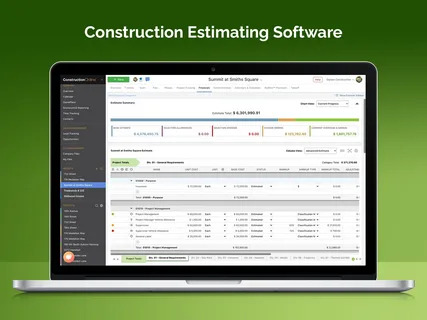
For large commercial construction projects, it is important to have a good plan in place before the construction process starts. Contractors analyze project schedules, equipment costs, subcontractor costs, labor needs and material costs to develop accurate estimates. All of the preconstruction decisions impact the budgeting, bidding and project execution. In addition, precise estimating helps the construction team manage resources effectively and helps to ensure consistency in complex commercial developments, providing improved financial visibility.
The more complex the project, the harder it will be to handle big estimates on a manual basis. Commercial construction estimating software has a single workflow for quantities, pricing, drawings and cost information. Centralised records allow estimators to access project data to review, make updates, and create uniform bid documents. Estimating processes are also organized, which also increases the degree of cooperation between the project teams, and provides accurate financial planning at the preconstruction stage
Why Is Accurate Estimating Important for Large Commercial Projects?
Estimating correctly establishes a solid fiscal base prior to construction. Commercial projects are projects that have several trades, fluctuating material expenses, labor scheduling, and subcontractor coordination. Accurate estimates can enable contractors to better plan and budget projects and increase confidence in the planning process.
Good cost estimates also minimize the uncertainty of the finances during construction. Cost information organized in an organized manner helps project teams keep track of costs, compare the estimated costs, and have uniformity in budgeting. Financial planning is a crucial component that leads to more successful project management and can inform business decisions.
Managing Complex Project Costs
Commercial projects have numerous cost categories which need careful consideration. Other factors that influence the project estimate are equipment costs, labour costs, material prices and subcontractor quotes, as well as site requirements. The information in each category must be correct to help contractors to make competitive bids.
The following list of construction cost categories logically groups these costs into a structured construction cost estimation process. It is possible to view each item of cost at a single detail level while always having a full overview of the project. A list of organized information helps to eliminate confusion when making financial plans.
Building Reliable Project Budgets
Budgeting is based on full and precise estimating information. Historical pricing and supplier quotations, labor needs, and equipment are reviewed by contractors when making financial projections. Stability in budgeting in the project planning process.
Good financial planning also enables project teams to know what they are going to spend and how much they have. This systematic strategy enhances the process of preparing a bid and sets expectations for projects’ delivery and financial management
How Does Commercial Construction Estimating Software Organise Project Data?
Estimating information is quite large in a big construction project. Commercial construction estimating software is able to keep project quantities and pricing data, labour data, and supporting documents in a single system. Centralised records allow for more uniformity in the estimating process.
This also saves time from having to locate data in individual documents and spreadsheets. Estimators, project managers and procurement teams can have access to the same information and keep project records uniform throughout the departments.
Collecting Quantity Takeoff Information
All commercial estimates start with a quantity takeoff. Digital drawings, measurements, material quantities and project specifications are read to the estimators who determine the cost of the project. Information about quantity is important because it will help you to create reliable cost estimates for each phase of the project.
Another advantage of digital QTO is to minimise inconsistencies between drawings and estimating records. Accurately organised data during measurement helps estimators easily review project quantities and keeps an accurate record for future reference.
Organizing Project Cost Information
Once the quantity is collected, the estimators categorise labour rates, material costs, equipment costs, subcontractor quotes, and indirect costs. Well-organised information will provide more visibility all over the estimate and will cut down calculation errors.
A centralized estimating database also can keep project teams from having to rebuild the estimate when they make updates to pricing. Regular cost organisation helps ensure accurate reporting, bid preparation, financial coordination and more in commercial construction projects.
How Does Estimating Software Improve Team Coordination?
For large-scale commercial projects, the estimators, project managers, procurement, executives and finance departments are all involved. A shared environment for commercial construction estimating software will make it possible to see the same estimating information for all stakeholders. Having all project information in one place helps to eliminate the communication issues and provides consistency throughout the estimating process.
Another benefit of improved cooperation is the elimination of redundant efforts and redundant information. Groups meet to discuss the changes to estimates, price changes, and project information from a single site. Communication is critical in construction for making educated decisions before submitting project bids.
Sharing Estimate Information Across Teams
Project cost estimates are created by estimators; scheduling needs are discussed by project managers, and pricing is checked by procurement. By sharing estimating information, all departments can be provided with the same project information. The coordinated approach minimises misunderstandings in the planning of the project.
Having access in the middle also enhances transparency throughout the company. No more looking in different spreadsheets or having lengthy email exchanges to view estimate information, update pricing, and review it.
Maintaining Version Control
Designs for commercial projects can change, resulting in changing estimates. Many revisions will be needed in material, labour rates and scope of work before the contractors will present a final bid. Versioned organization is used to track and provide documentation for all versions during the estimating process.
A revision history is also helpful in preventing confusion of older estimates and current estimates. Project teams can easily track changes, verify pricing accuracy and document effectively while making reliable bids.
What Features Matter Most for Large Commercial Projects?
When it comes to big construction jobs, all that they need is more than just figures and numbers. There is a need for organized reporting, detailed cost analysis, document management and project visibility for estimators. These features enable better knowledge of the project funding prior to construction.
Good estimating systems also provide the ability to share information with other departments in a way that makes it accessible. A robust project history is useful for creating financial plans and for teams to examine various cost viewpoints before putting in bids for projects.
Reporting and Cost Analysis
Detailed reports provide information on the cost of materials, manpower cost, equipment cost, quotes from subcontractors, project value, etc. The reports enable decision-makers to see the financial information without having to look at each individual cost item. Clear reporting instills more confidence when evaluating projects.
A cost analysis also provides insight on expenditures for each stage of the project. Estimators can develop well-structured financial reports that are useful in helping to arrive at more accurate commercial estimates, compare cost categories and assess consistency in pricing.
Integration With Construction Systems
In many cases, accounting software, project management platforms, ERP systems, and document management tools are all integrated into a single suite, such as accounting software. With connected systems, you can estimate information flow smoothly between departments with accurate financial records.
Integrated workflows also minimise manual data entry and duplicate data documentation. Uniform and consistent information facilitates smooth communication between estimating, procurement, accounting and project management teams during all stages of commercial construction.
What Challenges Can Affect Commercial Construction Estimating?
Financial estimating comes with a number of difficulties prior to construction. Even though commercial construction estimating software provides great organization for project data, precise estimates still rely on accurate project data and planning. Throughout the bidding process, the changing conditions need to be assessed by the estimators.
The more complex a project becomes, the larger the building, the more technical demands and the more stakeholders that are involved, the more complex it gets. With careful coordination, contractors can continue to have streamlined estimating processes and deal with project changes effectively.
Changing Material Prices
The prices of construction materials can change often due to market conditions, availability of the suppliers and transportation costs. These changes have an impact on project prices and bid calculations. It is important that the estimators check and update the prices before final estimates.
Conducting price updates regularly helps to keep financial planning more realistic. Contractor cost databases can integrate supplier data that can be compared to other costs to have more consistency during the estimating process.
Incomplete Project Information
Uncertainty during estimating due to missing drawings, design changes, scope changes and unclear specifications. When there is incomplete information, it adds risk to the cost estimation process prior to the project bidding. Many contractors will look at the newly revised documents multiple times before making an estimate.
These challenges can be minimised by communication between designers, consultants and estimators. Consistent project documentation can help the estimator to provide accurate financial estimates and provide consistency throughout the project planning process.
What Should Contractors Consider Before Choosing Estimating Software?
When choosing estimating software, it is important to consider more than just its capabilities. The complexity, size and need of a company should determine the complexity of the software used to estimate commercial construction projects. The contractors need to also take into account future business expansion before investing long-term.
A clearly defined evaluation process minimises implementation issues and ensures uniformity of workflow. By evaluating their technical abilities, reporting needs and long-term reliability, contractors can choose a solution that fits into their estimating procedures and business goals.
Business Requirements and Scalability
All construction companies have projects of varying complexity. For small companies, they might predict a couple of projects per month, and for the larger contractors, they can be working a number of commercial bids at any given time. Knowing the operational needs provides a better basis for software selection.
There is a need to carefully consider a possible future expansion. Contractors need to assess access, project capacity, reporting requirements, and system flexibility to ensure the software will continue to meet the needs of the growing business.
Vendor Experience and Industry Knowledge
Experience with the construction industry is a key factor to consider when comparing software providers. The contractor should take into account industry knowledge, experience of implementation, training of the customers, and continuing technical support. The vendors who have been in the business know about the commercial estimating process and the needs of the projects.
Good software vendors also perform regular updates and ensure that systems operate normally. Stable operations of estimating in future commercial projects are achieved due to long-term product development and responsive technical assistance.
Conclusion
Estimating is still crucial in any commercial construction venture, even in this day and age of technology. This organisation of project data, coupled with reliable cost planning, team coordination and consistent reporting, has led to better bids and financial management. Operational requirements, scalability, and industry expertise should be explored as part of a contractor’s consideration of an estimating solution. A commercial construction estimating software solution that is well planned in place provides structured processes, project budgeting and well-informed decision-making at every step of the commercial construction planning process.
FAQs
What is commercial construction estimating software?
It allows it to consolidate project cost, quantity and bid data in one place – a tool used by contractors for preparing accurate estimates prior to project bidding.
Will estimating software work on large business projects?
Yes, it does. It handles complex project data from several trades and several cost categories. It also streamlines the organisation of estimates throughout the planning and bidding process.
What is the significance of estimating accurately before putting in a bid?
A commercial construction estimating software solution maintains uniformity and organisation of cost information. Uncertainty in finances is minimised and project plans are enhanced by reliable estimates.
What are some factors that should be considered by contractors in choosing estimating software?
Examine industry experience, scalability, reporting and integration options. Select a solution that meets long-term business and project needs.