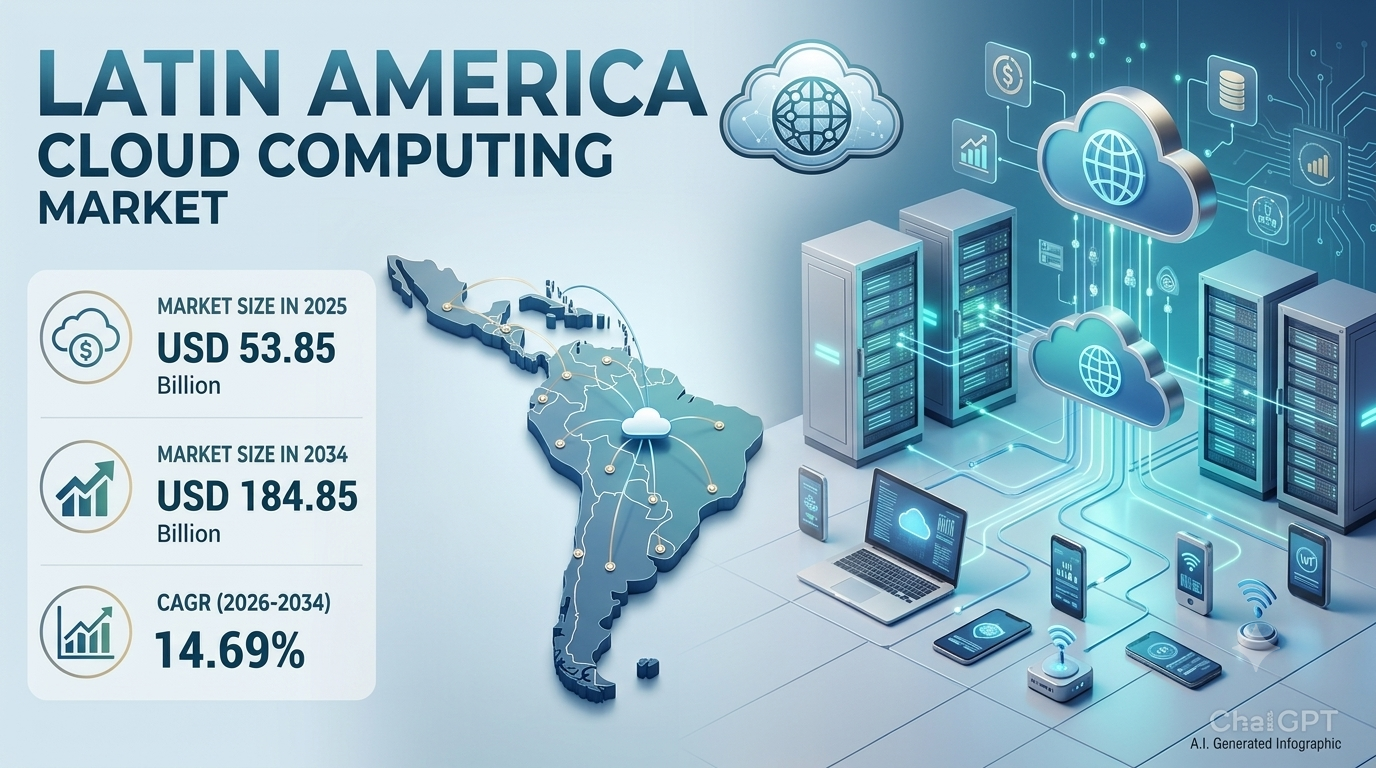
The Latin America cloud computing market is experiencing robust expansion as businesses and governments across the region prioritize digital transformation and modernize legacy infrastructure. The market size was valued at USD 53.85 Billion in 2025 and is projected to reach USD 184.85 Billion by 2034, growing at a compound annual growth rate (CAGR) of 14.69% during 2026-2034. Growing adoption of scalable, cost-effective cloud solutions enables organizations to enhance operational efficiency while reducing capital expenditures. The proliferation of artificial intelligence, machine learning, and data analytics applications is accelerating enterprise cloud migration across diverse industry verticals. Expanding internet connectivity and mobile broadband penetration are democratizing cloud access, enabling businesses of all sizes to leverage advanced computing capabilities. Strategic investments from global hyperscalers in regional data center infrastructure are strengthening the ecosystem, improving service latency, and ensuring data sovereignty compliance. Regulatory frameworks promoting data protection and cybersecurity are encouraging organizations to transition sensitive workloads to secure cloud environments, thereby expanding the Latin America cloud computing market share.
The Latin America cloud computing market is poised for sustained expansion, driven by accelerating digital transformation, AI adoption, and strategic hyperscaler investments in regional data center infrastructure. With a projected CAGR of 14.69% through 2034, the market presents significant opportunities for cloud service providers, technology partners, and enterprises seeking scalable and innovative cloud solutions.
LATIN AMERICA CLOUD COMPUTING MARKET SUMMARY
The Latin America cloud computing market encompasses a wide range of services designed to deliver scalable computing resources, storage, and application platforms across the BFSI, healthcare, retail, manufacturing, and government sectors. The ecosystem includes global hyperscalers (AWS, Microsoft Azure, Google Cloud, Oracle), regional cloud providers, managed service providers, system integrators, and end-use enterprises. Major segments identified in the market include service (Infrastructure as a Service – IaaS, Platform as a Service – PaaS, Software as a Service – SaaS), workload (data storage and backup, application development and testing, disaster recovery, others), deployment mode (public cloud, private cloud, hybrid cloud), organization size (large enterprises, SMEs), and vertical (BFSI, healthcare, retail, government, manufacturing, IT & telecom, others). IaaS dominates the service segment with a 38% market share in 2025, driven by enterprises migrating on-premises workloads to scalable virtual infrastructure platforms. BFSI represents the leading vertical with a 24% market share in 2025, as financial institutions prioritize digital transformation to modernize core banking systems.
PORTER’S FIVE FORCES ANALYSIS — LATIN AMERICA CLOUD COMPUTING MARKET
The competitive dynamics of the Latin America cloud computing market can be analyzed using Porter’s Five Forces framework.
- Competitive Rivalry: High, with intense competition between global hyperscalers (AWS, Microsoft Azure, Google Cloud, Oracle) and regional providers. Rivalry is driven by massive infrastructure investments, service innovation, and pricing strategies. Latin America has become a growth hotspot for IaaS and PaaS providers, with growth rates outpacing global averages. Business implication: Cloud providers must differentiate through localized solutions, data sovereignty compliance, industry-specific offerings, and strong partner ecosystems to win enterprise contracts and generate sustainable growth.
- Supplier Power (Infrastructure Providers): Hyperscalers have significant bargaining power over data center equipment suppliers, fiber providers, and energy providers due to large-scale procurement. However, the concentration of specialized infrastructure suppliers creates some dependency. Business implication: Cloud providers should develop long-term strategic partnerships with key infrastructure suppliers, diversify sourcing, and invest in renewable energy integration to secure supply chain resilience.
- Buyer Power (Enterprises): Large enterprises and government institutions have growing bargaining power as sophisticated buyers of cloud services, demanding customized solutions, competitive pricing, service-level agreements, and data residency guarantees. Business implication: Cloud providers must demonstrate strong security credentials, regulatory compliance, industry expertise, and value-added services to attract and retain enterprise commitments.
- Threat of Substitutes: On-premises IT infrastructure, colocation services, and multi-cloud strategies pose substitution threats for public cloud adoption. Business implication: Cloud providers must articulate clear cost advantages, operational benefits, innovation capabilities, and total cost of ownership improvements relative to on-premises alternatives.
- Threat of New Entrants: High barriers to entry exist for large-scale IaaS/PaaS providers due to capital intensity, infrastructure requirements, and regulatory compliance. However, lower barriers exist for niche SaaS providers and specialized cloud services. The region’s growing market attracts new domestic and international entrants. Business implication: Established players should build defensible positions through continuous infrastructure investment, localized solutions, strong partner networks, and regulatory expertise.
Competitive Rivalry — High (Intensifying)
- Multi-tier competition spans global hyperscalers (AWS with approximately 38% market share in Latin America, Microsoft Azure, Google Cloud, Oracle Cloud), regional providers (Stefanini Group, TIVIT), and specialized managed service providers — driving differentiation through service innovation, localization, sustainability credentials, and industry-specific solutions.
- Hyperscalers are launching new cloud regions across Latin America at an unprecedented pace, transforming the region into the next great battleground for global cloud competition. AWS, Microsoft Azure, Google Cloud, and Oracle are all expanding aggressively, establishing availability zones in Mexico, Brazil, Chile, Colombia, and beyond.
Request for Sample Report: https://www.imarcgroup.com/latin-america-cloud-computing-market/requestsample
MARKET GROWTH DRIVERS:
Several key factors are propelling the expansion of the Latin America cloud computing market.
Digital Transformation and Legacy Modernization
The accelerating digital transformation across Latin American enterprises serves as a powerful demand driver for cloud computing. Businesses and governments are prioritizing modernization of legacy IT infrastructure to enhance operational efficiency, reduce capital expenditures, and improve competitiveness. Government initiatives actively promote technology modernization through comprehensive programs supporting industrial digital transformation encompassing cloud computing, artificial intelligence, and big data infrastructure. The Brazilian government has introduced the REDATA policy through Provisional Measure 1,318/2025, establishing a Special Taxation Regime for Data Center Services to position the country as a leading hub for digital infrastructure in Latin America.
Proliferation of AI, Machine Learning, and Data Analytics
The proliferation of artificial intelligence, machine learning, and data analytics applications is accelerating enterprise cloud migration across diverse industry verticals. AI adoption is accelerating across Latin America, from e-commerce recommendation engines to agriculture analytics. These workloads require GPU clusters and high-density infrastructure, which hyperscaler cloud regions can provide at scale. Cloud platforms provide enterprises with unprecedented capabilities to deploy sophisticated applications, leverage advanced analytics, and access enterprise-grade computing resources.
Strategic Hyperscaler Investments and Data Center Expansion
Strategic investments from global hyperscalers in regional data center infrastructure are strengthening the ecosystem, improving service latency, and ensuring data sovereignty compliance. Hyperscalers are announcing multi-billion-dollar investments in Latin America to build sustainable campuses and cloud regions, including renewable energy integration, fiber upgrades, and workforce development. Brazil remains the most important data center colocation market in Latin America, but hyperscalers are making massive investments as they expand their cloud regions into Chile, Colombia, and Mexico.
Data Residency and Regulatory Compliance
Regulatory frameworks promoting data protection and cybersecurity are encouraging organizations to transition sensitive workloads to secure cloud environments. Governments across the region are enacting data sovereignty laws requiring sensitive data to remain within national borders. Hyperscalers launching in-country regions ensure compliance, opening the door to banking, healthcare, and government contracts. Brazil allows secure, in-country cloud services for classified government data, creating opportunities for certified providers meeting strict security rules.
Expanding Digital Connectivity and Mobile Broadband
Expanding internet connectivity and mobile broadband penetration are democratizing cloud access, enabling businesses of all sizes to leverage advanced computing capabilities. The region’s improving digital connectivity creates favorable conditions for widespread cloud adoption as businesses and consumers gain reliable access to internet services.
LATIN AMERICA CLOUD COMPUTING MARKET SEGMENTATION
Segmentation analysis provides a detailed view of the Latin America cloud computing market by category:
- Service Insights: Infrastructure as a Service (IaaS) — 38% market share in 2025, Platform as a Service (PaaS), Software as a Service (SaaS).
- Workload Insights: Data Storage and Backup — 25% market share in 2025, Application Development and Testing, Disaster Recovery, Others.
- Deployment Mode Insights: Public Cloud — 52% market share in 2025, Private Cloud, Hybrid Cloud.
- Organization Size Insights: Large Enterprises — 62% market share in 2025, Small and Medium Enterprises (SMEs).
- Vertical Insights: BFSI — 24% market share in 2025, Healthcare, Retail, Government, Manufacturing, IT & Telecom, Others.
- Regional Insights: Brazil — 38% market share in 2025, Mexico, Argentina, Colombia, Chile, Rest of Latin America.
COMPETITIVE LANDSCAPE
The Latin America cloud computing market features a highly competitive landscape, with multi-tier competition spanning global hyperscalers and strong regional players. Key companies operating in the market include:
- Amazon Web Services (AWS) — Market leader with approximately 38% share in Latin America, benefiting from significant first-mover advantage.
- Microsoft Azure — Strong competitor with aggressive expansion across the region.
- Google Cloud — Key player with expanding regional presence.
- Oracle Cloud — Expanding aggressively with new cloud regions.
- IBM Cloud — Established presence in the region.
- Huawei Cloud — Growing footprint in Latin America.
- Tencent Cloud — Expanding regional presence.
- Stefanini Group (Brazil) — Leading regional managed services provider.
- TIVIT (Brazil) — Key regional player in managed services.
- Regional Providers — Including domestic cloud and managed service providers serving local enterprise needs.
Strategic developments are shaping the competitive arena. Hyperscalers are launching new cloud regions across Latin America at an unprecedented pace, transforming the region into the next great battleground for global cloud competition. To navigate regulatory and business landscapes, hyperscalers are partnering with local telcos, utilities, and governments to accelerate permitting, ensure compliance, and build community goodwill. Frost & Sullivan’s Frost Radar™ analysis highlights that Latin America recently became a growth hotspot for IaaS and PaaS providers, with companies committing more money and resources to the region, resulting in growth rates outpacing global averages.
REGIONAL ANALYSIS:
Regional dynamics within the Latin America cloud computing market are shaped by varying levels of digital maturity, economic development, and infrastructure investment.
- Brazil emerges as the largest and most critical market, accounting for 38% of the regional market share in 2025 and establishing itself as the primary hub for cloud computing infrastructure investment in Latin America due to its mature digital ecosystem and substantial enterprise demand. São Paulo remains the anchor hub, with hyperscalers building multi-phase campuses to serve the nation’s 215 million people and regional customers. The Brazilian government’s REDATA policy provides tax incentives for data center expansion.
- Mexico serves as both a domestic growth market and a bridge to the United States, making it one of the hottest targets for new cloud regions. Querétaro and Monterrey are attracting hyperscaler builds, fueled by nearshoring, manufacturing, and fintech growth. Industrial sectors are accelerating cloud migration to support nearshoring initiatives.
- Colombia is becoming a rising star in Latin America’s cloud market, with Bogotá emerging as a fast-growing demand center. SMEs are leveraging cost-effective SaaS and IaaS solutions.
- Chile has emerged as a regional green energy leader, with hyperscalers investing in Santiago to leverage renewable power purchase agreements and serve Southern Cone countries. The country’s submarine cable connections to Asia provide global strategic value.
- Argentina and Beyond — While still developing, Argentina and other Southern Cone markets are on the radar, with hyperscalers assessing opportunities to expand once regulatory and economic conditions stabilize. Chile and Peru are seeing growth in fintech and healthcare adopting hybrid cloud systems.
RECENT INDUSTRY DEVELOPMENTS
September 2025: The Brazilian government introduced Provisional Measure No. 1,318/2025 establishing the Special Taxation Regime for Data Center Services (REDATA), aiming to expand Brazil’s capacity for data storage, processing, and management by encouraging the installation and expansion of data centers in the country.
2025: Hyperscalers launched new cloud regions across Latin America at an unprecedented pace, with AWS, Microsoft Azure, Google Cloud, and Oracle expanding aggressively and establishing availability zones in Mexico, Brazil, Chile, Colombia, and beyond.
2025: Frost & Sullivan’s Frost Radar™ analysis confirmed that Latin America became a growth hotspot for IaaS and PaaS providers, with 78% of Latin American IT leaders believing cloud is critical for business success.
2025: Regional industry revenue for IaaS and PaaS providers was projected to grow 15% in 2025, reaching an estimated $14 billion, with a compound annual growth rate of 22.4% from 2024 to 2031.
2025: Latin American enterprises continued moving workloads to the cloud at record pace, from digital-native startups in Mexico to financial institutions in Brazil, adopting hybrid and multicloud strategies to accelerate innovation.
2025: The Latin America cloud computing market was valued at USD 53.85 Billion in 2025, with IaaS dominating the service segment at 38% market share, data storage and backup leading workloads at 25%, and public cloud representing 52% of deployment modes.
Note: If you need any specific information that is not covered currently within the scope of the report, we will provide the same as a part of customization.
Request Customization: https://www.imarcgroup.com/request?type=report&id=30047&flag=E
Write this before about us
- Report Format, Delivery, and Customization Details
- Report Format Mode: PPT, PDF, and Excel
- Report Delivery Mode: Online Delivery, Physical Delivery
- Report Delivery Time: Report Delivered Over Email within 24 to 48 hours. If requested by the client, a physical copy will be delivered within three to ten days.
- Report Confirmation Mode: Yes via Email
- Report Customization Mode: Yes via Email / Call
- Report Table of Content: Yes
- Report List of Figures: Yes
- Report Methodology Mode: Yes
- Request For Sample Report: Yes