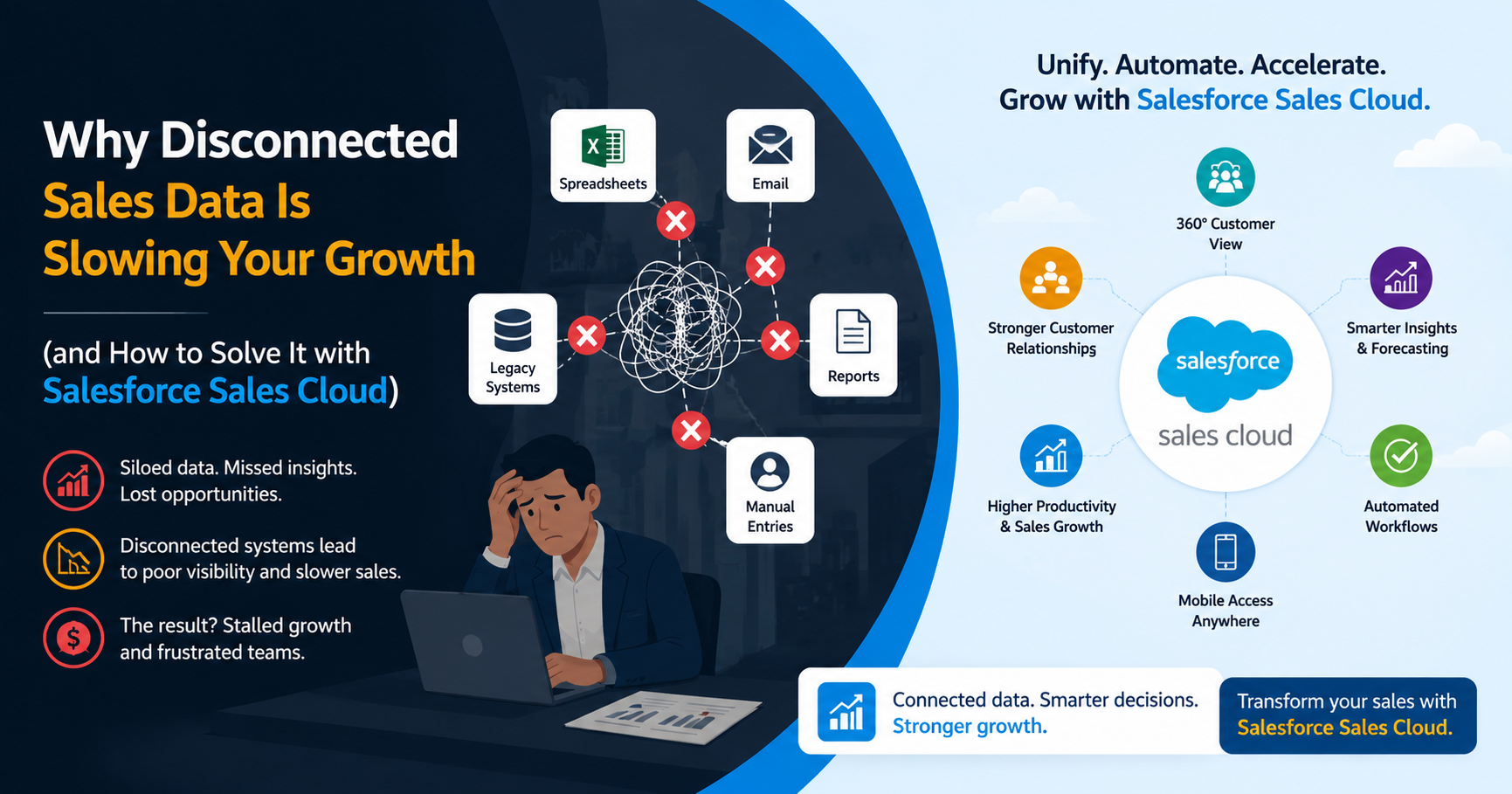
Sales organizations generate massive volumes of customer and pipeline data every day. Yet many companies still struggle to turn that data into reliable decisions. The problem is not a lack of information. The real issue comes from disconnected systems, duplicate records, inconsistent reporting structures, and isolated workflows spread across CRM platforms, spreadsheets, ERP tools, and communication channels.
The impact on revenue growth has become difficult to ignore. According to Salesforce’s 2024 State of Sales report, sales professionals in Singapore spend only 29% of their time actively selling because administrative work and fragmented processes consume the rest of their schedule. Another Salesforce study found that 89% of sales teams in India already use or experiment with AI-driven sales technologies, but concerns around integration and data quality continue to limit business value.
IBM’s “State of Salesforce 2024-2025” report revealed another critical insight: although 97% of organizations collect diverse customer data, only 24% successfully use that data to improve customer experiences and business outcomes.
These numbers highlight a growing challenge for modern enterprises. AI forecasting, customer analytics, lead scoring, and revenue intelligence cannot function properly when sales data remains fragmented across disconnected systems.
This is where Salesforce Sales Cloud becomes highly relevant. When implemented correctly, it creates a centralized and structured sales environment that supports forecasting accuracy, operational visibility, and scalable growth.
The Hidden Cost of Disconnected Sales Data
Disconnected sales data creates operational friction at almost every stage of the sales cycle. The damage often remains invisible until businesses experience stalled revenue growth, declining forecast accuracy, or poor customer retention.
1. Sales Teams Lose Time Searching for Information
Many organizations still rely on separate systems for customer communication, quotations, support tickets, inventory updates, and account management. Sales representatives frequently switch between tools just to gather basic customer context.
This creates several operational problems:
- Duplicate data entry
- Delayed follow-ups
- Inconsistent account histories
- Missing customer interactions
- Inaccurate pipeline reporting
Instead of focusing on customer engagement, sales teams spend hours validating data manually.
According to CRM industry research published in 2026, sales representatives still spend nearly 60% of their time on non-selling tasks due to disconnected systems and poor CRM processes.
2. Forecasting Becomes Unreliable
Revenue forecasting depends on clean and connected sales data. When teams maintain separate spreadsheets or outdated CRM records, forecast accuracy drops significantly.
Leadership teams then face major business risks:
- Incorrect hiring decisions
- Poor inventory planning
- Weak territory management
- Delayed expansion strategies
- Misaligned marketing investments
Forecasting problems become even more serious in enterprise sales environments where deal cycles involve multiple departments and approval layers.
3. Customer Experience Starts to Break Down
Customers now expect continuity across sales, service, and support interactions. Disconnected data prevents teams from maintaining a unified customer view.
For example:
- A sales representative may not know about unresolved support issues.
- Customer success teams may lack visibility into active deals.
- Marketing teams may send irrelevant campaigns to existing enterprise accounts.
This fragmentation weakens trust and affects long-term retention.
Why Traditional CRM Setups Often Fail
Many organizations already use CRM software but still struggle with disconnected sales operations. This happens because technology alone does not solve process fragmentation.
Several common issues contribute to CRM failure:
Poor Data Governance
Organizations often allow inconsistent data entry standards across departments. Over time, duplicate accounts, incomplete opportunity stages, and inaccurate contact details accumulate inside the system.
Recent CRM research found that 76% of organizations believe less than half of their CRM data remains accurate and complete.
Weak Integration Architecture
Sales data frequently sits across multiple platforms:
- ERP systems
- Marketing automation tools
- Support platforms
- Financial systems
- Third-party sales tools
Without proper integrations, CRM platforms become isolated systems rather than operational hubs.
Low User Adoption
Sales teams avoid CRM systems when workflows become overly complicated or time-consuming. This leads to incomplete records and inconsistent pipeline visibility.
Many enterprises mistakenly treat CRM implementation as an IT deployment instead of a long-term operational transformation project.
How Salesforce Sales Cloud Solves the Data Disconnect Problem
Centralized Customer and Opportunity Data
Salesforce Sales Cloud provides a unified environment for managing leads, accounts, contacts, opportunities, and activities.
Instead of storing customer information across disconnected applications, businesses can consolidate operational sales data into a single platform.
This improves:
- Sales visibility
- Customer interaction tracking
- Pipeline transparency
- Cross-functional collaboration
- Forecast accuracy
Sales managers gain real-time visibility into deal progression without relying on manually updated spreadsheets.
Real-Time Reporting and Forecasting
One of the strongest capabilities within Salesforce Sales Cloud involves centralized analytics and forecasting.
Leadership teams can monitor:
- Revenue pipelines
- Sales cycle duration
- Win rates
- Territory performance
- Rep productivity
- Customer acquisition trends
Because the system updates in real time, decision-makers can identify bottlenecks early rather than waiting for quarterly reviews.
Advanced forecasting models also become more reliable because the platform pulls data directly from active sales activities.
Workflow Automation Reduces Manual Tasks
Manual administrative work remains one of the largest productivity drains for sales teams.
Salesforce Sales Cloud helps automate repetitive tasks such as:
- Lead assignment
- Follow-up reminders
- Approval workflows
- Email notifications
- Opportunity stage updates
- Quote generation
Automation improves consistency while reducing human error.
This becomes especially valuable for enterprise organizations managing high-volume sales operations across multiple regions.
AI and Predictive Insights Work Better with Connected Data
AI-driven sales tools depend heavily on clean and centralized datasets. Fragmented systems reduce prediction quality and forecasting reliability.
Salesforce integrates AI capabilities directly into Sales Cloud through predictive scoring, opportunity insights, and customer intelligence tools.
However, these features only deliver meaningful results when organizations establish strong data governance and connected workflows first.
This is why many enterprises now invest in Salesforce Sales Cloud Consulting Services to optimize data architecture, workflow design, and integration strategy before scaling AI initiatives.
The Role of Salesforce Sales Cloud Consulting Services
Successful CRM transformation requires more than software implementation.
Experienced Salesforce consultants help organizations address operational challenges such as:
- CRM architecture planning
- Multi-system integrations
- Sales process standardization
- Data migration
- Workflow automation
- Security and compliance controls
- Reporting optimization
Without proper planning, companies often replicate inefficient workflows inside the CRM itself.
Professional Salesforce Sales Cloud Consulting Services help businesses align technology with actual sales operations and long-term revenue objectives.
Many enterprises also work with specialized sales cloud consulting services providers to improve CRM adoption across distributed sales teams. This includes user training, dashboard customization, territory management planning, and executive reporting frameworks.
Real-World Enterprise Example
IBM provides a strong example of enterprise-scale CRM transformation using Salesforce technologies.
According to IBM’s State of Salesforce report, the company previously faced fragmented sales and client service operations across multiple communication channels and systems. Teams lacked visibility into customer histories and operational activities, making personalized engagement difficult.
IBM addressed these issues by implementing Salesforce-based Customer 360 solutions that consolidated customer interactions into a centralized environment. Sales Cloud became a key operational system used by thousands of sellers and managers.
The result included:
- Improved visibility across customer interactions
- Better coordination between teams
- Faster sales workflows
- Stronger customer engagement processes
This example demonstrates that centralized sales data directly affects operational efficiency and customer experience quality.
ROI and Business Impact
Organizations that centralize sales operations through Salesforce Sales Cloud often experience measurable operational improvements within the first year.
Common business outcomes include:
- Faster sales cycle completion
- Higher forecast accuracy
- Reduced manual reporting effort
- Improved lead response times
- Better CRM adoption rates
- Increased visibility across territories
Businesses also reduce revenue leakage caused by duplicate records, delayed follow-ups, and inconsistent opportunity management.
In practical terms, even a modest improvement in forecast accuracy or conversion rates can create a substantial financial impact for enterprise sales organizations handling large pipelines.
For example:
- A 10% reduction in sales cycle length can improve quarterly cash flow
- Better opportunity tracking can reduce lost deals caused by delayed engagement
- Automated workflows can save hundreds of administrative hours annually
These operational gains often justify the investment in CRM modernization projects.
Final Thoughts
Disconnected sales data creates more than reporting problems. It directly affects productivity, forecasting accuracy, customer experience, and revenue growth.
Many organizations continue investing in AI, analytics, and automation while ignoring the underlying issue of fragmented operational data. Without centralized visibility, even advanced sales technologies produce inconsistent results.
Salesforce Sales Cloud addresses this challenge by providing a unified platform for sales operations, customer management, forecasting, and workflow automation. However, long-term success depends on proper implementation, governance, integration planning, and user adoption.
This is why enterprises increasingly rely on Salesforce Sales Cloud Consulting Services and experienced sales cloud consulting services providers to build scalable CRM ecosystems aligned with business goals.
In modern sales environments, connected data is no longer optional. It has become a foundational requirement for sustainable growth, operational accuracy, and competitive decision-making.