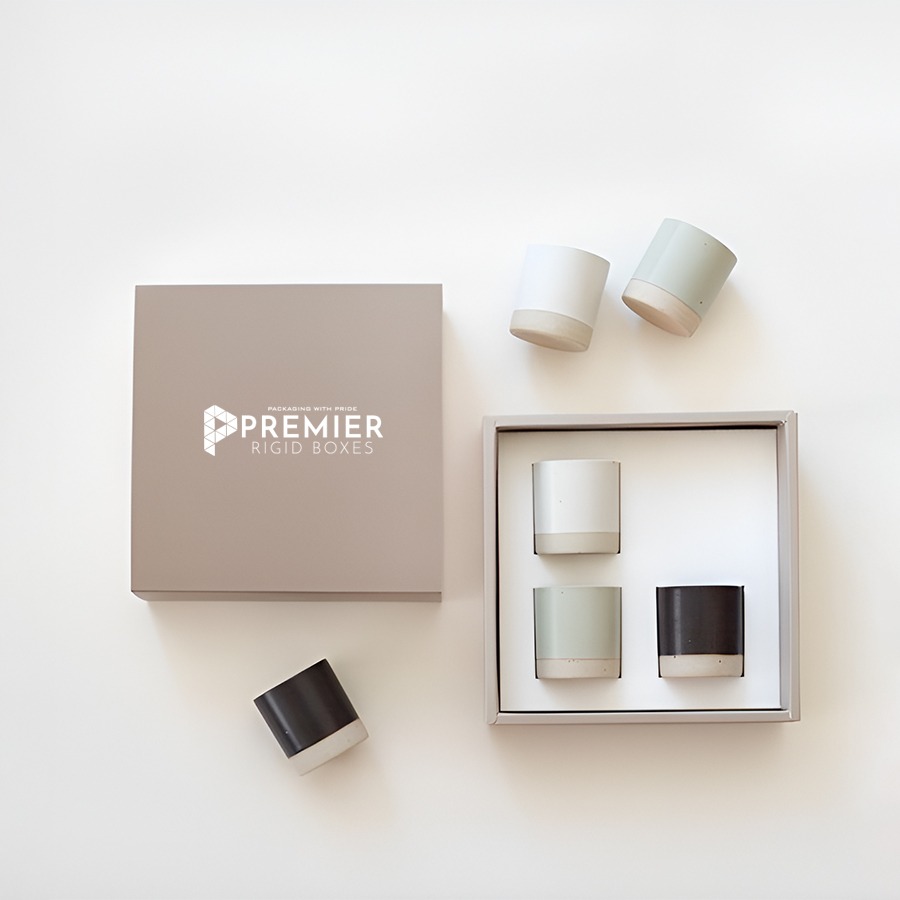
The appearance of a jar candle is similar to a small candle. It fits in the hand and is compact. You then pick up a carton of them, and discover they are quite heavy. This weight is the reason most candle packaging fails more often than expected, and why board specification is important in practically any other category.
Jar Candles Are Heavier Than They Look
From the physical reality, begin with a jar candle is a thick glass with a solid block of wax, both of which are heavy.
Medium-sized jar candles weigh a pound or more. Put 12 of them in a case and you have a heavy load. Brands will specify the board by reference to the box size rather than its contents, and that is where the issue begins.
Jar candles are heavy due to:
- Heat-resistant thick glass.
- A dense wax that fills most of the volume.
- A lid which makes it even more heavy.
That is a trick question, as size is deceiving. Use weight, NOT dimensions.
When Boxes Stack, Weight Compounds
Each box contains only the objects in that box. The board is truly tested at the bottom of the stack where there’s a box to carry everything above it.
In the warehouse, cases are stacked on top of each other multiple times. When the boxes are arranged in a carton for shipment, they are stacked on top of each other. Many times the box of a pallet may be carrying several times its own weight for hours or days. Candle boxes break in just this instance, sometimes without anyone realising.
Stacking causes issues via:
- Applied load over a long time.
- Doubled the weight of the stack at the bottom.
- Slow deformation, not failure.
This is not a drop survival course. It’s the idea of not dying one by one slowly.
Strengthened with glass, a weak box does not break.
These are the advantages of candles compared to other dense products. The contents are not only fragile but also heavy, an unusual combination.
A box that deforms when loaded will take the load inside. Jars break open, chip at the edge or crack. A heavy item in a weak box is problematic but a heavy, fragile item in a weak box is worse as the failure can destroy the stock.
Weak boards result in:
- These are cracked jars caused by pressure during stacking.
- Chipped rims (glass to board).
- Full damage to the product during transportation.
The box is not simply holding the candle. It will keep the candle from being affected by other candles.
Board Weight Is Not the Only Factor
This is where the specification becomes more specific. Two boards with the same weights can be very different when under load.
Edge crush resistance is the most important factor to consider when choosing a stacking board as it is a measure of how much pressure a board can hold from above. This is influenced by the size of the flute and the number of layers in the corrugated board. If it’s lighter product, one wall board can be enough, but with a case of jars, you’ll need two.
The performance of the stacks is influenced by:
- Edge crush resistance of the board.
- Flute profile in corrugated material.
- Single or double wall structure.
Don’t just ask for the thickness of the board, ask your supplier for crush resistance. They are not the same length.
The Box Structure Carries the Load
Strength is not a characteristic of a board alone. The way the box is constructed is as important.
Vertical walls can support loads much better than panels. Chunks of cell within a multi-pack serve both purposes: they keep the jars from touching and they provide structural support to the stack from above. A box with dividers is much stronger than a box without the dividers.
Structures enhance load-bearing by:
- Walls with compression forces applied vertically.
- Internal supports in the form of dividers.
- Corners that are loaded with the greatest force.
Good candle boxes utilise as much as they can the internal structure to calculate the strength, and not only as protection.
The bigger the problem, the worse the solution.
It’s easy to be tempted to put space between a breakable item to keep it safe. This works for light objects but does not work well for heavy objects.
When there is no bracing from the inside, walls are able to buckle more easily under load, which is called empty space. It also allows the jar to move and a heavy jar that has space to move can have momentum before it collides with something. Right sizing accelerates crush resistance as well as impact protection.
Oversizing causes:
- Walls crumbling because of lack of support.
- Weighted jars rolling down the ramp.
- Leaving materials unused, and shipping costs are increased.
Heavy contents = snug beats spacious.
Adjust the calculation if the moisture changes.
One additional piece of information, which is not a specification error, but rather goes against the above. As the board absorbs moisture, it loses in strength.
A damp board may lose a lot of its crush resistance, so if a box is properly specified in packing it can be ruined after being left in a damp warehouse or in the rain outside. It is more important for a large product than for a light one.
Moisture causes a decrease in performance because of:
- Reduces crush resistance when wet.
- Fibres that weaken and buckle easily.
- The loss of strength during storage or delivery.
Increase the margin if your trip requires outdoor handling or extended storage.
Final Thoughts
Jar candles have two very challenging characteristics. They’re heavy, they’re delicate. The majority of packaging issues in this category are caused by the use of the size of the box instead of the weight of the product being packaged.
This weight is multiplied in a stack, so the lower box will support many times its weight. Edge crush resistance is more important than board thickness. Internal dividers are solid and separate jars with reality. Oversizing makes it worse, not safer, as empty space means there is nothing to brace the walls.
Calculate the actual weight that your box will have to bear, ask for crush resistance not just thickness and make sure your box is snug. Candle boxes of this kind are slightly more expensive, but they are much less likely to break.