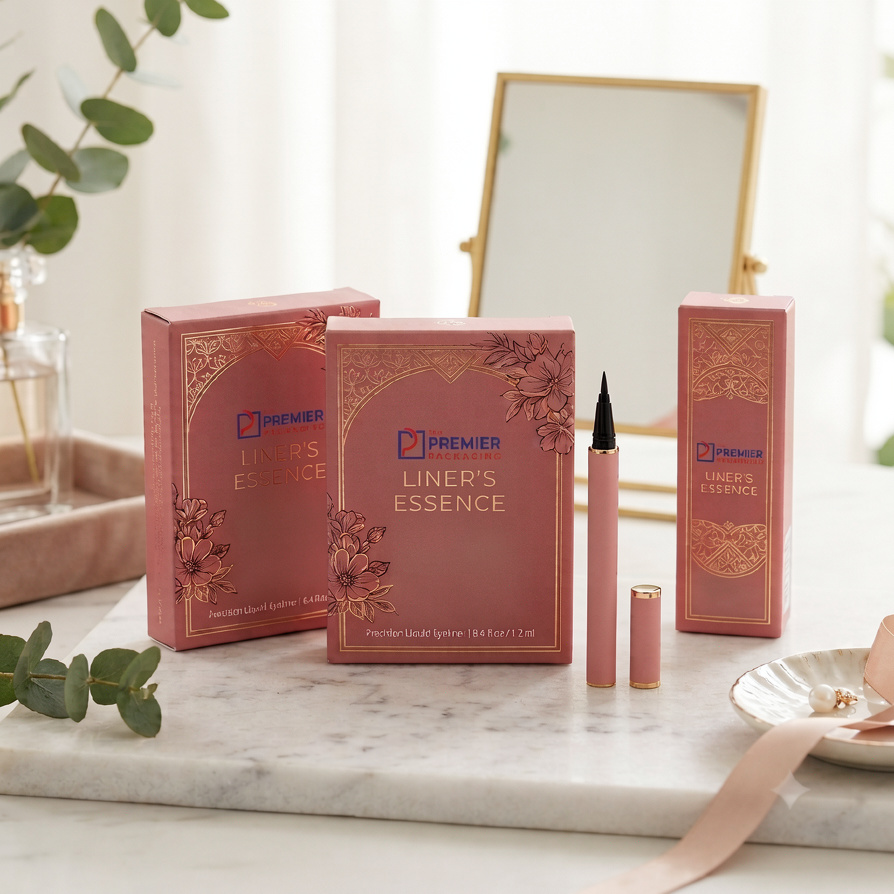
Two eyeliners can be nearly the same when lying on a shelf. The same size, the same shape and the same price! However, if both are packaged the same way, one will begin to arrive damaged. The liquids and pencil eyeliner have different vulnerabilities and it changes the way the box needs to be constructed. Here’s why.
They Fail in Different Places
Begin with what is really broken. A pencil eyeliner is a solid pencil, that is housed in a wooden case or plastic barrel. It is fairly tough along its length.
Liquid eye liner is not like that. It is a holder for fluid and has a fine tip (usually felt or thin brush) which is covered by a cap. The applicator is the weakest link, and it’s on one end which is most likely to be hit by pressure.
The two formats are broken through:
- Pencils: bent; or broken tip.
- Solids: a tool to push it through the seal.
- Both: surface scratching due to locomotion.
If the design foreseen the wrong failure, the packaging will not fare well. It is important to identify the specific one you want to protect against.
Pencils Tolerate a Tighter Fit:
As a pencil is solid for most of its length, it will fit safely in a box. Pressure on the barrel isn’t an issue.
This is a blessing. These need a pencil that is held firmly by a box that fits tightly against the eye, and a close-fitting eyeliner box is suitable. The main feature to be safeguarded is the sharp end, typically a cap or recess of the shape.
Use pencils (use Pencil Aims):
- A snug fit along the barrel.
- Protection at the tip end.
- No opportunities for lengthwise sliding.
Pencils are much easier to make mistakes with than the other format. When your internal length is correct, many of your troubles just melt away.
Liquids Need Room at the Top
Liquid eyeliner is the opposite. The last thing you want to do is put pressure on the cap, since that pressure will travel through the cap to the applicator within.
If you put a cap on a bottle on a box that fits the bottle, it will sink each time you add to the top of the box. That may bend the felt tip or cause it to lose its shape during hours of transit. You will need to measure the full height with cap, with a little bit of clearance to ensure nothing touches the cap.
When using liquids, you must have:
- Full height, capped.
- No clearance, no pressure will be applied downward.
- Rather, hold around the base.
This is the one thing you do wrong with liquid eyeliner the most. The box is a perfect fit to the product and yet it destroys it.
Attention to orientation is given only to one and not the other.
The following difference surprises people. Any direction that the pencil is wrapped is fine. Liquid eyeliner cannot.
Liquid products should be kept upright as much as possible. A fluid pool in the seal can leak and is more likely to leak if the seal is laid on its side for too long. Labelling, orientation, an insertion and sometimes the box itself is ruined by a leak, so it is worth designing it on purpose.
Orientation guidance differs:
- Pencils: any way will do.
- Liquids: steep upright is very desirable.
- Inserts: should be in the desired location.
Liquid formats require some type of insert to hold them up when they are to be stored or shipped flat.
Insert Design Changes Completely
There are variations in failure points, and hence in the inserts. This is the area in which they differ the most.
A simple option is the pencil insert, a channel that runs along the length of the pencil. However, a liquid insert must secure the base, support the bottle and keep the cap intact. Same product category, completely different inside.
The differences include:
- Pencils: A channel in the barrel that grips the pencil.
- Liquids: A base cradle, cap left free.
- Multi-packs: separation to avoid rubbing.
Brands suffer damage in only half their range by using a single insert design for both formats!
The difference in weight and balance are too large.
If using liquid eyeliner, it’s heavier than a pencil and the weight is low in the bottle. The effect of this on the package when it moves.
The product that is bottom heavy will want to roll over, so an insert that only holds the upper body will allow the product to roll over. Pencils are light and well balanced for easy stability. This will impact on the amount of support required and the location of the insert.
Weight has an impact on packaging in the following ways:
- Liquid that tips over when it is more dense in the bottom.
- Over rock if support is too high.
- Decreased mobility of lighter pencils.
Support a liquid product low down near its actual centre of weight, not near the top.
What They Do Share
Not everything differs. Both are small and slim cosmetics, both are sold in a competitive retail environment, which has led to common requirements.
They must both be printed in a high-quality manner that can still be seen as high-end at a small scale as the little boxes will reveal any flaws in the print. They both should have a tight inner chamber to prevent rattling. The box is also easily rigid enough that it will not bend; a flimsy eyeliner box sells the product short.
Shared requirements include:
- Clear printing on small size.
- No rattling inside.
- A firm board that has a definite form.
They all have the common need of presentation. The disparities are more related to protection.
Final Thoughts
Looks much the same, but acts very differently when placed in a box.
A pencil is solid, light, evenly balanced and will fit tightly in any direction. Keep the point in place, size the length appropriately, and it will generally look great. Heavy, bottom-weighted liquid eyeliner is created with a sticky applicator that never should be compressed. Above the cap it must be cleared, low around the base and upright as much as possible.
That is, measure each product individually including the cap, and make the insert around the weakest point of the product. The cost of a well-specified eyeliner box is less expensive than a poorly specified one. It’s just a representation of what it’s supposed to be.