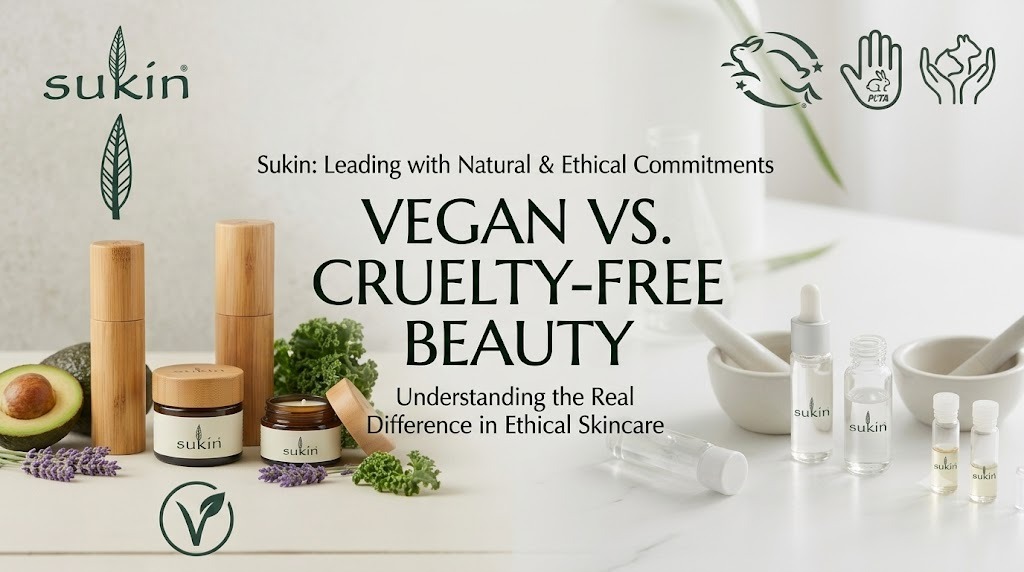
Vegan and cruelty-free are often used as if they mean the same thing. They do not.
A product can be vegan and still tested on animals. A product can be cruelty-free and still contain animal-derived ingredients. The two labels track completely different parts of how a product is made, and neither one guarantees the other.
This guide explains what each term actually covers, where they overlap, where they separate, and how to check a product before you buy it.
What Vegan Skincare Means
Vegan skincare is about ingredients. A product labelled vegan contains no animal-derived materials at all. This includes common additions such as:
- Beeswax
- Lanolin
- Collagen
- Carmine (a red pigment made from crushed insects)
- Honey
- Milk or dairy derivatives
- Squalene sourced from shark liver
If a moisturiser, cleanser, or serum is vegan, none of the raw materials used to make it came from an animal. The vegan label says nothing about how the product was tested, only what is inside it.
What Cruelty-Free Skincare Means
Cruelty-free is about testing, not ingredients. A cruelty-free product has not been tested on animals at any stage of development, either as a finished product or as individual ingredients.
A cruelty-free product can still contain animal-derived ingredients such as beeswax or lanolin, as long as those ingredients themselves were not tested on animals, and the finished product was not either.
This is the point most shoppers miss: cruelty-free tells you nothing about what is actually in the product.
Vegan vs Cruelty-Free: Side-by-Side Comparison
| Vegan | Cruelty-Free | |
|---|---|---|
| What it covers | Ingredients only | Animal testing only |
| Guarantees no animal-derived ingredients? | Yes | No |
| Guarantees no animal testing? | No | Yes |
| Can contain beeswax, lanolin, honey, or collagen? | No | Yes, possibly |
| Can be tested on animals for certain markets? | Yes, possibly | No |
| Common certification body | The Vegan Society | Leaping Bunny |
As the table shows, each label answers a different question. A product needs to be checked against both if you care about ingredients and testing practices equally.
Why a Product Can Be One Without the Other
Because the two labels track different things, a brand can meet one standard without meeting the other. The examples below show how this plays out in practice.
| Product Example | Vegan? | Cruelty-Free? | Why |
|---|---|---|---|
| Beeswax lip balm, no animal testing | No | Yes | Contains an animal-derived ingredient (beeswax), but no testing was involved anywhere in production |
| Plant-based serum sold in a market requiring animal testing | Yes | No | Formula has zero animal ingredients, but the brand or a regulator required animal testing for that market |
| Plant-based moisturiser, certified by both Leaping Bunny and The Vegan Society | Yes | Yes | Meets both standards: no animal ingredients and no animal testing anywhere |
| Collagen-based anti-ageing cream, not tested on animals | No | Yes | Collagen is typically animal-derived, but no animal testing occurred |
A brand needs to actively pursue and maintain both standards separately. Achieving one does not automatically lead to the other, which is why checking for both matters more than trusting a single word on the packaging.
How to Tell the Difference When Shopping
Marketing language on packaging is not always reliable on its own. The most reliable way to confirm either claim is to look for third-party certification rather than a brand’s own wording.
Common certifications to look for:
- Leaping Bunny – an internationally recognised cruelty-free certification with defined criteria and independent audits
- Vegan Society (Vegan Trademark) – confirms no animal-derived ingredients and no animal testing
- PETA’s Cruelty-Free and Vegan lists – self-reported by brands based on a signed statement, without independent auditing
If a product only states “cruelty-free” or “vegan” in its own marketing with no certification logo, it is worth checking the ingredients list yourself, or contacting the brand directly to ask how the claim is verified.
Quick Reference: Where to Look
| Claim | Where to Check | What It Confirms |
|---|---|---|
| Vegan | Ingredients list, Vegan Trademark logo | No animal-derived ingredients |
| Cruelty-Free | Leaping Bunny logo, brand testing policy page | No animal testing at any stage |
| Both | Certification from both bodies, or a brand’s own detailed policy page | Full alignment with both standards |
Why This Distinction Matters
For many shoppers, this is not just a technical detail. People choosing vegan products are usually making a decision based on ingredients and personal values around animal-derived materials. People choosing cruelty-free products are usually making a decision about animal testing practices, regardless of what is in the formula.
These two motivations can overlap, but they do not have to. Someone avoiding animal testing may not mind a beeswax-based balm. Someone avoiding all animal-derived ingredients may not think to check whether a fully plant-based product was tested on animals for a specific market.
Knowing the difference means choosing products that actually match the reason behind the choice, rather than assuming one label automatically covers both concerns.
A Note on Regional Testing Requirements
One detail that often surprises shoppers: cosmetics testing rules vary by country. Some markets have historically required animal testing for imported cosmetics before they could be sold on shelves. A brand selling internationally may test on animals for that specific market while avoiding it everywhere else, or may choose not to sell in that market at all in order to maintain a fully cruelty-free position.
This is why checking a brand’s stated policy on international sales and testing, not just its home-market claims, gives a fuller picture.
Where Sukin Stands
Sukin Naturals products are formulated without animal-derived ingredients and are not tested on animals, certified cruelty-free through Leaping Bunny. If you want to see exactly what is left out of every formulation, the full list is available on our Ingredients page. You can also read more about our approach on our Brand Values page, or explore the Signature Range formulated with these same standards in mind.
FAQ
Can a product be vegan but not cruelty-free?
Yes. A product can contain zero animal ingredients and still have been tested on animals at some point in its development or for a specific market.
Can a product be cruelty-free but not vegan?
Yes. A product can avoid animal testing entirely while still containing animal-derived ingredients such as beeswax, lanolin, or honey.
Is a brand automatically cruelty-free if it sells in a country that bans animal testing?
Not necessarily. A brand may still test on animals for markets where it is required, unless it has confirmed it does not sell in those markets or does not comply with such requirements.
What is the easiest way to check both claims at once?
Look for certification from both Leaping Bunny (cruelty-free) and The Vegan Society or a similar vegan trademark, rather than relying on the words on the packaging alone.
Does “natural” mean the same as vegan or cruelty-free?
No. Natural refers to how ingredients are sourced or processed, not whether they are animal-derived or whether testing occurred. A product can be natural and still fail to be vegan or cruelty-free.