In today’s digital-first business environment, organizations generate enormous volumes of data from ERP systems, CRM platforms, finance applications, supply chains, and customer interactions. The challenge is not collecting data—it’s ensuring every department works with the same, accurate information. When sales, finance, procurement, and operations rely on different datasets, inconsistent reporting and poor decision-making become inevitable. This is where SAP Business Data Cloud helps organizations create a reliable single source of truth.
By connecting business-critical data, simplifying governance, and enabling trusted analytics, SAP Business Data Cloud provides a unified data foundation for informed decision-making. Businesses can eliminate fragmented information, improve operational efficiency, and gain real-time visibility across their enterprise.
Understanding the Need for a Single Source of Truth
Many organizations struggle with disconnected systems that store similar information in different formats. As data grows across multiple platforms, maintaining consistency becomes increasingly difficult. Teams often spend valuable time validating reports instead of making strategic decisions.
A single source of truth (SSOT) creates one trusted repository where business data is unified, standardized, and governed. This approach ensures that everyone—from executives to operational teams—works with the same accurate information, reducing errors and improving confidence in reporting.
What Is SAP Business Data Cloud?
SAP Business Data Cloud is a modern data platform designed to unify SAP and non-SAP data while preserving business context. Instead of simply moving data into one location, it creates a connected ecosystem where trusted information is available for analytics, planning, and AI-driven insights.
The platform enables organizations to:
- Integrate data from multiple business systems.
- Maintain consistent business semantics.
- Support advanced analytics and reporting.
- Improve governance and compliance.
- Deliver real-time insights for faster decision-making.
Its flexible architecture allows businesses to build scalable data environments without compromising security or data quality.
How to Build a Single Source of Truth
1. Consolidate Data Across Business Systems
The first step is identifying all critical business data sources, including ERP, finance, procurement, HR, customer management, and external applications. Consolidating these systems eliminates duplicate records and provides a centralized foundation for reporting.
Organizations running SAP S/4 HANA can seamlessly connect operational data with enterprise-wide information, ensuring consistent business processes and trusted reporting.
2. Establish Strong Data Governance
Technology alone cannot guarantee accurate information. Organizations must define clear ownership, validation rules, access controls, and data quality standards.
Effective governance ensures that data remains accurate, secure, and compliant while minimizing inconsistencies across departments.
3. Enable Real-Time Analytics
Once trusted data is available, businesses can transform it into actionable insights. Integrating with SAP Analytics Cloud enables interactive dashboards, predictive analytics, and executive reporting based on real-time business information.
Instead of waiting for manually prepared reports, decision-makers gain immediate visibility into operational performance, financial trends, and customer behavior.
4. Connect Business Applications
A connected business landscape strengthens the value of a unified data platform. Integrating with SAP Business Technology Platform helps organizations extend applications, automate workflows, and securely exchange information across multiple business systems without creating additional data silos.
This integration creates a more connected digital enterprise while supporting future innovation initiatives.
Business Benefits
Building a single source of truth offers significant long-term advantages.
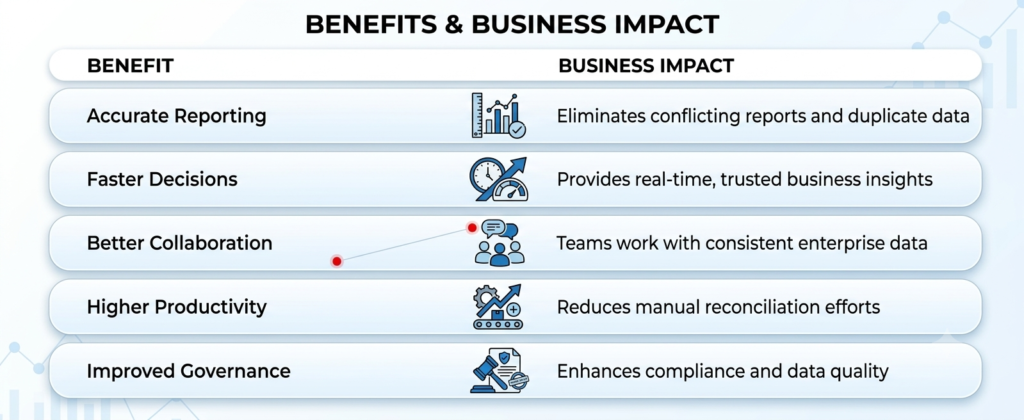
Organizations that invest in trusted enterprise data are better equipped to respond to market changes, improve customer experiences, and support data-driven innovation.
Best Practices for Success
To maximize the value of SAP Business Data Cloud, organizations should:
- Define clear business objectives before implementation.
- Prioritize data quality and governance from the beginning.
- Integrate both SAP and non-SAP business applications.
- Continuously monitor data accuracy and performance.
- Align analytics initiatives with business goals.
- Train users to effectively leverage enterprise insights.
A well-planned sap implementation strategy further ensures that organizations can successfully integrate data platforms while minimizing disruption and accelerating business value.
Conclusion
Building a single source of truth using SAP Business Data Cloud enables organizations to move beyond fragmented information and create a trusted data foundation for the entire enterprise. By unifying business data, strengthening governance, and enabling real-time analytics, companies can make faster decisions with greater confidence.
When combined with complementary SAP solutions such as SAP S/4 HANA, SAP Analytics Cloud, and SAP Business Technology Platform, organizations can unlock greater operational efficiency, improve collaboration, and build a scalable foundation for future digital transformation. The result is a connected business that relies on accurate, consistent, and actionable data to drive sustainable growth.