Picture this: it’s the middle of a production run, the press is waiting, and someone on the floor is manually wrestling a heavy metal coil into position — again. A few minutes lost here, a slight misalignment there, and by the end of the shift, those “small delays” have quietly eaten into your output numbers. If this sounds familiar, you’re not alone. It’s one of the most common (and most avoidable) bottlenecks in metal stamping and sheet metal processing.
This is exactly the problem a Coil Feeding Machine is built to solve. Whether you’re running a small stamping shop or a large-scale metal processing line, understanding how coil feeders work — and why they matter — can genuinely change how smoothly your production floor runs.
In this guide, we’ll break down what a coil feeding machine actually does, why it’s become essential equipment in modern manufacturing, and how to choose, use, and maintain one the right way. No jargon overload — just practical, real-world insight from the team at Highmach CTL.
What Is a Coil Feeding Machine?
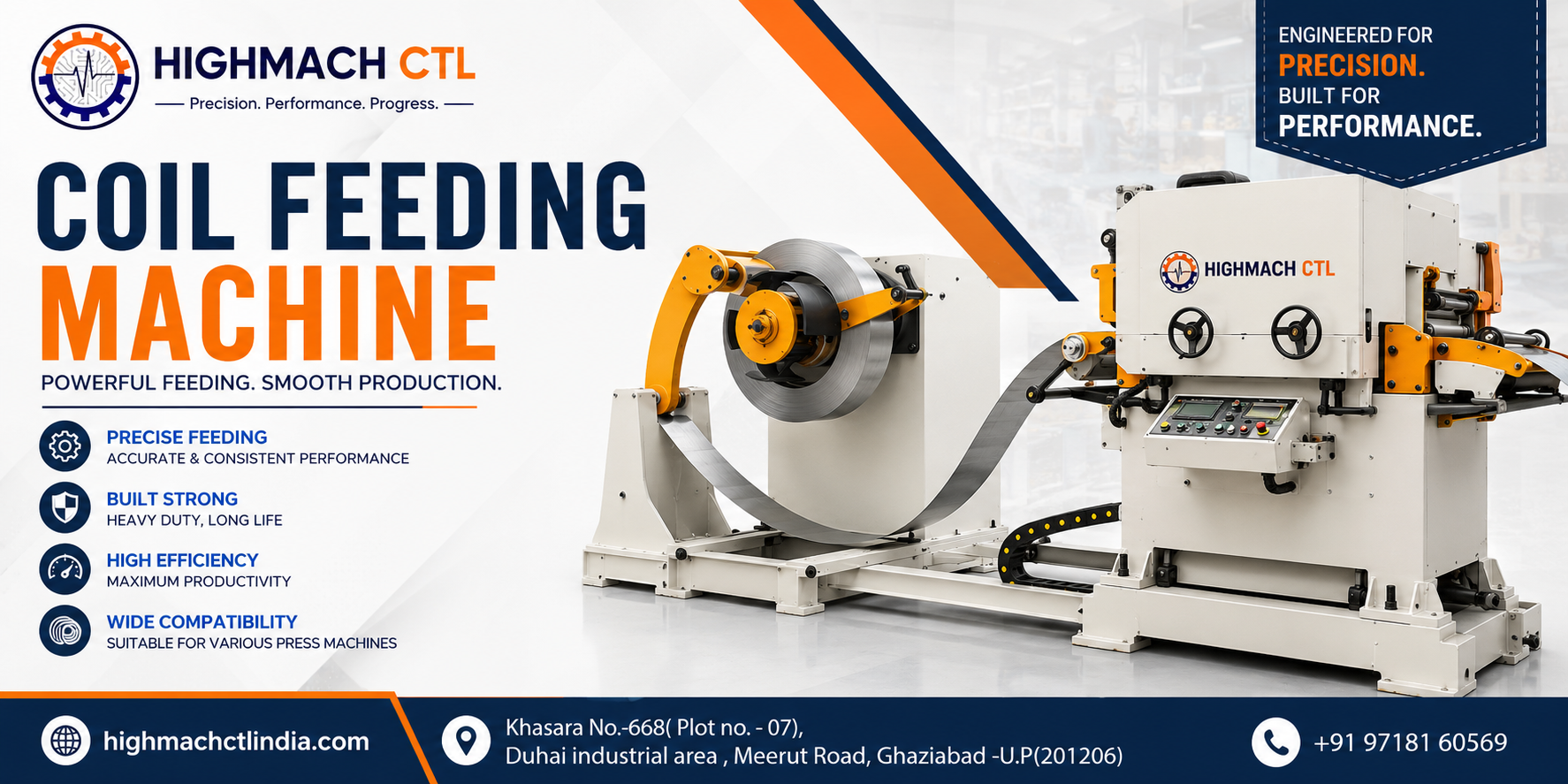
In simple terms, a coil feeding machine is equipment used to unwind, straighten, and feed metal coil (steel, aluminum, copper, or other sheet metal) into a press or processing line at a controlled speed and length. Instead of manually feeding sheets one at a time, the machine automates the whole process — pulling material from a coil, flattening out the natural curl, and pushing it forward with precise, repeatable accuracy.
Think of it like the difference between hand-feeding paper into an old printer versus using an automatic paper tray. One depends entirely on a person’s timing and consistency; the other just… works, every single time.
Coil feeders are typically used alongside two other pieces of equipment — a decoiler (which holds and unwinds the coil) and a straightener (which removes the coil’s natural curve). Together, this combination is often called a coil feeding line or CTL (cut-to-length) line, depending on the setup.
Why Manual Feeding Falls Short
Manual feeding isn’t just slower — it’s inconsistent. Human fatigue, small timing errors, and material handling risks (yes, coil stock is heavy and unforgiving) all add up. A coil feeding machine removes that variability, which is exactly why it’s become a standard fixture in stamping, roll forming, and metal fabrication industries.
Key Benefits of Using a Coil Feeding Machine
Let’s get into why manufacturers are increasingly investing in coil feeding equipment. Here are the core advantages:
- Higher Production Speed: Automated feeding keeps pace with high-speed presses without human lag.
- Improved Accuracy: Precise feed length control reduces material waste and part defects.
- Reduced Labor Dependency: One operator can often oversee multiple lines instead of manually feeding each one.
- Better Worker Safety: Removes the need for manual handling of heavy, sharp-edged coil stock.
- Consistent Material Quality: Combined with a straightener, it delivers flat, uniform material into the press every time.
- Lower Long-Term Costs: Less scrap, less downtime, and less rework mean better ROI over time.
Feature vs. Benefit: What It Is and Why It Matters
| Feature | Why It Matters |
| Servo-Controlled Feed | Delivers precise, repeatable feed length — critical for tight-tolerance stamping |
| Automatic Loop Control | Keeps material tension balanced between decoiler and feeder, reducing jams |
| Adjustable Feed Width | Allows the machine to handle a variety of coil sizes without retooling |
| Integrated Safety Guards | Protects operators from pinch points and moving material |
| PLC/HMI Interface | Makes it easy to set, save, and recall feed programs for different jobs |
Note: Not every coil feeding machine includes all these features — it depends on the model and application. Always match features to your actual production needs.
Types of Coil Feeding Machines: Which One Fits Your Line?
Coil feeders generally fall into a few categories, and choosing the right one depends on your material thickness, coil width, and press speed. Here’s a quick side-by-side comparison to help you get oriented.
Comparison: Common Coil Feeder Types
| Feeder Type | Best For | Speed Range | Precision Level |
| Roll Feeder | Thin to medium gauge material, general stamping | Medium to high | High |
| Grip Feeder | Heavier gauge, wider material | Medium | Medium to high |
| NC Servo Feeder | Precision stamping, tight-tolerance parts | High | Very high |
| Compact/Space-Saver Feeder | Smaller shops, limited floor space | Low to medium | Medium |
This comparison is a general guideline. Actual performance varies by manufacturer, material type, and press integration.
How a Coil Feeding Machine Works: Step-by-Step
If you’re new to this equipment, here’s a simplified walkthrough of how material typically moves through a coil feeding line, from raw coil to finished feed into the press.
Coil Feeding Process Overview
| Step | What Happens |
| 1. Load Coil | Coil is mounted onto the decoiler and secured |
| 2. Unwind Material | Decoiler rotates and feeds material toward the straightener |
| 3. Straighten Material | Rollers flatten the coil’s natural curve for a flat, even sheet |
| 4. Feed into Press | The feeder advances material by a pre-set length at controlled speed |
| 5. Stamp / Process | Press performs the stamping, cutting, or forming operation |
| 6. Repeat Cycle | The feeder automatically repeats the feed-and-stamp cycle |
This cycle repeats continuously, often several times per second on high-speed lines, without manual intervention.
Tips for Getting the Most Out of Your Coil Feeding Machine
- Match feeder capacity to material weight. Don’t undersize your feeder for the coil width and gauge you’re running — it strains the motor and reduces accuracy.
- Keep tension settings consistent. Loose or overly tight loop control between decoiler and feeder is a leading cause of feed errors.
- Schedule regular roller inspections. Worn or dirty feed rollers directly affect material grip and feed accuracy.
- Train operators on the HMI settings. Many “machine problems” are actually just incorrect program settings.
- Pair with a properly sized straightener. A mismatched straightener undoes the precision your feeder provides.
Common Mistakes to Avoid
Do’s and Don’ts Checklist
| Do | Don’t |
| Match feeder specs to your heaviest expected coil | Assume “bigger is always better” without checking press speed compatibility |
| Perform routine maintenance on rollers and sensors | Ignore small feed inconsistencies — they usually get worse, not better |
| Train all operators on safe loading procedures | Let untrained staff handle coil loading and threading |
| Buy from a supplier who offers after-sales support | Choose equipment based on price alone |
Small, consistent habits often matter more than the equipment’s specs sheet — good practices protect your investment long-term.
Frequently Asked Questions
1. What industries use coil feeding machines?
Coil feeders are widely used in metal stamping, automotive parts manufacturing, electrical component production, appliance manufacturing, and general sheet metal fabrication.
2. What’s the difference between a coil feeder and a decoiler?
A decoiler unwinds the coil and holds it in place, while the coil feeding machine actively pulls and advances the material into the press at a controlled length and speed. They usually work together as a system.
3. Can one coil feeding machine handle different material thicknesses?
Many feeders are adjustable within a certain range, but very thick or very thin materials outside that range may require a different feeder model or roller configuration.
4. How much does a coil feeding machine cost?
Pricing varies widely based on size, precision level (servo vs. mechanical), and brand — ranging from moderate investments for compact feeders to significant investments for high-precision servo systems on large production lines.
5. Do coil feeding machines require special training to operate?
Basic operation is straightforward, but proper training on loading, tension settings, and the HMI interface significantly reduces errors and downtime.
6. How often should a coil feeding machine be serviced?
Routine inspection is generally recommended monthly, with a full service check at least twice a year — though high-usage lines may need more frequent attention.
Final Thoughts
A coil feeding machine isn’t just another piece of factory equipment — it’s often the quiet difference between a production line that runs smoothly and one that’s constantly fighting small, avoidable delays. Getting the right feeder for your material, pairing it with proper straightening equipment, and maintaining good operating habits can noticeably improve both your output and your bottom line.
If you’re evaluating options for your production line, it’s worth talking to a team that understands both the equipment and the real-world demands of your process. At Highmach CTL, we work with manufacturers to match the right coil feeding solutions to their actual production needs — not just a spec sheet. If you’d like to talk through what would work best for your line, we’re happy to help you figure it out.
Contact us: +91-9811228235
Email: [email protected]
Address: Khasara No.-668( Plot no. -07), Duhai industrial area , Meerut Road, Ghaziabad -U.P(201206)