It’s the early hours of the morning and the pump starts in preparation for a scheduled maintenance. In the middle, the pipe whirs and roars in a loud and high-pitched sound that the supervisor of the shift bewilder. The valve shuts fast, resulting in the flange cracking, and no one to repair within the budget. Talk to anyone on the factory floor for long enough, and you’ll find a variation of this tale. You can trace the story back as far as you want and the story usually boils down to one tiny simple, easily forgotten aspect.
Customers often have to choose between two popular industry check valves, i.e., double door and swing-style check. It’s not clear which of them is better until you look at how both actually perform. Each does the same job in theory, but they’re completely different when they are installed. Find out the areas where each model earns its money so that you can avoid costly repairs, unplanned shutdowns, as well as the pipe system that isn’t running in the manner it is supposed to.
Why the Check Valve You Pick Actually Matters
A check valve is easy to understand once you break it down. Fluid moves through it in one direction. If it ever tries to flow backward, the valve stops it. Simple enough on paper. Problems arise when the process doesn’t progress quickly enough.
If a system cannot end reverse flow on time, then compressors, pumps and even the piping suffer the brunt. The sudden change in flow causes high pressures, which users in the field call water hammer. In time these spikes wear away joints, gaskets, as well as welding.
An appropriately matched valve will protect the system in a variety of effective ways:
- Prevents backflow that could contaminate a process line
- Reduces wear on pumps and compressors from reverse thrust
- Keeps maintenance predictable instead of reactive
- Improves energy efficiency by cutting unnecessary pressure loss
You’ll find check valves almost anywhere fluid moves under pressure. Water treatment plants use them to protect pumps. HVAC systems rely on them to manage chilled and hot water loops. Oil and gas operations, chemical processing lines, and food and beverage plants all need the right valve just to keep production running safely.
Understanding a Double Door Check Valve
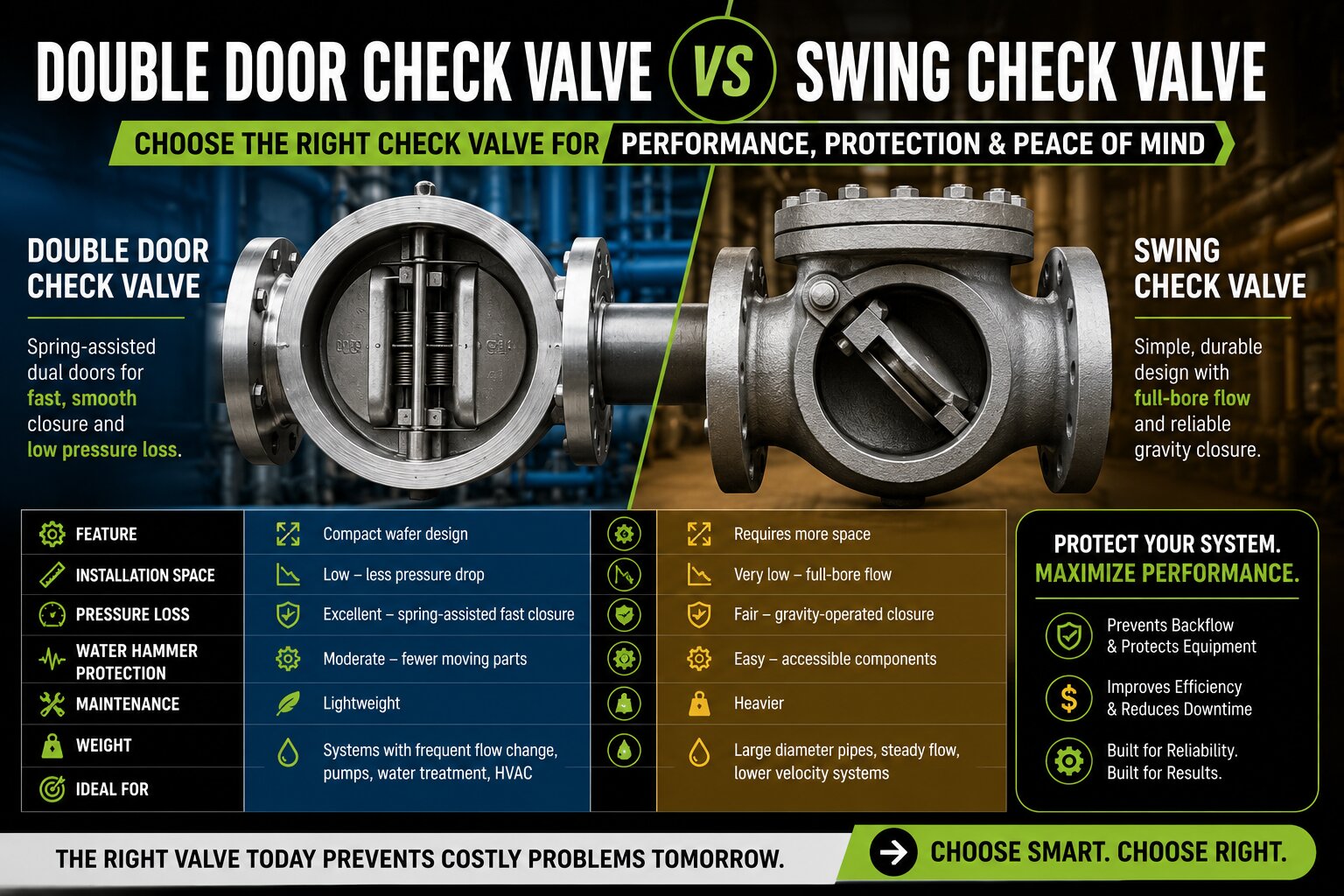
A double door check valve relies on two spring-loaded discs, or doors, mounted on a central hinge pin. Flow starts, both doors swing open together. The instant flow tries to reverse, the springs snap them shut before backflow has a real chance to build.
That spring assist is really the whole story here. Instead of leaning on gravity to force the disc closed, the springs react almost instantly and cut down on the slamming that causes water hammer.
A few advantages worth pointing out:
- Lightweight construction compared to older cast designs
- Reduced pressure drop, which keeps pumping costs down
- Less water hammer thanks to fast, spring-assisted closing
- Straightforward installation between flanges in a compact space
- A compact body that fits tighter piping layouts
How Swing Check Valves Work and Where They Perform Best
Swing check valves work differently. A single hinged disc swings open with the flow and falls shut by gravity once flow slows down or reverses. There’s no spring doing the work here, just the weight of the disc and whatever the flow conditions happen to be.
The payoff is a full-bore flow path. The disc doesn’t pinch down the pipe diameter the way some designs do, and that’s exactly why swing check valves show up so often in larger pipe sizes and systems where flow stays fairly steady.
A few things these valves do well:
- Handle larger diameter piping without a fuss
- Keep the mechanism simple, with fewer moving parts
- Perform reliably in slower, steadier flow systems
- Make visual inspection easier during maintenance shutdowns
Double Door Check Valve vs Swing Check Valve: Side-by-Side Comparison
Once you understand what valve closes which one and weighing the valve against your system is a lot more straightforward.
- Installation Space
A double door check valve packs into a compact, wafer-style body that fits between flanges without adding much length. A swing check valve needs more room, mostly because of its full-bore swinging disc and larger body cavity.
- Pressure Loss
Because the doors open fully and sit close to the flow path, double door designs generally lose less pressure. That’s exactly why engineers reach for a wafer check valve with this dual-disc layout when they need to minimize pressure drop over long pipeline runs.
- Water Hammer Protection
Spring assistance is what really separates the two here. Double door valves close fast enough to catch most reverse flow before it gains momentum. Swing check valves close slower, since gravity alone drives the disc, and that gap can let more water hammer through in systems with frequent flow reversals.
- Maintenance Requirements
Ask a technician, and most will say swing check valves are easier to inspect. The single disc and hinge sit right where you can get at them. Double door valves have fewer wear points overall, but servicing one can take a bit more familiarity with the spring and hinge assembly.
- Weight
Double door valves weigh a lot less, which speeds up handling and installation, especially in tight overhead or vertical runs. Swing check valves, especially in the larger sizes, get heavy fast and can be a pain to maneuver into place.
- Cost vs Long-Term Value
Swing check valves usually cost less upfront, particularly in bigger sizes. Double door valves might cost more at the outset, but they tend to pay that back through lower pressure loss and less water hammer damage down the line.
Which Industries Usually Prefer Each Valve Type?
The right pick usually comes down to flow characteristics, available space, and how much downtime a facility can actually afford.
- Water Treatment
Plants often lean toward double door valves here. The compact footprint and fast closing action do a good job protecting pumps from backflow surges.
- HVAC Systems
Tight mechanical rooms benefit from the smaller size and lighter weight double door designs bring to the table.
- Chemical Processing
Either design can work well, depending on line size and how consistent the flow stays. Reliability and easy maintenance access usually decide it.
- Food Processing
Sanitary requirements and easy inspection tend to push facilities toward whatever design is simplest to clean and service.
- Oil and Gas
Swing check valves frequently perform best here, where pipe diameters run larger and flow tends to stay steady.
- General Manufacturing
Flow conditions vary so much across a typical plant that many facilities end up running a mix of both valve types, depending on the line.
Key Factors to Weigh Before Buying an Industrial Check Valve
Being aware of how to choose a check valve will boil down to just a handful of important questions that you need to answer before opening an online catalog.
This is what you should keep in your mind:
- The valve should be matched to the pipe’s dimensions and the expected flow rate.
- Confirm the flow direction and plan the correct installation orientation.
- Check the pressure rating against real operating conditions, not just the spec sheet.
- Account for the temperature range the valve actually handles.
- Verify material compatibility with the process fluid.
- Plan for maintenance access before installation, not after the fact.
- Look for API compliant check valves wherever industry standards call for certification.
- Think about how the valve holds up over years of servicing, not just on day one.
Run through an industrial valve selection guide with these factors in mind, and you’ll narrow down the best check valve for industrial piping for your application fairly quickly. Manufacturers carry a wide range of materials, pressure classes, and certified product options for different operating conditions, which makes it a lot easier to match a valve to what your system actually needs and buy your industrial check valves with confidence.
Common Mistakes That Can Lead to Costly Repairs
Even experienced buyers get caught in some predictable traps while selecting the right valve. Making a decision based solely on cost and not considering long-term operational expenses.
- Ignoring pressure ratings that don’t match actual system conditions
- Picking the wrong material for the fluid or environment
- Skipping proper installation planning, including orientation and spacing
- Overlooking maintenance needs until a valve fails unexpectedly
- Buying without confirming the valve meets recognized industry standards
A low maintenance check valve picked for the wrong application doesn’t stay low maintenance for long. What you actually want are reliable pipeline flow control solutions that genuinely prevent backflow in industrial pipelines, built around a high-performance non-return valve suited to the conditions it will actually face.
Choose the Valve That Matches Your System, Not Just Your Budget
There’s no single “best” check valve available for all situations regardless of how attractive the specification sheet appears. It all comes down to the system’s design and flow requirements, maintenance requirements as well as how it performs over years of usage, not only what it looks like at the beginning of its life.
Before committing to purchasing, you should be sure to look over your proposal. A wafer check valve that’s perfect in one place could be just a mistake for a different one in the future. It is important to prioritize reliability, safety, and lifetime value over upfront costs.
FAQs
Can Check Valves Be Installed Vertically?
Many check valve designs work fine in vertical lines, but it depends on flow direction. Spring-assisted types close reliably in any orientation, while gravity types need upward flow to seat properly. Check the manufacturer’s orientation rating first.
How Long Do Check Valves Typically Last?
Most industrial check valves last ten to fifteen years under normal conditions, though that shifts with fluid type, pressure cycles, and material choice. Springs and seats usually wear out first, and replacing those parts extends a valve’s working life.
What Is a Valve’s Cracking Pressure?
Cracking pressure is the minimum pressure needed before a check valve opens and lets fluid pass through. Set it too high and you waste pump energy; too low, and the valve may chatter or leak under low flow.
Do Check Valves Need Regular Testing?
Yes, especially in critical systems like fire protection or chemical processing. Routine testing confirms the valve opens under normal flow and seals tightly once flow stops. Most facilities schedule checks during planned shutdowns rather than waiting for a failure.
What Causes a Check Valve To Fail?
Debris on the sealing surface, worn springs, corrosion, and incorrect sizing are the usual culprits. Installing a valve in the wrong orientation or ignoring its pressure rating shortens its life too, often causing leaks or a valve that won’t close.