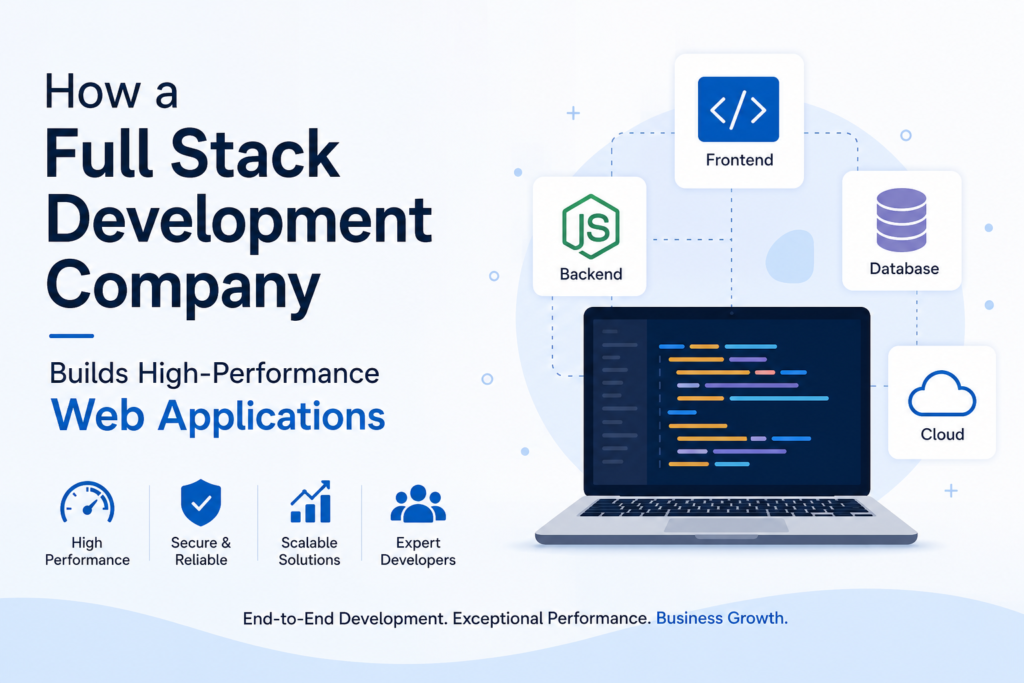
In today’s digital-first world, businesses can no longer rely on basic websites to attract customers and drive growth. Modern users expect lightning-fast loading speeds, intuitive user experiences, enterprise-grade security, and seamless performance across devices. To meet these expectations, organizations increasingly partner with a full stack development company capable of managing every aspect of application development—from frontend interfaces to backend architecture, databases, APIs, cloud infrastructure, and ongoing maintenance.
Whether you’re building a SaaS platform, enterprise portal, eCommerce solution, healthcare application, fintech platform, or customer portal, choosing the right development partner directly impacts your application’s performance, scalability, and long-term success.
This guide explains how a full stack development company builds high-performance web applications, the technologies involved, and why full stack expertise has become the preferred choice for businesses worldwide.
What Is a Full Stack Development Company?
A full stack development company provides end-to-end software development services covering both client-side (frontend) and server-side (backend) development. Instead of hiring multiple vendors for UI design, APIs, databases, deployment, testing, and maintenance, businesses work with one experienced team that manages the complete software lifecycle.
Typically, their expertise includes:
- Frontend development
- Backend development
- Database architecture
- API development
- Cloud deployment
- DevOps automation
- UI/UX implementation
- Security optimization
- Performance optimization
- Maintenance and support
Many businesses also prefer working with a trusted software development company that offers full stack capabilities because it simplifies project management while ensuring consistency throughout development.
Why High-Performance Web Applications Matter
Users abandon slow websites within seconds. Performance directly affects:
- Customer satisfaction
- Search engine rankings
- Conversion rates
- Revenue generation
- User retention
- Brand reputation
A high-performance web application delivers:
- Fast loading speeds
- Smooth navigation
- Secure user authentication
- Reliable uptime
- Responsive design
- Scalability for future growth
These qualities require much more than attractive design—they require robust engineering throughout the technology stack.
The Full Stack Development Process
1. Understanding Business Requirements
Every successful application begins with understanding business goals.
Development teams analyze:
- Target audience
- Industry challenges
- Competitor landscape
- Required features
- User journeys
- Technical constraints
- Scalability expectations
This discovery phase creates a roadmap that minimizes development risks and aligns technology decisions with business objectives.
2. Designing an Intuitive User Experience
Performance isn’t just about speed—it also includes usability.
Frontend developers collaborate with UI/UX designers to create interfaces that are:
- Easy to navigate
- Mobile responsive
- Accessible
- Fast-loading
- Consistent across devices
Modern frameworks such as React, Angular, Vue.js, and Next.js help deliver interactive user experiences while maintaining excellent performance.
3. Building a Powerful Backend
The backend is the engine that powers every application.
A professional full stack development company develops backend systems capable of handling:
- User authentication
- Business logic
- Payment processing
- Notifications
- File management
- Database operations
- Third-party integrations
Popular backend technologies include:
- Node.js
- Laravel
- Django
- ASP.NET
- Spring Boot
- Express.js
These technologies ensure reliable application performance even under heavy traffic.
4. Choosing the Right Database
Applications generate enormous amounts of data.
Choosing the correct database architecture improves:
- Query speed
- Data security
- Scalability
- Reliability
Depending on project requirements, developers may use:
- MySQL
- PostgreSQL
- MongoDB
- Redis
- Firebase
Proper indexing, caching, and optimization significantly improve application speed.
5. API Development and Integration
Modern web applications rarely operate in isolation.
Businesses often integrate with:
- Payment gateways
- CRM systems
- ERP platforms
- Marketing tools
- Cloud storage
- AI services
- Analytics platforms
Well-designed APIs ensure smooth communication between systems while maintaining security and performance.
Performance Optimization Techniques Used by Full Stack Developers
Creating a high-performance application involves continuous optimization.
Frontend Optimization
Developers improve frontend performance through:
- Lazy loading
- Code splitting
- Image optimization
- Browser caching
- Asset compression
- Content Delivery Networks (CDNs)
These techniques reduce loading times and improve user experience.
Backend Optimization
Backend performance improvements include:
- Efficient database queries
- Server-side caching
- Load balancing
- Queue management
- Optimized API responses
- Asynchronous processing
These enhancements allow applications to handle thousands of simultaneous users efficiently.
Cloud Infrastructure Optimization
Cloud platforms provide scalability and flexibility.
Common deployment platforms include:
- AWS
- Microsoft Azure
- Google Cloud Platform
Cloud-native deployment enables:
- Automatic scaling
- Faster deployments
- Better uptime
- Disaster recovery
- Global accessibility
Security at Every Layer
Cybersecurity is a critical component of modern application development.
A reliable website development firm implements multiple security layers, including:
- SSL encryption
- Secure authentication
- Role-based access control
- Data encryption
- Regular vulnerability testing
- API security
- Secure coding standards
Security should be integrated throughout development rather than treated as an afterthought.
Continuous Testing Ensures Reliability
High-performance applications undergo extensive testing before deployment.
Testing typically includes:
- Unit testing
- Integration testing
- Performance testing
- Load testing
- Security testing
- User acceptance testing
Continuous testing helps identify issues early, reducing costs and improving product quality.
DevOps Speeds Up Development
Modern development teams embrace DevOps practices to accelerate software delivery.
DevOps enables:
- Continuous Integration (CI)
- Continuous Deployment (CD)
- Automated testing
- Infrastructure as Code
- Faster releases
- Reduced downtime
These practices improve development efficiency while maintaining application stability.
Why Businesses Prefer Full Stack Development
Working with a single development partner offers several advantages.
Faster Development
One integrated team minimizes communication gaps and accelerates project delivery.
Lower Development Costs
Businesses avoid hiring multiple specialized vendors while reducing project management overhead.
Better Collaboration
Frontend and backend teams work together from day one, leading to fewer integration issues.
Easier Maintenance
One company understands the complete codebase, making updates and troubleshooting faster.
Future Scalability
Applications are built with growth in mind, allowing businesses to add new features without rebuilding from scratch.
How Full Stack Development Supports Mobile Experiences
Today’s customers interact with businesses across multiple devices.
Many companies choose a Mobile App Development company that also offers full stack expertise because it ensures seamless integration between web applications and mobile apps.
Benefits include:
- Shared APIs
- Unified databases
- Consistent user experiences
- Faster feature releases
- Simplified maintenance
This unified approach creates a connected digital ecosystem rather than isolated platforms.
Should You Hire Dedicated Developers?
Growing businesses often need additional development capacity.
Instead of building an in-house team, many organizations prefer to hire dedicated developers who can focus exclusively on their projects.
Dedicated developers offer:
- Specialized expertise
- Flexible engagement models
- Faster project execution
- Lower recruitment costs
- Easy team scaling
This model is especially beneficial for startups and businesses with evolving development needs.
Industries Benefiting from Full Stack Development
Full stack development supports organizations across various industries, including:
- Healthcare
- FinTech
- Retail & eCommerce
- Education
- Logistics
- Manufacturing
- Real Estate
- Travel & Hospitality
- Media & Entertainment
- SaaS Platforms
Each industry has unique requirements, making experienced full stack expertise essential for delivering customized solutions.
Emerging Trends in Full Stack Development
The future of web application development continues to evolve with new technologies.
Key trends include:
- AI-powered applications
- Serverless architecture
- Progressive Web Apps (PWAs)
- Edge computing
- Microservices architecture
- Low-code integrations
- Cloud-native development
- Advanced cybersecurity frameworks
Businesses that embrace these innovations can deliver faster, smarter, and more scalable digital experiences.
Choosing the Right Full Stack Development Company
Before selecting a development partner, consider:
- Technical expertise
- Industry experience
- Technology stack
- Portfolio of successful projects
- Client reviews
- Security practices
- Communication process
- Post-launch support
- Scalability capabilities
An experienced development partner should understand both technology and business strategy to deliver long-term value.
Final Thoughts
Building a high-performance web application requires more than writing code—it demands strategic planning, scalable architecture, optimized performance, strong security, and continuous improvement. A professional full stack development company brings together frontend, backend, cloud, database, and DevOps expertise to deliver robust digital solutions that support business growth.
Whether you’re launching a startup product, modernizing an enterprise platform, or expanding your digital presence, partnering with an experienced web development company can streamline the entire development process. Organizations that work with a trusted software development company gain access to comprehensive technical expertise, while the option to hire dedicated developers offers the flexibility to scale projects efficiently. By combining modern technologies with proven development practices, businesses can build secure, scalable, and future-ready web applications that deliver exceptional user experiences and long-term success.